10-Q
false0000275880Q2--12-31111three yearshttp://fasb.org/us-gaap/2026#LiabilitiesCurrenthttp://fasb.org/us-gaap/2026#LiabilitiesCurrenthttp://fasb.org/us-gaap/2026#OtherLiabilitiesNoncurrenthttp://fasb.org/us-gaap/2026#OtherLiabilitiesNoncurrent2025-06-302025-06-302022-09-30P5DP10D2025-06-30http://fasb.org/srt/2026#ChiefExecutiveOfficerMember00002758802024-02-012024-02-2900002758802025-04-012025-06-300000275880psn:ChesapeakeTechnologyInternationalCorpMember2026-06-300000275880us-gaap:FairValueInputsLevel2Memberus-gaap:EstimateOfFairValueFairValueDisclosureMember2026-06-300000275880us-gaap:NoncompeteAgreementsMember2026-06-300000275880psn:ChesapeakeTechnologyInternationalCorpMemberus-gaap:DevelopedTechnologyRightsMember2025-06-302025-06-300000275880psn:AltamiraTechnologiesCorporationMemberus-gaap:TradeNamesMember2026-01-142026-01-140000275880us-gaap:CostOfGoodsAndServicesSold2026-04-012026-06-300000275880us-gaap:ParentMember2026-04-012026-06-300000275880us-gaap:TimeAndMaterialsContractMember2026-01-012026-06-300000275880country:US2026-06-300000275880psn:CriticalInfrastructureSegmentMemberus-gaap:NorthRegionMember2026-01-012026-06-300000275880us-gaap:TreasuryStockCommonMember2026-03-310000275880psn:AppliedSciencesConsultingIncMember2026-04-012026-06-300000275880us-gaap:FurnitureAndFixturesMember2025-12-310000275880us-gaap:FairValueInputsLevel2Memberpsn:ConvertibleSeniorNotesDueTwoThousandTwentyNineMemberus-gaap:EstimateOfFairValueFairValueDisclosureMember2025-12-310000275880psn:EngineeredSystemsMemberpsn:FederalSolutionSegmentMember2026-04-012026-06-300000275880psn:InvesteesOtherMember2026-04-012026-06-300000275880psn:ConvertibleSeniorNotesDueTwoThousandTwentyFiveMember2025-04-012025-06-300000275880us-gaap:CustomerRelationshipsMember2026-01-012026-06-300000275880psn:ConsolidatedJointVenturesMember2025-12-310000275880us-gaap:TreasuryStockCommonMember2024-12-310000275880psn:AltamiraTechnologiesCorporationMemberus-gaap:SellingGeneralAndAdministrativeExpense2026-01-012026-06-300000275880us-gaap:RetainedEarningsMember2025-01-012025-06-300000275880us-gaap:NoncontrollingInterestMember2026-03-310000275880psn:ChesapeakeTechnologyInternationalCorpMember2025-01-012025-06-300000275880psn:ConvertibleSeniorNotesDueTwoThousandTwentyNineMember2024-02-290000275880psn:UnconsolidatedJointVenturesMember2026-01-012026-06-3000002758802024-12-310000275880psn:RevolvingCreditFacilityDueTwoThousandThirtyMemberus-gaap:SecuredOvernightFinancingRateSofrOvernightIndexSwapRateMembersrt:MinimumMember2025-06-012025-06-300000275880us-gaap:AdditionalPaidInCapitalMember2025-03-310000275880psn:FederalSolutionSegmentMember2026-07-012026-06-300000275880us-gaap:CommonStockMember2025-12-310000275880psn:EmployeeStockOwnershipPlanMember2026-06-300000275880psn:ConvertibleSeniorNotesDueTwoThousandTwentyNineMember2026-06-300000275880psn:EngineeredSystemsMemberpsn:FederalSolutionSegmentMember2025-04-012025-06-300000275880psn:ConvertibleSeniorNotesDueTwoThousandTwentyFiveMember2020-08-012020-08-310000275880srt:NorthAmericaMember2026-06-300000275880us-gaap:ParentMember2025-06-300000275880us-gaap:RetainedEarningsMember2025-03-310000275880us-gaap:NoncompeteAgreementsMemberpsn:AltamiraTechnologiesCorporationMember2026-01-142026-01-140000275880us-gaap:NoncontrollingInterestMember2025-12-310000275880psn:ParsonsTransportationGroupIncAndAgainstAlstomSignalingOperationsLLCMemberpsn:AllegedViolationOfFalseClaimsActMember2024-07-012024-07-010000275880us-gaap:TradeNamesMember2026-06-300000275880us-gaap:ParentMember2025-04-012025-06-300000275880us-gaap:BuildingAndBuildingImprovementsMember2026-06-300000275880psn:EmployeeStockOwnershipPlanMember2025-12-310000275880psn:RevolvingCreditFacilityDueTwoThousandTwentySixMember2025-06-012025-06-300000275880us-gaap:CostOfGoodsAndServicesSold2026-01-012026-06-300000275880us-gaap:FixedPriceContractMember2026-01-012026-06-300000275880psn:FederalSolutionSegmentMember2026-01-012026-06-300000275880us-gaap:AccumulatedOtherComprehensiveIncomeMember2026-01-012026-06-300000275880psn:ChesapeakeTechnologyInternationalCorpMemberus-gaap:OrderOrProductionBacklogMember2025-06-302025-06-300000275880us-gaap:AccountingStandardsUpdate202309Member2026-06-300000275880us-gaap:RetainedEarningsMember2026-03-310000275880country:US2025-01-012025-06-300000275880psn:AppliedSciencesConsultingIncMember2025-10-010000275880psn:RevolvingCreditFacilityDueTwoThousandThirtyMember2025-04-012025-06-300000275880us-gaap:CommonStockMember2026-01-012026-06-300000275880psn:TRSGroupIncMemberus-gaap:TradeNamesMember2025-01-312025-01-310000275880psn:RevolvingCreditFacilityDueTwoThousandTwentySixMember2025-04-012025-06-300000275880psn:ConsolidatedJointVenturesMember2025-04-012025-06-3000002758802028-07-012026-06-300000275880psn:CriticalInfrastructureSegmentMember2025-12-310000275880psn:ConvertibleSeniorNotesDueTwoThousandTwentyNineMember2026-01-012026-06-300000275880srt:MaximumMemberpsn:TermLoanMember2025-06-012025-06-300000275880psn:CriticalInfrastructureSegmentMemberpsn:UnconsolidatedJointVenturesMember2026-04-012026-06-300000275880us-gaap:AccumulatedOtherComprehensiveIncomeMember2025-01-012025-06-300000275880psn:RevolvingCreditFacilityDueTwoThousandThirtyMemberus-gaap:BaseRateMembersrt:MaximumMember2025-01-012025-06-3000002758802025-06-300000275880psn:ConvertibleSeniorNotesDueTwoThousandTwentyFiveMemberpsn:CappedCallTransactionMember2024-02-290000275880us-gaap:FairValueInputsLevel2Memberus-gaap:EstimateOfFairValueFairValueDisclosureMember2025-12-310000275880psn:TermLoanMember2025-04-012025-06-300000275880us-gaap:AccountingStandardsUpdate202403Member2026-06-300000275880srt:MinimumMemberus-gaap:BuildingAndBuildingImprovementsMember2026-06-300000275880us-gaap:StockCompensationPlanMember2026-01-012026-06-300000275880us-gaap:RetainedEarningsMember2025-04-012025-06-300000275880us-gaap:AdditionalPaidInCapitalMember2025-06-300000275880us-gaap:AccumulatedOtherComprehensiveIncomeMember2025-06-300000275880us-gaap:CommonStockMember2025-01-012025-06-300000275880us-gaap:AdditionalPaidInCapitalMember2025-12-310000275880us-gaap:FixedPriceContractMember2025-01-012025-06-300000275880psn:CriticalInfrastructureSegmentMemberpsn:UnconsolidatedJointVenturesMember2026-01-012026-06-300000275880psn:UnconsolidatedJointVenturesMember2025-04-012025-06-300000275880psn:UnconsolidatedJointVenturesMember2026-04-012026-06-300000275880srt:MaximumMember2021-08-090000275880srt:RestatementAdjustmentMember2025-04-012025-06-300000275880us-gaap:AdditionalPaidInCapitalMember2026-03-310000275880psn:RevolvingCreditFacilityDueTwoThousandTwentySixMember2026-04-012026-06-3000002758802025-01-012025-06-300000275880srt:MaximumMember2026-01-012026-06-300000275880country:US2026-01-012026-06-300000275880us-gaap:CarryingReportedAmountFairValueDisclosureMemberus-gaap:FairValueInputsLevel2Member2026-06-300000275880us-gaap:AccumulatedOtherComprehensiveIncomeMember2025-03-310000275880us-gaap:RetainedEarningsMember2026-01-012026-06-300000275880us-gaap:MiddleEastMember2026-04-012026-06-300000275880psn:AppliedSciencesConsultingIncMember2025-01-012025-06-300000275880us-gaap:CarryingReportedAmountFairValueDisclosureMemberus-gaap:FairValueInputsLevel2Memberpsn:ConvertibleSeniorNotesDueTwoThousandTwentyNineMember2025-12-310000275880psn:AltamiraTechnologiesCorporationMembersrt:MaximumMember2026-01-142026-01-140000275880us-gaap:USGovernmentCorporationsAndAgenciesSecuritiesMember2026-06-300000275880us-gaap:RetainedEarningsMember2025-06-300000275880us-gaap:AccumulatedOtherComprehensiveIncomeMember2026-04-012026-06-300000275880psn:UnconsolidatedJointVenturesMember2025-12-310000275880us-gaap:NoncompeteAgreementsMemberpsn:AppliedSciencesConsultingIncMember2025-10-012025-10-010000275880us-gaap:CommonStockMember2026-03-3100002758802026-07-210000275880psn:TermLoanMember2025-12-310000275880us-gaap:RetainedEarningsMember2026-06-300000275880us-gaap:NoncontrollingInterestMember2024-12-310000275880psn:MarchTwoThousandAndTwentyFiveAuthorizationMemberus-gaap:SubsequentEventMember2026-07-240000275880psn:TRSGroupIncMember2026-01-012026-06-300000275880psn:ConvertibleSeniorNotesDueTwoThousandTwentyFiveMember2025-01-012025-06-300000275880psn:FederalSolutionSegmentMember2026-04-012026-06-300000275880psn:CriticalInfrastructureSegmentMemberus-gaap:EMEAMember2026-01-012026-06-300000275880us-gaap:ParentMember2024-12-310000275880psn:ChesapeakeTechnologyInternationalCorpMemberus-gaap:CustomerRelationshipsMember2025-06-302025-06-300000275880psn:TermLoanMember2025-06-300000275880psn:TwoThousandTwentyTwoDelayedDrawTermLoanMembersrt:MaximumMember2022-09-012022-09-3000002758802025-12-310000275880us-gaap:NoncompeteAgreementsMember2026-01-012026-06-300000275880us-gaap:MiddleEastMember2025-04-012025-06-300000275880psn:AppliedSciencesConsultingIncMember2025-04-012025-06-300000275880psn:EarnoutLiabilityMemberus-gaap:FairValueMeasurementsRecurringMember2026-06-300000275880us-gaap:MiddleEastMember2025-12-310000275880psn:CostPlusMember2025-01-012025-06-300000275880psn:ConsolidatedJointVenturesMember2026-04-012026-06-300000275880us-gaap:ConstructionInProgressMember2026-06-300000275880us-gaap:AdditionalPaidInCapitalMember2026-06-300000275880us-gaap:StockCompensationPlanMember2026-04-012026-06-300000275880psn:CostPlusMember2025-04-012025-06-300000275880psn:ConstructionEquipmentMember2025-12-310000275880psn:ChesapeakeTechnologyInternationalCorpMember2026-01-012026-06-300000275880psn:PaidInEighteenMonthsMember2025-01-312025-01-310000275880psn:ChesapeakeTechnologyInternationalCorpMember2025-06-300000275880us-gaap:OrderOrProductionBacklogMember2025-12-310000275880us-gaap:RevolvingCreditFacilityMember2025-12-310000275880psn:AllegedViolationOfFalseClaimsActMember2026-01-012026-06-300000275880psn:TwoThousandTwentyTwoDelayedDrawTermLoanMember2022-09-300000275880us-gaap:AccumulatedOtherComprehensiveIncomeMember2025-04-012025-06-300000275880psn:FederalSolutionSegmentMemberpsn:DefenseAndIntelligenceMember2026-01-012026-06-300000275880psn:ConvertibleSeniorNotesDueTwoThousandTwentyNineMember2025-01-012025-06-300000275880us-gaap:TradeNamesMember2025-12-310000275880psn:AppliedSciencesConsultingIncMember2026-01-012026-06-300000275880us-gaap:SecuredOvernightFinancingRateSofrOvernightIndexSwapRateMembersrt:MaximumMemberpsn:TermLoanMember2025-06-012025-06-300000275880psn:ParsonsTransportationGroupIncAndAgainstAlstomSignalingOperationsLLCMemberpsn:AllegedViolationOfFalseClaimsActMember2024-09-230000275880us-gaap:NoncontrollingInterestMember2025-03-310000275880psn:CriticalInfrastructureSegmentMember2025-04-012025-06-300000275880psn:ConsolidatedJointVenturesMember2026-01-012026-06-300000275880psn:TRSGroupIncMember2026-04-012026-06-300000275880psn:EngineeredSystemsMemberpsn:FederalSolutionSegmentMember2026-01-012026-06-300000275880srt:MaximumMemberus-gaap:BuildingAndBuildingImprovementsMember2026-06-300000275880psn:MarchTwoThousandAndTwentyFiveAuthorizationMemberus-gaap:CommonStockMember2025-03-012025-03-310000275880psn:AltamiraTechnologiesCorporationMember2026-03-310000275880psn:RevolvingCreditFacilityDueTwoThousandThirtyMemberus-gaap:BaseRateMembersrt:MinimumMember2025-01-012025-06-300000275880psn:ConstructionEquipmentMember2026-06-300000275880us-gaap:FixedPriceContractMember2026-04-012026-06-300000275880psn:CriticalInfrastructureSegmentMemberus-gaap:EMEAMember2025-01-012025-06-300000275880psn:TermLoanMember2025-01-012025-06-300000275880psn:AltamiraTechnologiesCorporationMemberus-gaap:OrderOrProductionBacklogMember2026-01-142026-01-140000275880psn:RevolvingCreditFacilityDueTwoThousandTwentySixMember2025-01-012025-06-300000275880us-gaap:FairValueInputsLevel2Memberpsn:ConvertibleSeniorNotesDueTwoThousandTwentyNineMemberus-gaap:EstimateOfFairValueFairValueDisclosureMember2026-06-300000275880country:US2025-12-310000275880us-gaap:DevelopedTechnologyRightsMember2025-12-310000275880psn:CappedCallTransactionMember2024-02-290000275880psn:ChesapeakeTechnologyInternationalCorpMemberus-gaap:TradeNamesMember2025-06-302025-06-300000275880us-gaap:AccumulatedOtherComprehensiveIncomeMember2025-12-310000275880psn:CriticalInfrastructureSegmentMemberus-gaap:EMEAMember2025-04-012025-06-300000275880us-gaap:FixedPriceContractMember2025-04-012025-06-300000275880us-gaap:OrderOrProductionBacklogMember2026-01-012026-06-300000275880psn:ConvertibleSeniorNotesDueTwoThousandTwentyFiveMember2020-08-310000275880psn:AltamiraTechnologiesCorporationMember2026-04-012026-06-300000275880us-gaap:NoncontrollingInterestMember2025-06-300000275880psn:ChesapeakeTechnologyInternationalCorpMember2026-04-012026-06-300000275880us-gaap:AccumulatedOtherComprehensiveIncomeMember2024-12-310000275880psn:JointVenturesMember2025-12-310000275880us-gaap:AdditionalPaidInCapitalMember2025-04-012025-06-300000275880us-gaap:CommonStockMember2024-12-310000275880psn:CriticalInfrastructureSegmentMember2025-01-012025-06-300000275880srt:MinimumMemberpsn:AllegedViolationOfFalseClaimsActMember2026-01-012026-06-300000275880us-gaap:FairValueInputsLevel2Memberus-gaap:RevolvingCreditFacilityMemberus-gaap:EstimateOfFairValueFairValueDisclosureMember2026-06-300000275880us-gaap:NoncompeteAgreementsMember2025-12-3100002758802027-07-012026-06-300000275880psn:AltamiraTechnologiesCorporationMember2026-06-300000275880psn:UnconsolidatedJointVenturesMember2026-06-300000275880srt:MinimumMember2026-01-012026-06-300000275880psn:AltamiraTechnologiesCorporationMember2026-01-142026-01-140000275880psn:CostPlusMember2026-01-012026-06-300000275880us-gaap:TreasuryStockCommonMember2025-06-300000275880us-gaap:CommonStockMember2025-04-012025-06-300000275880srt:MinimumMemberpsn:ConstructionEquipmentMember2026-06-300000275880psn:AltamiraTechnologiesCorporationMember2026-01-140000275880psn:AltamiraTechnologiesCorporationMemberus-gaap:CustomerRelationshipsMember2026-01-142026-01-140000275880psn:UnconsolidatedJointVenturesMember2025-12-310000275880srt:RestatementAdjustmentMember2025-01-012025-06-300000275880psn:ChesapeakeTechnologyInternationalCorpMember2025-04-012025-06-300000275880psn:UnconsolidatedJointVenturesMember2025-01-012025-06-300000275880psn:FederalSolutionSegmentMemberpsn:DefenseAndIntelligenceMember2026-04-012026-06-300000275880us-gaap:FairValueMeasurementsRecurringMember2026-06-300000275880srt:MinimumMemberus-gaap:FurnitureAndFixturesMember2026-06-300000275880us-gaap:ComputerEquipmentMember2025-12-310000275880psn:TermLoanMember2026-06-300000275880psn:InvesteesOtherMember2025-04-012025-06-300000275880psn:CriticalInfrastructureSegmentMember2028-07-012026-06-300000275880us-gaap:DevelopedTechnologyRightsMemberpsn:TRSGroupIncMember2025-01-312025-01-310000275880us-gaap:CommonStockMember2025-06-300000275880psn:TermLoanDueTwoThousandTwentyEightMember2025-06-300000275880psn:ConvertibleSeniorNotesDueTwoThousandTwentyFiveMemberpsn:CappedCallTransactionMember2024-02-012024-02-290000275880us-gaap:NoncontrollingInterestMember2025-04-012025-06-300000275880us-gaap:NoncontrollingInterestMember2025-01-012025-06-300000275880us-gaap:TreasuryStockCommonMember2025-12-310000275880us-gaap:ParentMember2025-03-310000275880psn:FederalSolutionSegmentMemberpsn:DefenseAndIntelligenceMember2025-01-012025-06-300000275880us-gaap:TimeAndMaterialsContractMember2025-01-012025-06-300000275880psn:CriticalInfrastructureSegmentMember2026-01-012026-06-300000275880us-gaap:ParentMember2026-01-012026-06-300000275880psn:TRSGroupIncMember2025-01-312025-01-310000275880us-gaap:FurnitureAndFixturesMember2026-06-300000275880us-gaap:ComputerEquipmentMember2026-06-300000275880psn:FederalSolutionSegmentMember2025-04-012025-06-300000275880us-gaap:NoncontrollingInterestMember2026-06-300000275880psn:TRSGroupIncMemberus-gaap:OrderOrProductionBacklogMember2025-01-312025-01-310000275880us-gaap:NonUsMember2026-01-012026-06-300000275880psn:UnconsolidatedJointVenturesMember2026-01-012026-06-300000275880us-gaap:NoncontrollingInterestMember2026-01-012026-06-300000275880us-gaap:FairValueInputsLevel3Memberus-gaap:FairValueMeasurementsRecurringMember2026-06-300000275880us-gaap:SecuredOvernightFinancingRateSofrOvernightIndexSwapRateMembersrt:MinimumMemberpsn:TermLoanMember2025-06-012025-06-300000275880srt:NorthAmericaMember2025-01-012025-06-300000275880srt:RestatementAdjustmentMember2026-01-012026-06-300000275880psn:AltamiraTechnologiesCorporationMember2025-01-012025-06-300000275880us-gaap:CommonStockMember2026-06-300000275880psn:UnconsolidatedJointVenturesMember2026-04-012026-06-300000275880psn:RevolvingCreditFacilityDueTwoThousandThirtyMember2025-01-012025-06-300000275880psn:DelayedDrawTermLoanDueTwoThousandTwentyFiveMember2025-06-012025-06-300000275880psn:TermLoanMember2026-04-012026-06-300000275880psn:CriticalInfrastructureSegmentMember2027-07-012026-06-300000275880psn:CriticalInfrastructureSegmentMemberus-gaap:EMEAMember2026-04-012026-06-300000275880us-gaap:MiddleEastMember2026-01-012026-06-300000275880us-gaap:USGovernmentCorporationsAndAgenciesSecuritiesMember2025-12-310000275880psn:TermLoanDueTwoThousandTwentyEightMember2026-06-300000275880psn:FederalSolutionSegmentMember2025-12-310000275880us-gaap:SellingGeneralAndAdministrativeExpensepsn:TRSGroupIncMember2025-01-012025-12-3100002758802026-07-012026-06-300000275880psn:CriticalInfrastructureSegmentMemberus-gaap:NorthRegionMember2025-04-012025-06-300000275880psn:RevolvingCreditFacilityDueTwoThousandThirtyMember2025-12-310000275880srt:NorthAmericaMember2025-12-310000275880psn:CriticalInfrastructureSegmentMemberpsn:UnconsolidatedJointVenturesMember2025-01-012025-06-300000275880psn:ConvertibleSeniorNotesDueTwoThousandTwentyNineMember2024-02-012024-02-290000275880psn:CriticalInfrastructureSegmentMemberus-gaap:NorthRegionMember2025-01-012025-06-300000275880us-gaap:DevelopedTechnologyRightsMember2026-06-300000275880psn:TermLoanMember2025-06-012025-06-300000275880us-gaap:RetainedEarningsMember2026-04-012026-06-300000275880us-gaap:TimeAndMaterialsContractMember2026-04-012026-06-300000275880psn:TwoThousandTwentyTwoDelayedDrawTermLoanMember2022-09-012022-09-300000275880psn:InvesteesOtherMember2025-01-012025-06-300000275880psn:ConvertibleSeniorNotesDueTwoThousandTwentyNineMember2025-04-012025-06-300000275880us-gaap:ConstructionInProgressMember2025-12-310000275880us-gaap:FairValueInputsLevel2Memberpsn:TermLoanDueTwoThousandTwentyEightMemberus-gaap:EstimateOfFairValueFairValueDisclosureMember2026-06-300000275880psn:MarchTwoThousandAndTwentyFiveAuthorizationMemberus-gaap:SubsequentEventMembersrt:MaximumMember2026-07-240000275880psn:TwoThousandTwentyTwoDelayedDrawTermLoanMember2026-06-300000275880us-gaap:CostOfGoodsAndServicesSold2025-01-012025-06-300000275880us-gaap:RevolvingCreditFacilityMember2026-06-3000002758802021-08-092021-08-090000275880us-gaap:BuildingAndBuildingImprovementsMember2025-12-310000275880us-gaap:BaseRateMembersrt:MaximumMemberpsn:TermLoanMember2025-06-012025-06-300000275880psn:ChesapeakeTechnologyInternationalCorpMember2025-06-302025-06-300000275880psn:AppliedSciencesConsultingIncMemberus-gaap:TradeNamesMember2025-10-012025-10-010000275880us-gaap:TreasuryStockCommonMember2025-03-310000275880psn:RevolvingCreditFacilityDueTwoThousandThirtyMember2026-06-300000275880psn:RevolvingCreditFacilityDueTwoThousandThirtyMember2025-06-300000275880us-gaap:CommonStockMember2026-04-012026-06-300000275880psn:RevolvingCreditFacilityDueTwoThousandThirtyMember2026-01-012026-06-300000275880psn:ConvertibleSeniorNotesDueTwoThousandTwentyNineMember2026-04-012026-06-300000275880us-gaap:OtherIntangibleAssetsMember2026-06-300000275880us-gaap:ParentMember2025-12-310000275880psn:FederalSolutionSegmentMemberpsn:DefenseAndIntelligenceMember2025-04-012025-06-300000275880us-gaap:AdditionalPaidInCapitalMember2025-01-012025-06-300000275880us-gaap:TreasuryStockCommonMember2026-06-300000275880psn:FederalSolutionSegmentMember2027-07-012026-06-300000275880us-gaap:AdditionalPaidInCapitalMember2026-01-012026-06-300000275880us-gaap:CarryingReportedAmountFairValueDisclosureMemberus-gaap:FairValueInputsLevel2Memberpsn:TermLoanDueTwoThousandTwentyEightMember2026-06-300000275880srt:MaximumMemberpsn:AllegedViolationOfFalseClaimsActMember2026-01-012026-06-300000275880us-gaap:NoncontrollingInterestMember2026-04-012026-06-3000002758802026-03-310000275880us-gaap:CommonStockMember2025-03-310000275880us-gaap:TimeAndMaterialsContractMember2025-04-012025-06-300000275880psn:TermLoanMember2026-01-012026-06-300000275880us-gaap:MiddleEastMember2026-06-300000275880us-gaap:NonUsMember2025-01-012025-06-300000275880us-gaap:AdditionalPaidInCapitalMember2024-12-310000275880psn:TRSGroupIncMember2025-01-012025-06-3000002758802026-06-300000275880psn:CriticalInfrastructureSegmentMemberpsn:UnconsolidatedJointVenturesMember2025-04-012025-06-300000275880us-gaap:OtherIntangibleAssetsMember2025-12-310000275880us-gaap:BaseRateMembersrt:MinimumMemberpsn:TermLoanMember2025-06-012025-06-300000275880psn:AppliedSciencesConsultingIncMemberus-gaap:OrderOrProductionBacklogMember2025-10-012025-10-010000275880psn:UnconsolidatedJointVenturesMember2026-06-300000275880us-gaap:FairValueInputsLevel3Memberpsn:EarnoutLiabilityMemberus-gaap:FairValueMeasurementsRecurringMember2026-06-3000002758802024-02-290000275880us-gaap:RetainedEarningsMember2024-12-310000275880psn:JointVenturesMember2026-06-300000275880psn:EngineeredSystemsMemberpsn:FederalSolutionSegmentMember2025-01-012025-06-300000275880srt:NorthAmericaMember2025-04-012025-06-300000275880psn:TRSGroupIncMember2025-04-012025-06-300000275880psn:ConstructionEquipmentMembersrt:MaximumMember2026-06-300000275880psn:TwoThousandTwentyTwoDelayedDrawTermLoanMember2025-04-012025-06-300000275880psn:AltamiraTechnologiesCorporationMember2025-04-012025-06-300000275880us-gaap:FairValueInputsLevel2Memberpsn:TermLoanDueTwoThousandTwentyEightMemberus-gaap:EstimateOfFairValueFairValueDisclosureMember2025-12-310000275880psn:TwoThousandTwentyTwoDelayedDrawTermLoanMember2025-01-012025-06-300000275880psn:AltamiraTechnologiesCorporationMember2026-01-012026-06-300000275880srt:MaximumMemberus-gaap:ComputerEquipmentMember2026-06-300000275880us-gaap:InProcessResearchAndDevelopmentMember2026-06-300000275880us-gaap:DevelopedTechnologyRightsMember2026-01-012026-06-300000275880psn:AppliedSciencesConsultingIncMemberus-gaap:CustomerRelationshipsMember2025-10-012025-10-010000275880us-gaap:ParentMember2026-03-310000275880us-gaap:InProcessResearchAndDevelopmentMember2025-12-310000275880us-gaap:AccumulatedOtherComprehensiveIncomeMember2026-03-310000275880us-gaap:TradeNamesMember2026-01-012026-06-300000275880us-gaap:ParentMember2025-01-012025-06-300000275880srt:NorthAmericaMember2026-01-012026-06-300000275880country:US2025-04-012025-06-300000275880psn:MarchTwoThousandAndTwentyFiveAuthorizationMembersrt:MaximumMember2026-06-3000002758802025-03-3100002758802026-04-012026-06-300000275880us-gaap:NonUsMember2025-04-012025-06-300000275880psn:ConvertibleSeniorNotesDueTwoThousandTwentyFiveMember2026-01-012026-06-300000275880srt:MinimumMemberus-gaap:ComputerEquipmentMember2026-06-300000275880us-gaap:CarryingReportedAmountFairValueDisclosureMemberus-gaap:FairValueInputsLevel2Memberpsn:TermLoanDueTwoThousandTwentyEightMember2025-12-310000275880psn:RevolvingCreditFacilityDueTwoThousandThirtyMemberus-gaap:SecuredOvernightFinancingRateSofrOvernightIndexSwapRateMembersrt:MaximumMember2025-06-012025-06-300000275880us-gaap:SellingGeneralAndAdministrativeExpensepsn:AppliedSciencesConsultingIncMember2025-01-012025-12-310000275880us-gaap:AccumulatedOtherComprehensiveIncomeMember2026-06-300000275880psn:AltamiraTechnologiesCorporationMemberus-gaap:SellingGeneralAndAdministrativeExpense2026-04-012026-06-300000275880psn:RevolvingCreditFacilityDueTwoThousandThirtyMember2026-04-012026-06-300000275880psn:CriticalInfrastructureSegmentMember2026-06-300000275880srt:RestatementAdjustmentMember2026-04-012026-06-300000275880us-gaap:TreasuryStockCommonMember2026-01-012026-06-300000275880psn:ConvertibleSeniorNotesDueTwoThousandTwentyNineMember2025-12-310000275880psn:UnconsolidatedJointVenturesMember2025-04-012025-06-300000275880us-gaap:CostOfGoodsAndServicesSold2025-04-012025-06-300000275880psn:CriticalInfrastructureSegmentMemberus-gaap:NorthRegionMember2026-04-012026-06-300000275880us-gaap:CarryingReportedAmountFairValueDisclosureMemberus-gaap:FairValueInputsLevel2Member2025-12-3100002758802025-01-012025-12-310000275880psn:UnconsolidatedJointVenturesMember2025-01-012025-06-300000275880us-gaap:ParentMember2026-06-300000275880us-gaap:MiddleEastMember2025-01-012025-06-300000275880psn:TRSGroupIncMember2025-01-3100002758802026-01-012026-06-300000275880psn:CostPlusMember2026-04-012026-06-300000275880psn:ChesapeakeTechnologyInternationalCorpMemberus-gaap:SellingGeneralAndAdministrativeExpense2025-01-012025-12-310000275880us-gaap:RetainedEarningsMember2025-12-310000275880us-gaap:StockCompensationPlanMember2025-04-012025-06-300000275880us-gaap:CustomerRelationshipsMember2026-06-300000275880us-gaap:StockCompensationPlanMember2025-01-012025-06-300000275880psn:FederalSolutionSegmentMember2025-01-012025-06-300000275880psn:ConsolidatedJointVenturesMember2026-06-300000275880us-gaap:CarryingReportedAmountFairValueDisclosureMemberus-gaap:FairValueInputsLevel2Memberpsn:ConvertibleSeniorNotesDueTwoThousandTwentyNineMember2026-06-300000275880us-gaap:OrderOrProductionBacklogMember2026-06-300000275880us-gaap:AdditionalPaidInCapitalMember2026-04-012026-06-300000275880psn:AppliedSciencesConsultingIncMember2025-10-012025-10-010000275880psn:FederalSolutionSegmentMember2026-06-300000275880psn:CriticalInfrastructureSegmentMember2026-07-012026-06-300000275880srt:NorthAmericaMember2026-04-012026-06-300000275880country:US2026-04-012026-06-300000275880psn:RevolvingCreditFacilityDueTwoThousandTwentySixMember2026-01-012026-06-300000275880psn:TermLoanDueTwoThousandTwentyEightMember2025-12-310000275880us-gaap:NonUsMember2026-04-012026-06-300000275880psn:InvesteesOtherMember2026-01-012026-06-300000275880psn:ConsolidatedJointVenturesMember2025-01-012025-06-300000275880psn:RevolvingCreditFacilityDueTwoThousandThirtyMember2025-06-012025-06-300000275880us-gaap:CustomerRelationshipsMember2025-12-310000275880psn:ChesapeakeTechnologyInternationalCorpMemberus-gaap:NoncompeteAgreementsMember2025-06-302025-06-300000275880us-gaap:CarryingReportedAmountFairValueDisclosureMemberus-gaap:FairValueInputsLevel2Memberus-gaap:RevolvingCreditFacilityMember2026-06-300000275880psn:CriticalInfrastructureSegmentMember2026-04-012026-06-300000275880us-gaap:FurnitureAndFixturesMembersrt:MaximumMember2026-06-300000275880psn:FederalSolutionSegmentMember2028-07-012026-06-30xbrli:purepsn:Segmentxbrli:sharesutr:Diso4217:USDpsn:Claimpsn:Extension
UNITED STATES
SECURITIES AND EXCHANGE COMMISSION
WASHINGTON, DC 20549
FORM 10-Q
(Mark One)
☒ QUARTERLY REPORT PURSUANT TO SECTION 13 OR 15(d) OF THE SECURITIES EXCHANGE ACT OF 1934
For the quarterly period ended June 30, 2026
OR
☐ TRANSITION REPORT PURSUANT TO SECTION 13 OR 15(d) OF THE SECURITIES EXCHANGE ACT OF 1934
For the transition period from to
Commission File Number: 001-07782

Parsons Corporation
(Exact Name of Registrant as Specified in its Charter)
|
|
Delaware |
95-3232481 |
(State or other jurisdiction of incorporation or organization) |
(I.R.S. Employer Identification No.) |
|
|
14291 Park Meadow Drive, Suite 100 Chantilly, Virginia |
20151 |
(Address of principal executive offices) |
(Zip Code) |
Registrant’s telephone number, including area code: (703) 988-8500
Securities registered pursuant to Section 12(b) of the Act:
|
|
|
|
|
Title of each class |
|
Trading Symbol(s) |
|
Name of each exchange on which registered |
Common Stock, $1 par value |
|
PSN |
|
New York Stock Exchange |
Indicate by check mark whether the registrant (1) has filed all reports required to be filed by Section 13 or 15(d) of the Securities Exchange Act of 1934 during the preceding 12 months (or for such shorter period that the registrant was required to file such reports), and (2) has been subject to such filing requirements for the past 90 days. Yes ☒ No ☐
Indicate by check mark whether the registrant has submitted electronically every Interactive Data File required to be submitted pursuant to Rule 405 of Regulation S-T (§232.405 of this chapter) during the preceding 12 months (or for such shorter period that the registrant was required to submit such files). Yes ☒ No ☐
Indicate by check mark whether the registrant is a large accelerated filer, an accelerated filer, a non-accelerated filer, smaller reporting company, or an emerging growth company. See the definitions of “large accelerated filer,” “accelerated filer,” “smaller reporting company,” and “emerging growth company” in Rule 12b-2 of the Exchange Act.
|
|
|
|
|
Large accelerated filer |
☒ |
|
Accelerated filer |
☐ |
Non-accelerated filer |
☐ |
|
Smaller reporting company |
☐ |
Emerging growth company |
☐ |
|
|
|
If an emerging growth company, indicate by check mark if the registrant has elected not to use the extended transition period for complying with any new or revised financial accounting standards provided pursuant to Section 13(a) of the Exchange Act. ☐
Indicate by check mark whether the registrant is a shell company (as defined in Rule 12b-2 of the Exchange Act). Yes ☐ No ☒
As of July 21, 2026, the registrant had 106,805,394 shares of common stock, $1.00 par value per share, outstanding.
PART I—FINANCIAL INFORMATION
Item 1. Financial Statements.
PARSONS CORPORATION AND SUBSIDIARIES
Consolidated Balance Sheets
(in thousands, except share information)
(Unaudited)
|
|
|
|
|
|
|
|
|
|
|
|
|
June 30, 2026 |
|
|
December 31, 2025 |
|
Assets |
|
|
|
|
|
|
Current assets: |
|
|
|
|
|
|
|
Cash and cash equivalents (including $79,806 and $153,144 Cash of consolidated joint ventures) |
|
$ |
266,044 |
|
|
$ |
466,388 |
|
|
Accounts receivable, net (including $356,033 and $337,270 Accounts receivable of consolidated joint ventures) |
|
|
1,146,226 |
|
|
|
1,124,417 |
|
|
Contract assets (including $48,953 and $41,318 Contract assets of consolidated joint ventures) |
|
|
1,062,280 |
|
|
|
915,806 |
|
|
Prepaid expenses and other current assets (including $16,942 and $11,145 Prepaid expenses and other current assets of consolidated joint ventures) |
|
|
228,495 |
|
|
|
176,932 |
|
|
Assets held for sale |
|
|
17,233 |
|
|
|
- |
|
|
Total current assets |
|
|
2,720,278 |
|
|
|
2,683,543 |
|
|
|
|
|
|
|
|
|
|
Property and Equipment, net (including $2,334 and $2,488 Property and equipment of consolidated joint ventures) |
|
|
159,507 |
|
|
|
151,061 |
|
|
Right of use assets, operating leases (including $3,744 and $4,482 Right of use assets, operating leases of consolidated joint ventures) |
|
|
147,854 |
|
|
|
126,770 |
|
|
Goodwill |
|
|
2,421,427 |
|
|
|
2,186,650 |
|
|
Investments in and advances to unconsolidated joint ventures |
|
|
153,328 |
|
|
|
148,640 |
|
|
Intangible assets, net |
|
|
384,179 |
|
|
|
325,880 |
|
|
Deferred tax assets |
|
|
61,077 |
|
|
|
88,191 |
|
|
Other noncurrent assets |
|
|
59,296 |
|
|
|
58,799 |
|
|
Total assets |
|
$ |
6,106,946 |
|
|
$ |
5,769,534 |
|
|
|
|
|
|
|
|
|
Liabilities and Shareholders' Equity |
|
|
|
|
|
|
Current liabilities: |
|
|
|
|
|
|
|
Accounts payable (including $49,525 and $58,914 Accounts payable of consolidated joint ventures) |
|
$ |
246,895 |
|
|
$ |
250,514 |
|
|
Accrued expenses and other current liabilities (including $184,251 and $195,747 Accrued expenses and other current liabilities of consolidated joint ventures) |
|
|
940,534 |
|
|
|
884,445 |
|
|
Contract liabilities (including $44,283 and $44,802 Contract liabilities of consolidated joint ventures) |
|
|
346,576 |
|
|
|
340,113 |
|
|
Short-term lease liabilities, operating leases (including $2,041 and $2,395 Short-term lease liabilities, operating leases of consolidated joint ventures) |
|
|
40,308 |
|
|
|
45,353 |
|
|
Income taxes payable |
|
|
2,102 |
|
|
|
11,239 |
|
|
Liabilities held for sale |
|
|
60,725 |
|
|
|
- |
|
|
Total current liabilities |
|
|
1,637,140 |
|
|
|
1,531,664 |
|
|
|
|
|
|
|
|
|
|
Long-term employee incentives |
|
|
26,923 |
|
|
|
30,834 |
|
|
Long-term debt |
|
|
1,474,048 |
|
|
|
1,237,816 |
|
|
Long-term lease liabilities, operating leases (including $1,699 and $2,083 Long-term lease liabilities, operating leases of consolidated joint ventures) |
|
|
120,296 |
|
|
|
94,044 |
|
|
Deferred tax liabilities |
|
|
10,076 |
|
|
|
12,159 |
|
|
Other long-term liabilities |
|
|
90,694 |
|
|
|
95,345 |
|
|
Total liabilities |
|
$ |
3,359,177 |
|
|
$ |
3,001,862 |
|
Contingencies (Note 12) |
|
|
|
|
|
|
Shareholders' equity: |
|
|
|
|
|
|
|
Common stock, $1 par value; authorized 1,000,000,000 shares; 145,506,001 and 145,676,335 shares issued; 57,556,643 and 56,103,965 public shares outstanding; 49,241,105 and 50,864,117 ESOP shares outstanding |
|
$ |
145,506 |
|
|
$ |
145,676 |
|
|
Treasury stock, 38,708,253 shares at cost |
|
|
(793,002 |
) |
|
|
(792,638 |
) |
|
Additional paid-in capital |
|
|
2,611,828 |
|
|
|
2,648,730 |
|
|
Retained earnings |
|
|
694,530 |
|
|
|
661,173 |
|
|
Accumulated other comprehensive loss |
|
|
(27,443 |
) |
|
|
(20,921 |
) |
|
Total Parsons Corporation shareholders' equity |
|
|
2,631,419 |
|
|
|
2,642,020 |
|
|
Noncontrolling interests |
|
|
116,350 |
|
|
|
125,652 |
|
|
Total shareholders' equity |
|
|
2,747,769 |
|
|
|
2,767,672 |
|
|
Total liabilities and shareholders' equity |
|
$ |
6,106,946 |
|
|
$ |
5,769,534 |
|
The accompanying notes are an integral part of these consolidated financial statements.
PARSONS CORPORATION AND SUBSIDIARIES
Consolidated Statements of Income
(In thousands, except per share information)
(Unaudited)
|
|
|
|
|
|
|
|
|
|
|
|
|
|
|
|
|
|
|
Three Months Ended |
|
|
Six Months Ended |
|
|
|
June 30, 2026 |
|
|
June 30, 2025 |
|
|
June 30, 2026 |
|
|
June 30, 2025 |
|
Revenue |
|
$ |
1,575,867 |
|
|
$ |
1,584,323 |
|
|
$ |
3,067,043 |
|
|
$ |
3,138,683 |
|
Direct cost of contracts |
|
|
1,280,629 |
|
|
|
1,235,970 |
|
|
|
2,414,385 |
|
|
|
2,436,347 |
|
Equity in losses of unconsolidated joint ventures |
|
|
(33,748 |
) |
|
|
(642 |
) |
|
|
(27,592 |
) |
|
|
(1,329 |
) |
Selling, general and administrative expenses |
|
|
260,195 |
|
|
|
252,050 |
|
|
|
528,097 |
|
|
|
496,113 |
|
Operating income |
|
|
1,295 |
|
|
|
95,661 |
|
|
|
96,969 |
|
|
|
204,894 |
|
Interest income |
|
|
565 |
|
|
|
1,068 |
|
|
|
2,376 |
|
|
|
3,210 |
|
Interest expense |
|
|
(16,386 |
) |
|
|
(12,569 |
) |
|
|
(32,384 |
) |
|
|
(24,815 |
) |
Other income, net |
|
|
18,283 |
|
|
|
5,019 |
|
|
|
18,094 |
|
|
|
6,654 |
|
Total other income (expense) |
|
|
2,462 |
|
|
|
(6,482 |
) |
|
|
(11,914 |
) |
|
|
(14,951 |
) |
Income before income tax expense |
|
|
3,757 |
|
|
|
89,179 |
|
|
|
85,055 |
|
|
|
189,943 |
|
Income tax benefit (expense) |
|
|
(4,222 |
) |
|
|
(18,690 |
) |
|
|
(20,309 |
) |
|
|
(37,667 |
) |
Net (loss) income including noncontrolling interests |
|
|
(465 |
) |
|
|
70,489 |
|
|
|
64,746 |
|
|
|
152,276 |
|
Net income attributable to noncontrolling interests |
|
|
(14,754 |
) |
|
|
(15,259 |
) |
|
|
(27,039 |
) |
|
|
(30,843 |
) |
Net (loss) income attributable to Parsons Corporation |
|
$ |
(15,219 |
) |
|
$ |
55,230 |
|
|
$ |
37,707 |
|
|
$ |
121,433 |
|
Earnings per share: |
|
|
|
|
|
|
|
|
|
|
|
|
Basic |
|
$ |
(0.14 |
) |
|
$ |
0.52 |
|
|
$ |
0.35 |
|
|
$ |
1.14 |
|
Diluted |
|
$ |
(0.14 |
) |
|
$ |
0.50 |
|
|
$ |
0.35 |
|
|
$ |
1.10 |
|
The accompanying notes are an integral part of these consolidated financial statements.
PARSONS CORPORATION AND SUBSIDIARIES
Consolidated Statements of Comprehensive Income
(In thousands)
(Unaudited)
|
|
|
|
|
|
|
|
|
|
|
|
|
|
|
|
|
|
|
|
|
Three Months Ended |
|
|
Six Months Ended |
|
|
|
|
June 30, 2026 |
|
|
June 30, 2025 |
|
|
June 30, 2026 |
|
|
June 30, 2025 |
|
Net (loss) income including noncontrolling interests |
|
|
$ |
(465 |
) |
|
$ |
70,489 |
|
|
$ |
64,746 |
|
|
$ |
152,276 |
|
Other comprehensive income, net of tax |
|
|
|
|
|
|
|
|
|
|
|
|
|
Foreign currency translation adjustment, net of tax |
|
|
|
(4,004 |
) |
|
|
7,619 |
|
|
|
(6,522 |
) |
|
|
8,468 |
|
Pension adjustments, net of tax |
|
|
|
- |
|
|
|
62 |
|
|
|
- |
|
|
|
69 |
|
Comprehensive income (loss) including noncontrolling interests, net of tax |
|
|
|
(4,469 |
) |
|
|
78,170 |
|
|
|
58,224 |
|
|
|
160,813 |
|
Comprehensive income attributable to noncontrolling interests, net of tax |
|
|
|
(14,754 |
) |
|
|
(15,267 |
) |
|
|
(27,039 |
) |
|
|
(30,853 |
) |
Comprehensive (loss) income attributable to Parsons Corporation, net of tax |
|
|
$ |
(19,223 |
) |
|
$ |
62,903 |
|
|
$ |
31,185 |
|
|
$ |
129,960 |
|
The accompanying notes are an integral part of these consolidated financial statements.
PARSONS CORPORATION AND SUBSIDIARIES
Consolidated Statements of Cash Flows
(In thousands)
(Unaudited)
|
|
|
|
|
|
|
|
|
|
|
|
|
For the Six Months Ended |
|
|
|
|
June 30, 2026 |
|
|
June 30, 2025 |
|
Cash flows from operating activities: |
|
|
|
|
|
|
|
Net income including noncontrolling interests |
|
$ |
64,746 |
|
|
$ |
152,276 |
|
|
Adjustments to reconcile net income to net cash used in operating activities |
|
|
|
|
|
|
|
Depreciation and amortization |
|
|
72,563 |
|
|
|
55,995 |
|
|
Amortization of debt issue costs |
|
|
2,446 |
|
|
|
2,611 |
|
|
Loss (gain) on disposal of property and equipment |
|
|
1,000 |
|
|
|
63 |
|
|
Loss (gain) on sale of business |
|
|
(19,300 |
) |
|
|
- |
|
|
Deferred taxes |
|
|
1,921 |
|
|
|
2,225 |
|
|
Foreign currency transaction gains and losses |
|
|
1,800 |
|
|
|
(5,171 |
) |
|
Equity in losses (earnings) of unconsolidated joint ventures |
|
|
27,592 |
|
|
|
1,329 |
|
|
Return on investments in unconsolidated joint ventures |
|
|
13,062 |
|
|
|
15,907 |
|
|
Stock-based compensation |
|
|
22,401 |
|
|
|
22,926 |
|
|
Contributions of treasury stock |
|
|
39,130 |
|
|
|
35,382 |
|
|
Changes in assets and liabilities, net of acquisitions and consolidated
joint ventures: |
|
|
|
|
|
|
|
Accounts receivable |
|
|
(5,478 |
) |
|
|
(31,905 |
) |
|
Contract assets |
|
|
(157,998 |
) |
|
|
(84,802 |
) |
|
Prepaid expenses and other assets |
|
|
(55,126 |
) |
|
|
(7,544 |
) |
|
Accounts payable |
|
|
(7,266 |
) |
|
|
62,462 |
|
|
Accrued expenses and other current liabilities |
|
|
15,022 |
|
|
|
(94,320 |
) |
|
Contract liabilities |
|
|
68,430 |
|
|
|
14,472 |
|
|
Income taxes |
|
|
(10,217 |
) |
|
|
5,828 |
|
|
Other long-term liabilities |
|
|
(20,844 |
) |
|
|
280 |
|
|
Net cash provided by operating activities |
|
|
53,884 |
|
|
|
148,014 |
|
Cash flows from investing activities: |
|
|
|
|
|
|
|
Capital expenditures |
|
|
(31,053 |
) |
|
|
(22,909 |
) |
|
Proceeds from sale of property and equipment |
|
|
- |
|
|
|
35 |
|
|
Proceeds from sale of business |
|
|
23,966 |
|
|
|
- |
|
|
Payments for acquisitions, net of cash acquired |
|
|
(330,123 |
) |
|
|
(117,858 |
) |
|
Investments in unconsolidated joint ventures |
|
|
(56,859 |
) |
|
|
(35,496 |
) |
|
Return of investments in unconsolidated joint ventures |
|
|
7,578 |
|
|
|
11,920 |
|
|
Net cash used in investing activities |
|
|
(386,491 |
) |
|
|
(164,308 |
) |
Cash flows from financing activities: |
|
|
|
|
|
|
|
Proceeds from borrowings under credit agreement |
|
|
454,900 |
|
|
|
243,700 |
|
|
Repayments of borrowings under credit agreement |
|
|
(220,900 |
) |
|
|
(243,700 |
) |
|
Repurchases of convertible notes due 2025 |
|
|
- |
|
|
|
(28,486 |
) |
|
Proceeds from term loan |
|
|
- |
|
|
|
450,000 |
|
|
Repayment of delayed draw term loan |
|
|
- |
|
|
|
(350,000 |
) |
|
Payments for debt issuance costs |
|
|
- |
|
|
|
(2,571 |
) |
|
Contributions by noncontrolling interests |
|
|
234 |
|
|
|
327 |
|
|
Distributions to noncontrolling interests |
|
|
(36,575 |
) |
|
|
(45,055 |
) |
|
Repurchases of common stock |
|
|
(49,989 |
) |
|
|
(39,994 |
) |
|
Taxes paid on vested stock |
|
|
(19,932 |
) |
|
|
(18,210 |
) |
|
Redemption of warrants |
|
|
(4 |
) |
|
|
- |
|
|
Proceeds from issuance of common stock |
|
|
5,700 |
|
|
|
4,796 |
|
|
Net cash (used in) provided by financing activities |
|
|
133,434 |
|
|
|
(29,193 |
) |
|
Effect of exchange rate changes |
|
|
(1,171 |
) |
|
|
3,266 |
|
|
Net increase (decrease) in cash, cash equivalents, and restricted cash |
|
|
(200,344 |
) |
|
|
(42,221 |
) |
|
Cash, cash equivalents and restricted cash: |
|
|
|
|
|
|
|
Beginning of year |
|
|
466,388 |
|
|
|
453,548 |
|
|
End of period |
|
$ |
266,044 |
|
|
$ |
411,327 |
|
The accompanying notes are an integral part of these consolidated financial statements.
PARSONS CORPORATION AND SUBSIDIARIES
Consolidated Statements of Shareholders’ Equity
For the Three Months Ended June 30, 2026 and June 30, 2025
(In thousands)
(Unaudited)
|
|
|
|
|
|
|
|
|
|
|
|
|
|
|
|
|
|
|
|
|
|
|
|
|
|
|
|
|
|
|
|
|
|
|
Common
Stock |
|
|
Treasury
Stock |
|
|
Additional
Paid-in
Capital |
|
|
Retained
Earnings |
|
|
Accumulated
Other
Comprehensive
Income (Loss) |
|
|
Total
Parsons
Equity |
|
|
Noncontrolling
Interests |
|
|
Total |
|
Balances at March 31, 2026 |
|
$ |
145,678 |
|
|
$ |
(793,002 |
) |
|
$ |
2,610,651 |
|
|
$ |
709,725 |
|
|
$ |
(23,439 |
) |
|
$ |
2,649,613 |
|
|
$ |
104,544 |
|
|
$ |
2,754,157 |
|
Net (loss) income |
|
|
- |
|
|
|
- |
|
|
|
- |
|
|
|
(15,219 |
) |
|
|
- |
|
|
|
(15,219 |
) |
|
|
14,754 |
|
|
|
(465 |
) |
Foreign currency translation
loss, net |
|
|
- |
|
|
|
- |
|
|
|
- |
|
|
|
- |
|
|
|
(4,004 |
) |
|
|
(4,004 |
) |
|
|
- |
|
|
|
(4,004 |
) |
Distributions |
|
|
- |
|
|
|
- |
|
|
|
- |
|
|
|
- |
|
|
|
- |
|
|
|
- |
|
|
|
(2,948 |
) |
|
|
(2,948 |
) |
Issuance of equity securities,
net of retirement |
|
|
123 |
|
|
|
- |
|
|
|
4,722 |
|
|
|
24 |
|
|
|
- |
|
|
|
4,869 |
|
|
|
- |
|
|
|
4,869 |
|
Repurchases of common stock |
|
|
(295 |
) |
|
|
- |
|
|
|
(14,705 |
) |
|
|
- |
|
|
|
- |
|
|
|
(15,000 |
) |
|
|
- |
|
|
|
(15,000 |
) |
Stock based compensation |
|
|
- |
|
|
|
- |
|
|
|
11,160 |
|
|
|
- |
|
|
|
- |
|
|
|
11,160 |
|
|
|
- |
|
|
|
11,160 |
|
Balances at June 30, 2026 |
|
$ |
145,506 |
|
|
$ |
(793,002 |
) |
|
$ |
2,611,828 |
|
|
$ |
694,530 |
|
|
$ |
(27,443 |
) |
|
$ |
2,631,419 |
|
|
$ |
116,350 |
|
|
$ |
2,747,769 |
|
|
|
|
|
|
|
|
|
|
|
|
|
|
|
|
|
|
|
|
|
|
|
|
|
|
|
|
|
|
|
|
|
|
|
|
|
|
|
|
|
|
|
|
|
|
|
|
|
|
|
Balances at March 31, 2025 |
|
$ |
146,704 |
|
|
$ |
(815,282 |
) |
|
$ |
2,660,487 |
|
|
$ |
487,625 |
|
|
$ |
(25,740 |
) |
|
$ |
2,453,794 |
|
|
$ |
91,938 |
|
|
$ |
2,545,732 |
|
Net income |
|
|
- |
|
|
|
- |
|
|
|
- |
|
|
|
55,230 |
|
|
|
- |
|
|
|
55,230 |
|
|
|
15,259 |
|
|
|
70,489 |
|
Foreign currency translation
gain, net |
|
|
- |
|
|
|
- |
|
|
|
- |
|
|
|
- |
|
|
|
7,611 |
|
|
|
7,611 |
|
|
|
8 |
|
|
|
7,619 |
|
Pension adjustments,
net |
|
|
- |
|
|
|
- |
|
|
|
- |
|
|
|
- |
|
|
|
62 |
|
|
|
62 |
|
|
|
- |
|
|
|
62 |
|
Contributions |
|
|
- |
|
|
|
- |
|
|
|
- |
|
|
|
- |
|
|
|
- |
|
|
|
- |
|
|
|
1,581 |
|
|
|
1,581 |
|
Distributions |
|
|
- |
|
|
|
- |
|
|
|
- |
|
|
|
- |
|
|
|
- |
|
|
|
- |
|
|
|
(3,046 |
) |
|
|
(3,046 |
) |
Issuance of equity securities,
net of retirements |
|
|
191 |
|
|
|
- |
|
|
|
2,925 |
|
|
|
(890 |
) |
|
|
- |
|
|
|
2,226 |
|
|
|
|
|
|
2,226 |
|
Repurchases of common stock |
|
|
(219 |
) |
|
|
- |
|
|
|
(14,781 |
) |
|
|
- |
|
|
|
- |
|
|
|
(15,000 |
) |
|
|
- |
|
|
|
(15,000 |
) |
Stock based compensation |
|
|
- |
|
|
|
- |
|
|
|
11,948 |
|
|
|
- |
|
|
|
- |
|
|
|
11,948 |
|
|
|
- |
|
|
|
11,948 |
|
Balances at June 30, 2025 |
|
$ |
146,676 |
|
|
$ |
(815,282 |
) |
|
$ |
2,660,579 |
|
|
$ |
541,965 |
|
|
$ |
(18,067 |
) |
|
$ |
2,515,871 |
|
|
$ |
105,740 |
|
|
$ |
2,621,611 |
|
The accompanying notes are an integral part of these consolidated financial statements.
PARSONS CORPORATION AND SUBSIDIARIES
Consolidated Statements of Shareholders’ Equity
For the Six Months Ended June 30, 2026 and June 30, 2025
(In thousands)
(Unaudited)
|
|
|
|
|
|
|
|
|
|
|
|
|
|
|
|
|
|
|
|
|
|
|
|
|
|
|
|
|
|
|
|
|
|
|
Common
Stock |
|
|
Treasury
Stock |
|
|
Additional
Paid-in
Capital |
|
|
Retained
Earnings |
|
|
Accumulated
Other
Comprehensive
Income (Loss) |
|
|
Total
Parsons
Equity |
|
|
Noncontrolling
Interests |
|
|
Total |
|
Balances at December 31, 2025 |
|
$ |
145,676 |
|
|
$ |
(792,638 |
) |
|
$ |
2,648,730 |
|
|
$ |
661,173 |
|
|
$ |
(20,921 |
) |
|
$ |
2,642,020 |
|
|
$ |
125,652 |
|
|
$ |
2,767,672 |
|
Net income |
|
|
- |
|
|
|
- |
|
|
|
- |
|
|
|
37,707 |
|
|
|
- |
|
|
|
37,707 |
|
|
|
27,039 |
|
|
|
64,746 |
|
Foreign currency translation
loss, net |
|
|
- |
|
|
|
- |
|
|
|
- |
|
|
|
- |
|
|
|
(6,522 |
) |
|
|
(6,522 |
) |
|
|
- |
|
|
|
(6,522 |
) |
Contributions of treasury stock to ESOP |
|
|
- |
|
|
|
(364 |
) |
|
|
364 |
|
|
|
- |
|
|
|
- |
|
|
|
- |
|
|
|
- |
|
|
|
- |
|
Contributions |
|
|
- |
|
|
|
- |
|
|
|
- |
|
|
|
- |
|
|
|
- |
|
|
|
- |
|
|
|
234 |
|
|
|
234 |
|
Distributions |
|
|
- |
|
|
|
- |
|
|
|
- |
|
|
|
- |
|
|
|
- |
|
|
|
- |
|
|
|
(36,575 |
) |
|
|
(36,575 |
) |
Repurchase of warrants |
|
|
32 |
|
|
|
- |
|
|
|
(35 |
) |
|
|
- |
|
|
|
- |
|
|
|
(3 |
) |
|
|
- |
|
|
|
(3 |
) |
Issuance of equity securities,
net of retirement |
|
|
667 |
|
|
|
- |
|
|
|
(10,512 |
) |
|
|
(4,350 |
) |
|
|
- |
|
|
|
(14,195 |
) |
|
|
- |
|
|
|
(14,195 |
) |
Repurchases of common stock |
|
|
(869 |
) |
|
|
- |
|
|
|
(49,120 |
) |
|
|
- |
|
|
|
- |
|
|
|
(49,989 |
) |
|
|
- |
|
|
|
(49,989 |
) |
Stock based compensation |
|
|
- |
|
|
|
- |
|
|
|
22,401 |
|
|
|
- |
|
|
|
- |
|
|
|
22,401 |
|
|
|
- |
|
|
|
22,401 |
|
Balances at June 30, 2026 |
|
$ |
145,506 |
|
|
$ |
(793,002 |
) |
|
$ |
2,611,828 |
|
|
$ |
694,530 |
|
|
$ |
(27,443 |
) |
|
$ |
2,631,419 |
|
|
$ |
116,350 |
|
|
$ |
2,747,769 |
|
|
|
|
|
|
|
|
|
|
|
|
|
|
|
|
|
|
|
|
|
|
|
|
|
|
|
|
|
|
|
|
|
|
|
|
|
|
|
|
|
|
|
|
|
|
|
|
|
|
|
Balances at December 31, 2024 |
|
$ |
146,655 |
|
|
$ |
(815,282 |
) |
|
$ |
2,684,829 |
|
|
$ |
426,781 |
|
|
$ |
(26,594 |
) |
|
$ |
2,416,389 |
|
|
$ |
118,100 |
|
|
$ |
2,534,489 |
|
Net income |
|
|
- |
|
|
|
- |
|
|
|
- |
|
|
|
121,433 |
|
|
|
- |
|
|
|
121,433 |
|
|
|
30,843 |
|
|
|
152,276 |
|
Foreign currency translation
gain, net |
|
|
- |
|
|
|
- |
|
|
|
- |
|
|
|
- |
|
|
|
8,458 |
|
|
|
8,458 |
|
|
|
10 |
|
|
|
8,468 |
|
Pension adjustments,
net |
|
|
- |
|
|
|
- |
|
|
|
- |
|
|
|
- |
|
|
|
69 |
|
|
|
69 |
|
|
|
- |
|
|
|
69 |
|
Contributions |
|
|
- |
|
|
|
- |
|
|
|
- |
|
|
|
- |
|
|
|
- |
|
|
|
- |
|
|
|
1,841 |
|
|
|
1,841 |
|
Distributions |
|
|
- |
|
|
|
- |
|
|
|
- |
|
|
|
- |
|
|
|
- |
|
|
|
- |
|
|
|
(45,054 |
) |
|
|
(45,054 |
) |
Issuance of equity securities,
net of retirement |
|
|
664 |
|
|
|
- |
|
|
|
(7,824 |
) |
|
|
(6,249 |
) |
|
|
- |
|
|
|
(13,409 |
) |
|
|
- |
|
|
|
(13,409 |
) |
Repurchases of common stock |
|
|
(643 |
) |
|
|
- |
|
|
|
(39,352 |
) |
|
|
- |
|
|
|
- |
|
|
|
(39,995 |
) |
|
|
- |
|
|
|
(39,995 |
) |
Stock based compensation |
|
|
- |
|
|
|
- |
|
|
|
22,926 |
|
|
|
- |
|
|
|
- |
|
|
|
22,926 |
|
|
|
- |
|
|
|
22,926 |
|
Balances at June 30, 2025 |
|
$ |
146,676 |
|
|
$ |
(815,282 |
) |
|
$ |
2,660,579 |
|
|
$ |
541,965 |
|
|
$ |
(18,067 |
) |
|
$ |
2,515,871 |
|
|
$ |
105,740 |
|
|
$ |
2,621,611 |
|
Parsons Corporation and Subsidiaries
Notes to Consolidated Financial Statements (Unaudited)
1.Description of Operations
Organization
Parsons Corporation, a Delaware corporation, and its subsidiaries (collectively, the “Company”) provide sophisticated design, engineering and technical solutions to the United States federal government and Critical Infrastructure customers worldwide. The Company performs work in various foreign countries through local subsidiaries, joint ventures and foreign offices maintained to carry out specific projects.
2.Basis of Presentation and Principles of Consolidation
The accompanying unaudited consolidated financial statements and related notes of the Company have been prepared in accordance with generally accepted accounting principles in the United States of America ("GAAP") and pursuant to the interim period reporting requirements of Form 10-Q. They do not include all of the information and footnotes required by GAAP for complete financial statements and, therefore, should be read in conjunction with our consolidated financial statements and the notes thereto included in the Company’s Annual Report on Form 10-K for the year ended December 31, 2025.
In the opinion of management, the consolidated financial statements reflect all normal recurring adjustments necessary for a fair statement of the financial position, results of operations and cash flows for the interim periods presented. The results of operations and cash flows for any interim period are not necessarily indicative of results for the full year or for future years.
This Quarterly Report on Form 10-Q includes the accounts of Parsons Corporation and its subsidiaries and affiliates which it controls. Interests in joint ventures that are controlled by the Company, or for which the Company is otherwise deemed to be the primary beneficiary, are consolidated. For joint ventures in which the Company does not have a controlling interest, but exerts a significant influence, the Company applies the equity method of accounting (see “Note 14 – Investments in and Advances to Joint Ventures" for further discussion). Intercompany accounts and transactions are eliminated in consolidation. Certain amounts may not foot due to rounding.
The preparation of the consolidated financial statements in accordance with GAAP requires management to make estimates and assumptions that affect the reported amounts of assets and liabilities at the date of the financial statements and the reported amounts of revenues and expenses during the reporting period. Actual amounts could differ from those estimates. The Company’s most significant estimates and judgments involve revenue recognition with respect to the determination of the costs to complete contracts and transaction price; determination of self-insurance reserves; useful lives of property and equipment and intangible assets; valuation of deferred income tax assets and uncertain tax positions, among others. Estimates of costs to complete contracts are continually evaluated as work progresses and are revised when necessary. When a change in estimate is determined to have an impact on contract profit, the Company records a positive or negative adjustment to the consolidated statement of income.
3.New Accounting Pronouncements
In the fourth quarter of 2024, the FASB issued ASU 2024-03 "Income Statement—Reporting Comprehensive Income—Expense Disaggregation Disclosures (Subtopic 220-40): Disaggregation of Income Statement Expenses" ("ASU 2024-03"). ASU 2024-03 requires disclosure, in the notes to financial statements, of specified information about certain costs and expenses. ASU 2024-03 is effective for annual reporting periods beginning after December 15, 2026, and interim reporting periods beginning after December 15, 2027. Early adoption is permitted and this ASU should be applied prospectively; however, retrospective application is also permitted. The adoption of this ASU will not have a material impact on the Company's consolidated financial statements.
In December 2023, the FASB issued ASU No. 2023-09, Income Taxes (Topic 740): Improvements to Income Tax Disclosures (“ASU 2023-09”), to improve the transparency of income tax disclosures. ASU 2023-09 requires a public business entity (“PBE”) to disclose, on an annual basis, specific categories in its income tax rate reconciliation and provide additional information for reconciling items that meet a quantitative threshold. ASU 2023-09 also requires all entities to disclose its income taxes paid, net of refunds received, disaggregated by federal, state and foreign taxes, with further disaggregation required for significant individual jurisdictions. For public business entities, the new standard is effective for annual periods beginning after December 15, 2024. This ASU was adopted in the fourth quarter of 2025, prospectively. The adoption of this ASU only impacted disclosures and did not have a material impact on the Company's consolidated financial statements.
Altamira Technologies Corporation
On January 14, 2026, the Company acquired a 100% ownership interest in Altamira Technologies Corporation ("ATC"), a privately owned company, for approximately $339 million in cash and up to an additional $45 million in the event an earn out EBITDA target is exceeded. The Company borrowed $330.0 million under the Credit Agreement (as defined in "Note 10—Debt and Credit Facilities") to fund the acquisition. Headquartered in McLean, Virginia, ATC enhances Parsons’ defense and intelligence portfolio by delivering advanced analytics, signals intelligence (SIGINT), cyber, missile warning, and space capabilities, complementing the Company’s strengths in all‑domain technology integration and Indo‑Pacific operations, and expanding with intelligence community (IC) customers. In connection with this acquisition, the Company recognized $5 million of acquisition-related expenses in “Selling, general and administrative expense” in the consolidated statements of income for the six months ended June 30, 2026, including legal fees, consulting fees, and other miscellaneous direct expenses associated with the acquisition. No acquisition-related expenses were recognized for the three months ended June 30, 2026.
The Company agreed to pay the selling shareholders up to an additional $45 million in the event an earn out EBITDA target is exceeded during the fiscal year ended December 31, 2026. In the event that the 2026 EBITDA is less than target, the earn out payment shall be zero. The fair value of the earn out (contingent consideration in the table below) was calculated using a Black-Scholes model. See "Note 16—Fair Value" for further information on how the fair value of contingent consideration is determined.
The following table summarizes the acquisition date fair value of the purchase consideration transferred (in thousands):
|
|
|
|
|
|
|
Amount |
|
Cash paid |
|
$ |
338,745 |
|
Fair value of contingent consideration to be achieved |
|
|
11,387 |
|
Total purchase price |
|
$ |
350,132 |
|
The estimated fair value of the ATC contingent consideration as of June 30, 2026 is $0.9 million, a $10.5 million decrease from the quarter ended March 31, 2026. The change in the estimated fair value was recorded to "selling, general and administrative expenses" in the consolidated financial statements.
The following table summarizes the estimated fair values of the assets acquired and liabilities assumed based on the purchase price allocation as of the date of acquisition (in thousands):
|
|
|
|
|
|
|
Amount |
|
Cash and cash equivalents |
|
$ |
6,918 |
|
Accounts receivable |
|
|
20,443 |
|
Contract assets |
|
|
12,066 |
|
Right of use assets, operating leases |
|
|
20,927 |
|
Prepaid expenses and other current assets |
|
|
748 |
|
Income taxes receivable |
|
|
435 |
|
Property and Equipment |
|
|
3,556 |
|
Goodwill |
|
|
236,501 |
|
Intangible assets |
|
|
105,800 |
|
Other noncurrent assets |
|
|
178 |
|
Accounts payable |
|
|
(4,634 |
) |
Short-term lease liabilities, operating leases |
|
|
(1,989 |
) |
Accrued expenses and other current liabilities |
|
|
(7,288 |
) |
Income taxes payable |
|
|
(1,073 |
) |
Contract liabilities |
|
|
(1,139 |
) |
Long-term lease liabilities, operating leases |
|
|
(18,937 |
) |
Deferred tax liabilities, net |
|
|
(21,460 |
) |
Other long-term liabilities |
|
|
(920 |
) |
Net assets acquired |
|
$ |
350,132 |
|
Of the total purchase price, the following values were preliminarily assigned to intangible assets (in thousands, except for years):
|
|
|
|
|
|
|
|
|
Gross
Carrying
Amount |
|
|
Amortization
Period |
|
|
|
|
|
(in years) |
Customer relationships |
|
$ |
85,300 |
|
|
15 |
Backlog |
|
|
16,400 |
|
|
1 |
Trade name |
|
|
3,900 |
|
|
2 |
Non-compete agreements |
|
|
200 |
|
|
3 |
Amortization expense of $6.0 million and $12.1 million related to these intangible assets was recorded for the three and six months ended June 30, 2026, respectively. The entire value of goodwill was assigned to the Federal Solutions reporting unit and represents synergies expected to be realized from this business combination. $2.2 million of goodwill is deductible for tax purposes.
The amount of revenue generated by ATC and included within consolidated revenue is $50.4 million and $90.2 million for the three and six months ended June 30, 2026, respectively. The Company has determined that the presentation of net income from the date of acquisition is impracticable due to the integration of general corporate functions upon acquisition.
The Company is still in the process of finalizing its valuation of the assets and liabilities acquired.
Supplemental Pro Forma Information (Unaudited)
Supplemental information of unaudited pro forma operating results assuming the ATC acquisition had been consummated as of the beginning of fiscal year 2025 (in thousands) is as follows:
|
|
|
|
|
|
|
|
|
|
|
|
|
|
|
|
|
|
|
Three Months Ended |
|
|
Six Months Ended |
|
|
|
June 30, 2026 |
|
|
June 30, 2025 |
|
|
June 30, 2026 |
|
|
June 30, 2025 |
|
Pro forma Revenue |
|
$ |
1,575,867 |
|
|
$ |
1,618,007 |
|
|
$ |
3,073,020 |
|
|
$ |
3,207,403 |
|
Pro forma Net Income including noncontrolling interests |
|
|
7,848 |
|
|
|
60,787 |
|
|
|
79,647 |
|
|
|
132,015 |
|
The unaudited pro forma supplemental information is based on estimates and assumptions which the Company believes are reasonable and reflects the pro forma impact of additional amortization related to the fair value of acquired intangible assets, the pro forma impact of interest expense on acquired debt, and the pro forma impact of reflecting acquisition costs, which consisted of legal, advisory and due diligence fees and expenses which are reflected in the earliest period presented. This supplemental pro forma information has been prepared for comparative purposes and does not purport to be indicative of what would have occurred had the acquisition been consummated during the periods for which pro forma information is presented.
Applied Sciences Consulting, Inc.
On October 1, 2025, the Company acquired a 100% ownership interest in Applied Sciences Consulting, Inc. ("ASC"), a privately owned company, for $28.2 million from cash on hand. ASC specializes in water and stormwater solutions for cities, counties, and water management districts across the state of Florida. ASC enhances our ability to partner with Florida communities on delivering innovative solutions for their resiliency challenges, while expanding those capabilities to new and existing clients around the world. In connection with this acquisition, the Company recognized $0.5 million of acquisition-related expenses in “Selling, general and administrative expense” in the consolidated statements of income for the year ended December 31, 2025, including legal fees, consulting fees, and other miscellaneous direct expenses associated with the acquisition.
The following table summarizes the acquisition date fair value of the purchase consideration transferred (in thousands):
|
|
|
|
|
|
|
Amount |
|
Cash and cash equivalents |
|
$ |
1,422 |
|
Accounts receivable |
|
|
1,210 |
|
Right of use assets, operating leases |
|
|
586 |
|
Property and Equipment |
|
|
140 |
|
Goodwill |
|
|
21,852 |
|
Intangible assets |
|
|
4,590 |
|
Accounts payable |
|
|
(557 |
) |
Short-term lease liabilities, operating leases |
|
|
(107 |
) |
Accrued expenses and other current liabilities |
|
|
(398 |
) |
Long-term lease liabilities, operating leases |
|
|
(511 |
) |
Net assets acquired |
|
$ |
28,227 |
|
Of the total purchase price, the following values were preliminarily assigned to intangible assets (in thousands, except for years):
|
|
|
|
|
|
|
|
|
Gross
Carrying
Amount |
|
|
Amortization
Period |
|
|
|
|
|
(in years) |
Backlog |
|
$ |
2,460 |
|
|
3 |
Customer relationships |
|
|
1,840 |
|
|
3 |
Non-compete agreements |
|
|
220 |
|
|
3 |
Trade name |
|
|
70 |
|
|
1 |
Amortization expense of $0.4 million and $0.8 million related to these intangible assets was recorded for the three and six months ended June 30, 2026, respectively. The entire value of goodwill was assigned to the Critical Infrastructure reporting unit and represents synergies expected to be realized from this business combination. The entire value of goodwill is deductible for tax purposes.
The amount of revenue generated by ASC and included within consolidated revenue is $3.3 million and $5.7 million for the three and six months ended June 30, 2026, respectively. The Company has determined that the presentation of net income from the date of acquisition is impracticable due to the integration of general corporate functions upon acquisition.
The Company is still in the process of finalizing its valuation of the assets and liabilities acquired.
Supplemental Pro Forma Information (Unaudited)
Supplemental information of unaudited pro forma operating results assuming the ASC acquisition had been consummated as of the beginning of fiscal year 2024 (in thousands) is as follows:
|
|
|
|
|
|
|
|
|
Three Months Ended |
|
Six Months Ended |
|
|
June 30, 2025 |
|
|
June 30, 2025 |
|
Pro forma Revenue |
$ |
1,586,804 |
|
|
$ |
3,143,047 |
|
Pro forma Net Income including noncontrolling interests |
|
70,974 |
|
|
|
153,075 |
|
The unaudited pro forma supplemental information is based on estimates and assumptions which the Company believes are reasonable and reflects the pro forma impact of additional amortization related to the fair value of acquired intangible assets, and the pro forma impact of reflecting acquisition costs, which consisted of legal, advisory and due diligence fees and expenses which are reflected in the earliest period presented. This supplemental pro forma information has been prepared for comparative purposes and does not purport to be indicative of what would have occurred had the acquisition been consummated during the periods for which pro forma information is presented.
Chesapeake Technology International, Corp
On June 30, 2025, the Company acquired a 100% ownership interest in Chesapeake Technology International, Corp ("CTI"), a privately owned company, for $91.5 million from cash on hand. CTI brings extensive capabilities as an all-domain technology solutions provider, powered by cutting-edge products that enhance the warfighters’ ability to sense, evaluate and deliver effects within the invisible battlespaces. CTI enhances our mission-ready solutions for the Department of War. In connection with this acquisition, the Company recognized $2.2 million of acquisition-related expenses in “Selling, general and administrative expense” in the consolidated statements of income for the year ended December 31, 2025, including legal fees, consulting fees, and other miscellaneous direct expenses associated with the acquisition.
The following table summarizes the acquisition date fair value of the purchase consideration transferred (in thousands):
|
|
|
|
|
|
|
Amount |
|
Cash and cash equivalents |
|
$ |
4,769 |
|
Accounts receivable |
|
|
28,145 |
|
Contract assets |
|
|
4,256 |
|
Inventory |
|
|
169 |
|
Right of use assets, operating leases |
|
|
2,310 |
|
Prepaid expenses and other current assets |
|
|
498 |
|
Property and Equipment |
|
|
1,029 |
|
Goodwill |
|
|
57,468 |
|
Intangible assets |
|
|
34,820 |
|
Other noncurrent assets |
|
|
3,173 |
|
Accounts payable |
|
|
(17,818 |
) |
Short-term lease liabilities, operating leases |
|
|
(143 |
) |
Accrued expenses and other current liabilities |
|
|
(7,471 |
) |
Contract liabilities |
|
|
(8,079 |
) |
Deferred income taxes |
|
|
(5,446 |
) |
Long-term lease liabilities, operating leases |
|
|
(2,167 |
) |
Other long-term liabilities |
|
|
(3,979 |
) |
Net assets acquired |
|
$ |
91,534 |
|
Of the total purchase price, the following values were preliminarily assigned to intangible assets (in thousands, except for years):
|
|
|
|
|
|
|
|
|
Gross
Carrying
Amount |
|
|
Amortization
Period |
|
|
|
|
|
(in years) |
Customer relationships |
|
$ |
20,690 |
|
|
15 |
Backlog |
|
|
8,010 |
|
|
5 |
Developed technologies |
|
|
3,000 |
|
|
3 |
Non-compete agreements |
|
|
2,460 |
|
|
3 |
Trade name |
|
$ |
660 |
|
|
1 |
Amortization expense of $1.4 million and $2.7 million related to these intangible assets was recorded for the three and six months ended June 30, 2026, respectively. The entire value of goodwill was assigned to the Federal Solutions reporting unit and represents synergies expected to be realized from this business combination. $8.8 million of goodwill is deductible for tax purposes.
The amount of revenue generated by CTI and included within consolidated revenue is $18.8 million and $36.5 million for the three and six months ended June 30, 2026, respectively. The Company has determined that the presentation of net income from the date of acquisition is impracticable due to the integration of general corporate functions upon acquisition.
Supplemental Pro Forma Information (Unaudited)
Supplemental information of unaudited pro forma operating results assuming the CTI acquisition had been consummated as of the beginning of fiscal year 2024 (in thousands) is as follows:
|
|
|
|
|
|
|
|
|
Three Months Ended |
|
Six Months Ended |
|
|
June 30, 2025 |
|
|
June 30, 2025 |
|
Pro forma Revenue |
$ |
1,604,441 |
|
|
$ |
3,194,243 |
|
Pro forma Net Income including noncontrolling interests |
|
70,109 |
|
|
|
151,627 |
|
The unaudited pro forma supplemental information is based on estimates and assumptions which the Company believes are reasonable and reflects the pro forma impact of additional amortization related to the fair value of acquired intangible assets, and the pro forma impact of reflecting acquisition costs, which consisted of legal, advisory and due diligence fees and expenses which are reflected in the earliest period presented. This supplemental pro forma information has been prepared for comparative purposes and does not purport to be indicative of what would have occurred had the acquisition been consummated during the periods for which pro forma information is presented.
TRS Group, Inc.
On January 31, 2025, the Company acquired a 100% ownership interest in TRS Group, Inc. ("TRS"), a privately owned company, for $36.6 million from cash on hand (of which $3.8 million will be paid in July 2026). TRS is an environmental solutions firm that specializes in remediation technology. In connection with this acquisition, the Company recognized $0.5 million of acquisition-related expenses in “Selling, general and administrative expense” in the
consolidated statements of income for the year ended December 31, 2025, including legal fees, consulting fees, and other miscellaneous direct expenses associated with the acquisition.
The following table summarizes the acquisition date fair value of the purchase consideration transferred (in thousands):
|
|
|
|
|
|
|
Amount |
|
Cash and cash equivalents |
|
$ |
2,054 |
|
Accounts receivable |
|
|
3,390 |
|
Contract assets |
|
|
2,277 |
|
Income taxes receivable |
|
|
354 |
|
Prepaid expenses and other current assets |
|
|
2,414 |
|
Property and Equipment |
|
|
5,832 |
|
Goodwill |
|
|
22,972 |
|
Intangible assets |
|
|
6,100 |
|
Accounts payable |
|
|
(1,095 |
) |
Accrued expenses and other current liabilities |
|
|
(3,270 |
) |
Contract liabilities |
|
|
(4,222 |
) |
Short-term lease liabilities, operating leases |
|
|
(116 |
) |
Long-term lease liabilities, operating leases |
|
|
(124 |
) |
Net assets acquired |
|
$ |
36,566 |
|
Of the total purchase price, the following values were preliminarily assigned to intangible assets (in thousands, except for years):
|
|
|
|
|
|
|
|
|
Gross
Carrying
Amount |
|
|
Amortization
Period |
|
|
|
|
|
(in years) |
Backlog |
|
$ |
1,900 |
|
|
3 |
Developed technologies |
|
|
3,900 |
|
|
5 |
Trade name |
|
$ |
300 |
|
|
1 |
Amortization expense of $0.4 million and $0.7 million related to these intangible assets was recorded for the three and six months ended June 30, 2026, respectively and $0.4 million and $0.7 million for the three and six months ended June 30, 2025, respectively. The entire value of goodwill was assigned to the Critical Infrastructure reporting unit and represents synergies expected to be realized from this business combination. The entire value of goodwill is deductible for tax purposes.
The amount of revenue generated by TRS and included within consolidated revenue is $7.4 million and $11.5 million for the three and six months ended June 30, 2025, respectively. The Company has determined that the presentation of net income from the date of acquisition is impracticable due to the integration of general corporate functions upon acquisition.
Supplemental Pro Forma Information (Unaudited)
Supplemental information of unaudited pro forma operating results assuming the TRS acquisition had been consummated as of the beginning of fiscal year 2024 (in thousands) is as follows:
|
|
|
|
|
|
|
|
|
Three Months Ended |
|
Six Months Ended |
|
|
June 30, 2025 |
|
|
June 30, 2025 |
|
Pro forma Revenue |
$ |
1,584,323 |
|
|
$ |
3,140,706 |
|
Pro forma Net Income including noncontrolling interests |
|
70,752 |
|
|
|
152,799 |
|
The unaudited pro forma supplemental information is based on estimates and assumptions which the Company believes are reasonable and reflects the pro forma impact of additional amortization related to the fair value of acquired intangible assets, and the pro forma impact of reflecting acquisition costs, which consisted of legal, advisory and due diligence fees and expenses which are reflected in the earliest period presented. This supplemental pro forma information
has been prepared for comparative purposes and does not purport to be indicative of what would have occurred had the acquisition been consummated during the periods for which pro forma information is presented.
5.Contracts with Customers
Disaggregation of Revenue
The Company’s contracts contain both fixed-price and cost reimbursable components. Contract types are based on the component that represents the majority of the contract. The following table presents revenue disaggregated by contract type (in thousands):
|
|
|
|
|
|
|
|
|
|
|
|
|
|
|
|
|
|
|
Three Months Ended |
|
|
Six Months Ended |
|
|
|
June 30, 2026 |
|
|
June 30, 2025 |
|
|
June 30, 2026 |
|
|
June 30, 2025 |
|
Fixed-Price |
|
$ |
468,471 |
|
|
$ |
532,135 |
|
|
$ |
939,374 |
|
|
$ |
1,106,708 |
|
Time-and-Materials |
|
|
400,580 |
|
|
|
372,945 |
|
|
|
773,425 |
|
|
|
720,035 |
|
Cost-Plus |
|
|
706,816 |
|
|
|
679,243 |
|
|
|
1,354,244 |
|
|
|
1,311,940 |
|
Total |
|
$ |
1,575,867 |
|
|
$ |
1,584,323 |
|
|
$ |
3,067,043 |
|
|
$ |
3,138,683 |
|
See “Note 18 – Segments Information” for the Company’s revenues by business lines.
Contract Assets and Contract Liabilities
Contract assets and contract liabilities balances at June 30, 2026 and December 31, 2025 were as follows (in thousands):
|
|
|
|
|
|
|
|
|
|
|
|
|
|
|
|
|
|
|
June 30, 2026 |
|
|
December 31, 2025 |
|
|
$ change |
|
|
% change |
|
Contract assets (1) |
|
$ |
1,077,066 |
|
|
$ |
915,806 |
|
|
$ |
161,260 |
|
|
|
17.6 |
% |
Contract liabilities (2) |
|
|
407,301 |
|
|
|
340,113 |
|
|
|
67,188 |
|
|
|
19.8 |
% |
Net contract assets (liabilities) (3) |
|
$ |
669,765 |
|
|
$ |
575,693 |
|
|
$ |
94,072 |
|
|
|
16.3 |
% |
(1)Contract assets includes $14.8 million and $0 of assets held for sale as of June 30, 2026 and December 31, 2025, respectively, and is reported in assets held for sale on the consolidated balance sheets. Refer to contracts held for sale section below.
(2)Contract liabilities includes $60.7 million and $0 of liabilities held for sale as of June 30, 2026 and December 31, 2025, respectively, and is reported in liabilities held for sale on the consolidated balance sheets. Refer to contracts held for sale section below.
(3)Total contract retentions included in net contract assets (liabilities) were $117.8 million as of June 30, 2026, of which $55.6 million are not expected to be paid in the next 12 months. Total contract retentions included in net contract assets (liabilities) were $114.6 million as of December 31, 2025. Contract assets as of June 30, 2026 and December 31, 2025 include $58.9 million and $58.9 million, respectively, related to net claim recoveries. For the three and six months ended June 30, 2026 and June 30, 2025, there were no material losses recognized related to the collectability of claims, unapproved change orders, and requests for equitable adjustment.
During the three months ended June 30, 2026 and June 30, 2025, the Company recognized revenue of $37.7 million and $47.8 million, respectively and $170.9 million and $165.1 million during the six months ended June 30, 2026 and June 30, 2025, respectively, that was included in the corresponding contract liability balances at December 31, 2025 and December 31, 2024, respectively.
Certain changes in contract assets and contract liabilities consisted of the following (in thousands):
|
|
|
|
|
|
|
|
|
|
|
June 30, 2026 |
|
|
December 31, 2025 |
|
Acquired contract assets |
|
$ |
12,066 |
|
|
$ |
6,533 |
|
Acquired contract liabilities |
|
|
1,139 |
|
|
|
12,301 |
|
During the three and six months ended June 30, 2026, the Company recognized a reduction to contract assets of $16.8 million and an increase to contract liabilities of $60.7 million due to two loss position contracts and related cumulative catch-up reductions to revenue. These contracts and related contract assets and liabilities are classified as
held for sale as of June 30, 2026. Refer to the Contracts Held for Sale section below. There was no significant write-down of contract assets recognized during the three and six months ended June 30, 2025.
Revisions in estimates, such as changes in estimated claims or incentives, related to performance obligations partially satisfied in previous periods that individually had an impact of $5 million or more on revenue:
|
|
|
|
|
|
|
|
|
|
|
|
|
|
|
|
|
|
|
Three Months Ended |
|
|
Six Months Ended |
|
|
|
June 30, 2026 |
|
|
June 30, 2025 |
|
|
June 30, 2026 |
|
|
June 30, 2025 |
|
Revenue impact, net |
|
$ |
(16,810 |
) |
|
$ |
- |
|
|
$ |
(16,810 |
) |
|
$ |
- |
|
Operating income (loss) |
|
|
(77,535 |
) |
|
|
- |
|
|
|
(77,535 |
) |
|
|
- |
|
Net income (loss) |
|
$ |
(64,509 |
) |
|
$ |
- |
|
|
$ |
(64,509 |
) |
|
$ |
- |
|
Contracts Held for Sale
During the second quarter of 2026 management committed to a plan to sell two Remote Programs within the Federal Solutions segment as part of its strategy to transfer the remaining contractual obligations to a third party. Management expects the sale to be completed by the end of 2026. The assets and liabilities are classified as held for sale, reported at fair value less cost to sell and consist primarily of property and equipment, net of $2.4 million, contract assets of $14.8 million and contract liabilities of $60.7 million. These balances are reported as assets held for sale and liabilities held for sale on the consolidated balance sheet.
Accounts Receivable, net
Accounts receivable, net consisted of the following as of June 30, 2026 and December 31, 2025 (in thousands):
|
|
|
|
|
|
|
|
|
|
|
2026 |
|
|
2025 |
|
Billed |
|
$ |
736,354 |
|
|
$ |
732,414 |
|
Unbilled |
|
|
413,758 |
|
|
|
395,889 |
|
Total accounts receivable, gross |
|
|
1,150,112 |
|
|
|
1,128,303 |
|
Allowance for doubtful accounts |
|
|
(3,886 |
) |
|
|
(3,886 |
) |
Total accounts receivable, net |
|
$ |
1,146,226 |
|
|
$ |
1,124,417 |
|
Billed accounts receivable represents amounts billed to clients that have not been collected. Unbilled accounts receivable represents amounts where the Company has a present contractual right to bill but an invoice has not been issued to the customer at the period-end date. Receivables from contracts with the U.S. federal government and its agencies were 16% and 19% as of June 30, 2026 and December 31, 2025, respectively.
The allowance for doubtful accounts was determined based on consideration of trends in actual and forecasted credit quality of clients, including delinquency and payment history, type of client, such as a government agency or commercial sector client, and general economic conditions and particular industry conditions that may affect a client’s ability to pay.
Transaction Price Allocated to the Remaining Unsatisfied Performance Obligations
The Company’s remaining unsatisfied performance obligations (“RUPO”) as of June 30, 2026 represent a measure of the total dollar value of work to be performed on contracts awarded and in-progress. The Company had $6.9 billion in RUPO as of June 30, 2026.
RUPO will increase with awards of new contracts and decrease as the Company performs work and recognizes revenue on existing contracts. Projects are included within RUPO at such time the project is awarded and agreement on contract terms has been reached.
RUPO is comprised of: (a) original transaction price, (b) change orders for which written confirmations from our customers have been received, (c) pending change orders for which the Company expects to receive confirmations in the ordinary course of business, and (d) claim amounts that the Company has made against customers for which it has determined that it has a legal basis under existing contractual arrangements and a significant reversal of revenue is not probable, less revenue recognized to-date.
The Company expects to satisfy its RUPO as of June 30, 2026 over the following periods (in thousands):
|
|
|
|
|
|
|
|
|
|
|
|
|
Period RUPO Will Be Satisfied |
|
Within One Year |
|
|
Within One to
Two Years |
|
|
Thereafter |
|
Federal Solutions |
|
$ |
1,522,751 |
|
|
$ |
380,034 |
|
|
$ |
78,555 |
|
Critical Infrastructure |
|
|
2,313,893 |
|
|
|
1,335,860 |
|
|
|
1,268,367 |
|
Total |
|
$ |
3,836,644 |
|
|
$ |
1,715,894 |
|
|
$ |
1,346,922 |
|
The Company has operating and finance leases for corporate and project office spaces, vehicles, heavy machinery and office equipment. Our leases have remaining lease terms of one year to eleven years, some of which may include options to extend the leases for up to five years, and some of which may include options to terminate the leases after the third year.
The components of lease costs for the three and six months ended June 30, 2026 and June 30, 2025 are as follows (in thousands):
|
|
|
|
|
|
|
|
|
|
|
|
|
|
|
|
|
|
|
Three Months Ended |
|
|
Six Months Ended |
|
|
|
June 30, 2026 |
|
|
June 30, 2025 |
|
|
June 30, 2026 |
|
|
June 30, 2025 |
|
Operating lease cost |
|
$ |
15,843 |
|
|
$ |
16,709 |
|
|
$ |
32,376 |
|
|
$ |
33,264 |
|
Short-term lease cost |
|
|
4,478 |
|
|
$ |
3,289 |
|
|
|
9,748 |
|
|
|
6,667 |
|
Amortization of right-of-use assets |
|
|
1,201 |
|
|
$ |
1,169 |
|
|
|
2,332 |
|
|
|
2,277 |
|
Interest on lease liabilities |
|
|
125 |
|
|
$ |
133 |
|
|
|
242 |
|
|
|
261 |
|
Sublease income |
|
|
(606 |
) |
|
$ |
(898 |
) |
|
|
(1,473 |
) |
|
|
(1,822 |
) |
Total lease cost |
|
$ |
21,041 |
|
|
$ |
20,402 |
|
|
$ |
43,225 |
|
|
$ |
40,647 |
|
Supplemental cash flow information related to leases for the six months ended June 30, 2026 and June 30, 2025 is as follows (in thousands):
|
|
|
|
|
|
|
|
|
|
|
Six Months Ended |
|
|
|
June 30, 2026 |
|
|
June 30, 2025 |
|
Operating cash flows for operating leases |
|
$ |
31,893 |
|
|
$ |
33,068 |
|
Operating cash flows for finance leases |
|
|
248 |
|
|
|
261 |
|
Financing cash flows from finance leases |
|
|
2,356 |
|
|
|
2,210 |
|
Right-of-use assets obtained in exchange for new operating lease liabilities |
|
|
19,318 |
|
|
|
10,174 |
|
Right-of-use assets obtained in exchange for new finance lease liabilities |
|
$ |
3,413 |
|
|
$ |
1,591 |
|
Supplemental balance sheet and other information related to leases as of June 30, 2026 and December 31, 2025 are as follows (in thousands):
|
|
|
|
|
|
|
|
|
|
|
June 30, 2026 |
|
|
December 31, 2025 |
|
Operating Leases: |
|
|
|
|
|
|
Right-of-use assets |
|
$ |
147,854 |
|
|
$ |
126,770 |
|
Lease liabilities: |
|
|
|
|
|
|
Current |
|
|
40,308 |
|
|
|
45,353 |
|
Long-term |
|
|
120,296 |
|
|
|
94,044 |
|
Total operating lease liabilities |
|
$ |
160,604 |
|
|
$ |
139,397 |
|
Finance Leases: |
|
|
|
|
|
|
Other noncurrent assets |
|
$ |
10,338 |
|
|
$ |
8,990 |
|
Accrued expenses and other current liabilities |
|
$ |
4,580 |
|
|
$ |
4,118 |
|
Other long-term liabilities |
|
$ |
6,147 |
|
|
$ |
5,240 |
|
|
|
|
|
|
|
|
Weighted Average Remaining Lease Term: |
|
|
|
|
|
|
Operating leases |
|
4.5 Years |
|
|
3.7 Years |
|
Finance leases |
|
2.7 Years |
|
|
2.6 Years |
|
Weighted Average Discount Rate: |
|
|
|
|
|
|
Operating leases |
|
|
4.6 |
% |
|
|
4.6 |
% |
Finance leases |
|
|
4.9 |
% |
|
|
4.9 |
% |
As of June 30, 2026, the Company has no material leases that have not yet commenced.
A maturity analysis of the future undiscounted cash flows associated with the Company’s operating and finance lease liabilities as of June 30, 2026 is as follows (in thousands):
|
|
|
|
|
|
|
|
|
|
|
Operating Leases |
|
|
Finance Leases |
|
2026 |
|
$ |
24,579 |
|
|
$ |
2,692 |
|
2027 |
|
|
42,898 |
|
|
|
4,303 |
|
2028 |
|
|
36,312 |
|
|
|
2,958 |
|
2029 |
|
|
28,127 |
|
|
|
1,524 |
|
2030 |
|
|
15,534 |
|
|
|
323 |
|
Thereafter |
|
|
34,774 |
|
|
|
- |
|
Total lease payments |
|
|
182,224 |
|
|
|
11,800 |
|
Less: imputed interest |
|
|
(21,620 |
) |
|
|
(1,073 |
) |
Total present value of lease liabilities |
|
$ |
160,604 |
|
|
$ |
10,727 |
|
The following table summarizes the changes in the carrying value of goodwill by reporting segment from December 31, 2025 to June 30, 2026 (in thousands):
|
|
|
|
|
|
|
|
|
|
|
|
|
|
|
|
|
|
|
December 31, 2025 |
|
|
Acquisitions |
|
|
Foreign Exchange |
|
|
June 30, 2026 |
|
Federal Solutions |
|
$ |
1,861,218 |
|
|
$ |
236,541 |
|
|
$ |
- |
|
|
$ |
2,097,759 |
|
Critical Infrastructure |
|
|
325,432 |
|
|
|
76 |
|
|
|
(1,840 |
) |
|
|
323,668 |
|
Total |
|
$ |
2,186,650 |
|
|
$ |
236,617 |
|
|
$ |
(1,840 |
) |
|
$ |
2,421,427 |
|
The Company performed a qualitative triggering analysis and determined there was no triggering event indicating a potential impairment to the carrying value of its goodwill at June 30, 2026 and concluded there has not been an impairment.
The gross amount and accumulated amortization of intangible assets with finite useful lives included in “Intangible assets, net” on the consolidated balance sheets are as follows (in thousands except for years):
|
|
|
|
|
|
|
|
|
|
|
|
|
|
|
|
|
|
|
|
|
|
|
|
|
|
|
|
|
|
|
June 30, 2026 |
|
|
December 31, 2025 |
|
|
Weighted
Average |
|
|
|
Gross
Carrying
Amount |
|
|
Accumulated
Amortization |
|
|
Net
Carrying
Amount |
|
|
Gross
Carrying
Amount |
|
|
Accumulated
Amortization |
|
|
Net
Carrying
Amount |
|
|
Amortization
Period
(in years) |
|
Backlog |
|
$ |
170,870 |
|
|
$ |
(108,653 |
) |
|
$ |
62,217 |
|
|
$ |
154,470 |
|
|
$ |
(83,181 |
) |
|
$ |
71,289 |
|
|
|
3.3 |
|
Customer relationships |
|
|
480,030 |
|
|
|
(181,294 |
) |
|
|
298,736 |
|
|
|
395,460 |
|
|
|
(166,391 |
) |
|
|
229,069 |
|
|
|
12.1 |
|
Developed technology |
|
|
29,100 |
|
|
|
(15,726 |
) |
|
|
13,374 |
|
|
|
30,100 |
|
|
|
(13,496 |
) |
|
|
16,604 |
|
|
|
4.5 |
|
Trade name |
|
|
4,930 |
|
|
|
(1,987 |
) |
|
|
2,943 |
|
|
|
2,530 |
|
|
|
(2,123 |
) |
|
|
407 |
|
|
|
1.7 |
|
Non-compete agreements |
|
|
10,680 |
|
|
|
(5,571 |
) |
|
|
5,109 |
|
|
|
10,980 |
|
|
|
(4,293 |
) |
|
|
6,687 |
|
|
|
3.0 |
|
In process research and development |
|
|
1,800 |
|
|
|
- |
|
|
|
1,800 |
|
|
|
1,800 |
|
|
|
- |
|
|
|
1,800 |
|
|
n/a |
|
Other intangibles |
|
|
- |
|
|
|
- |
|
|
|
- |
|
|
|
24 |
|
|
|
- |
|
|
|
24 |
|
|
n/a |
|
Total intangible assets |
|
$ |
697,410 |
|
|
$ |
(313,231 |
) |
|
$ |
384,179 |
|
|
$ |
595,364 |
|
|
$ |
(269,484 |
) |
|
$ |
325,880 |
|
|
|
|
The aggregate amortization expense of intangible assets for the three months ended June 30, 2026 and June 30, 2025 was $23.7 million and $17.1 million, respectively and for the six months ended June 30, 2026 and June 30, 2025 was $47.5 million and $33.4 million, respectively.
Estimated amortization expense for the remainder of the current fiscal year and in each of the next four years and beyond is as follows (in thousands):
|
|
|
|
|
|
|
June 30, 2026 |
|
2026 |
|
$ |
42,069 |
|
2027 |
|
|
66,183 |
|
2028 |
|
|
48,480 |
|
2029 |
|
|
32,107 |
|
2030 |
|
|
28,389 |
|
Thereafter |
|
|
165,150 |
|
Total |
|
$ |
382,378 |
|
9.Property and Equipment, Net
Property and equipment consisted of the following at June 30, 2026 and December 31, 2025 (in thousands):
|
|
|
|
|
|
|
|
|
|
|
|
|
June 30, 2026 |
|
|
December 31, 2025 |
|
|
Useful Life
(years) |
Buildings and leasehold improvements |
|
$ |
120,055 |
|
|
$ |
118,945 |
|
|
1-15 |
Furniture and equipment |
|
|
85,478 |
|
|
|
88,011 |
|
|
3-10 |
Computer systems and equipment |
|
|
187,791 |
|
|
|
181,595 |
|
|
3-10 |
Construction equipment |
|
|
17,592 |
|
|
|
15,739 |
|
|
5-7 |
Construction in progress |
|
|
44,652 |
|
|
|
51,070 |
|
|
|
|
|
|
455,568 |
|
|
|
455,360 |
|
|
|
Accumulated depreciation |
|
|
(296,061 |
) |
|
|
(304,299 |
) |
|
|
Property and equipment, net |
|
$ |
159,507 |
|
|
$ |
151,061 |
|
|
|
Depreciation expense for the three months ended June 30, 2026 and June 30, 2025 was $10.6 million and $9.5 million, respectively and for the six months ended June 30, 2026 and June 30, 2025 was $20.8 million and $18.6 million, respectively.
10.Debt and Credit Facilities
Debt consisted of the following (in thousands):
|
|
|
|
|
|
|
|
|
|
|
June 30, 2026 |
|
|
December 31, 2025 |
|
Long-Term Debt: |
|
|
|
|
|
|
Convertible senior notes due 2029 |
|
$ |
800,000 |
|
|
$ |
800,000 |
|
Revolving credit facility |
|
|
234,000 |
|
|
|
- |
|
Term loan due 2028 |
|
|
450,000 |
|
|
|
450,000 |
|
Debt issuance costs |
|
|
(9,952 |
) |
|
|
(12,184 |
) |
Total Long-Term Debt |
|
|
1,474,048 |
|
|
|
1,237,816 |
|
Total Debt |
|
$ |
1,474,048 |
|
|
$ |
1,237,816 |
|
In June 2025, the Company terminated its $350 million Delayed Draw Term Loan due 2025 and its $650 million Revolving Credit Facility due 2026 and replaced these credit facilities with a $450 million Term Loan due 2028 and a $750 million Revolving Credit Facility due 2030. Proceeds from the Term Loan were used to pay off the outstanding balance of the Delayed Draw Term Loan.
Term Loan
In June 2025, the Company entered into a $450 million unsecured Term Loan with an increase option of up to $150 million. Proceeds of the Term Loan Agreement may be used (a) to pay off in full, or partially pay off, the Company’s existing Convertible Senior Notes, (b) to prepay revolving loans outstanding under the Revolving Credit Agreement (as defined below), or (c) for working capital, capital expenditures and other lawful corporate purposes. The Company incurred $0.9 million of debt issuance costs in connection with the Term Loan. These costs are presented as a direct deduction from long-term debt on the face of the balance sheet. Interest expense related to the Term Loan for the three and six months ended June 30, 2026 was $5.6 million and $11.1 million, respectively and $1.7 million for the three and six months ended June 30, 2025. Included in these amounts were amortization of debt fees of $0.1 million for the three and six months ended June 30, 2026 and $0.1 million for the three and six months ended June 30, 2025. The amortization of debt issuance costs and interest expense is recorded in “Interest expense” on the consolidated statements of income. As of June 30, 2026 and December 31, 2025, the net carrying value of the Term Loan was $449.4 million and $449.3 million, respectively.
The Term Loan has a three-year maturity and permits the Company to borrow in U.S. dollars. The Term Loan does not require any amortization payments by the Company. Depending on the Company’s consolidated leverage ratio (or debt rating after such time as the Company has such rating), borrowings under the Term Loan Agreement will bear interest at either an adjusted Term SOFR benchmark rate plus a margin between 0.875% and 1.500% or a base rate plus a margin of between 0% and 0.500% and will initially bear interest at the middle of this range. Amounts outstanding under the Term Loan Agreement may be prepaid at the option of the Company without premium or penalty, subject to customary breakage fees in connection with the prepayment of benchmark rate loans. The rates on June 30, 2026 and December 31, 2025 were 4.9% and 4.8%, respectively.
Delayed Draw Term Loan (Terminated June 2025)
In September 2022, the Company entered into a $350 million unsecured Delayed Draw Term Loan with an increase option of up to $150 million (the “2022 Delayed Draw Term Loan”). Proceeds of the 2022 Delayed Draw Term Loan Agreement may be used (a) to pay off in full, or partially pay off, the Company’s existing Senior Notes, (b) to prepay revolving loans outstanding under the Revolving Credit Agreement (as defined below), or (c) for working capital, capital expenditures and other lawful corporate purposes. The Company incurred $0.9 million of debt issuance costs in connection with the delayed draw term loan. These costs are presented as a direct deduction from long-term debt on the face of the balance sheet. Interest expense related to the Delayed Draw Term Loan for the three and six months ended June 30, 2025 were $3.3 million and $8.2 million, respectively. Included in these amounts were amortization of debt fees of $0.1 million for the three and six months ended June 30, 2025. The amortization of debt issuance costs and interest expense is recorded in “Interest expense” on the consolidated statements of income.
Convertible Senior Notes due 2025
In August 2020, the Company issued an aggregate $400.0 million of 0.25% Convertible Senior Notes due 2025, including the exercise of a $50.0 million initial purchasers’ option. The Company received proceeds from the issuance and sale of the Convertible Senior Notes of $389.7 million, net of $10.3 million of transaction fees and other third-party offering expenses. The Convertible Senior Notes accrued interest at a rate of 0.25% per annum, payable semi-annually on February 15 and August 15 of each year beginning on February 15, 2021. The Convertible Senior Notes due 2025 matured August 15, 2025.
The Company recognized interest expense of $0.1 million for the three and six months ended June 30, 2025.
Convertible Senior Notes due 2029
In February 2024, the Company issued an aggregate $800.0 million of 2.625% Convertible Senior Notes due 2029 (the “2029 Convertible Notes”), including the exercise of a $100.0 million initial purchasers’ option in full. The Company received proceeds from the issuance and sale of the 2029 Convertible Notes of $781.1 million, net of $18.9 million of transaction fees and other third-party offering expenses. The 2029 Convertible Notes accrue interest at a rate of 2.625% per annum, payable semi-annually on March 1 and September 1 of each year beginning on September 1, 2024, and will mature on March 1, 2029, unless earlier repurchased, redeemed or converted.
The 2029 Convertible Notes are the Company’s senior unsecured obligations and will rank senior in right of payment to any of the Company’s indebtedness that is expressly subordinated in right of payment to the 2029 Convertible Notes; equal in right of payment to any of the Company’s unsecured indebtedness that is not so subordinated; effectively junior in right of payment to any of the Company’s secured indebtedness, including borrowings under the Company’s revolving credit facility and term loan credit facility, to the extent of the value of the assets securing such indebtedness; and structurally junior to all indebtedness and other liabilities (including trade payables) of the Company’s subsidiaries.
Each $1,000 of principal of the 2029 Convertible Notes will initially be convertible into 10.6256 shares of our common stock, which is equivalent to an initial conversion price of approximately $94.11 per share, subject to adjustment upon the occurrence of specified events. On or after October 1, 2028 until the close of business on the second scheduled trading day immediately preceding the maturity date of the 2029 Convertible Notes, holders may convert all or a portion of their 2029 Convertible Notes, regardless of the conditions below.
Prior to the close of business on the business day immediately preceding October 1, 2028, the 2029 Convertible Notes will be convertible at the option of the holders thereof only under the following circumstances:
•during any calendar quarter commencing after the calendar quarter ending on June 30, 2024, if the last reported sale price of the Company’s common stock for at least 20 trading days, whether or not consecutive, during a period of 30 consecutive trading days ending on, and including the last trading day of the immediately preceding calendar quarter, is greater than or equal to 130% of the conversion price on each applicable trading day;
•during the five business day period after any ten consecutive trading day period in which, for each trading day of that period, the trading price per $1,000 principal amount of 2029 Convertible Notes for such trading day was less than 98% of the product of the last reported sale price of the Company’s common stock and the conversion rate on each such trading day;
•if the Company calls such 2029 Convertible Notes for redemption; or
•upon the occurrence of specified corporate events described in the Indenture.
The Company may redeem all or any portion of the 2029 Convertible Notes for cash, at its option, on or after March 8, 2027 and before the 51st scheduled trading day immediately before the maturity date at a redemption price equal to 100% of the principal amount of the 2029 Convertible Notes to be redeemed, plus accrued and unpaid interest, but only if the last reported sale price per share of the Company’s common stock exceeds 130% of the conversion price for a specified period of time. In addition, calling any 2029 Convertible Notes for redemption will constitute a Make-Whole Fundamental Change with respect to that 2029 Convertible Note, in which case the conversion rate applicable to the
conversion of that 2029 Convertible Notes will be increased in certain circumstances if it is converted after it is called for redemption.
Upon the occurrence of a Make-Whole Fundamental Change prior to the maturity date of the 2029 Convertible Notes, holders of the 2029 Convertible Notes may require the Company to repurchase all or a portion of the 2029 Convertible Notes for cash at a price equal to 100% of the principal amount of the 2029 Convertible Notes to be repurchased, plus any accrued and unpaid interest to, but excluding, the fundamental change repurchase date.
Upon conversion, the Company will settle the principal amount of the 2029 Convertible Notes converted in cash and will settle the remainder of the consideration owed upon conversion in cash, shares of the Company’s common stock, or a combination thereof, at the Company’s option, with such amount of cash and, if applicable, shares of common stock due upon conversion based on a daily conversion value calculated on a proportionate basis for each trading day in a 50-trading day observation period.
The Company recognized interest expense with respect to the Convertible Senior Notes Due 2029 of $6.3 million for the three months ended June 30, 2026 and June 30, 2025 and $12.6 million for the six months ended June 30, 2026 and June 30, 2025. Included in these amounts were amortization of debt fees of $1.1 million for the three months ended June 30, 2026 and June 30, 2025 and $2.1 million for the six months ended June 30, 2026 and June 30, 2025. As of June 30, 2026 and December 31, 2025, the net carrying value of the Convertible Senior Notes Due 2029 were $790.6 million and $788.5 million, respectively.
Capped Call Transactions - Convertible Senior Notes due 2029
In February 2024, in connection with the offering of the 2029 Convertible Notes, the Company entered into capped call transactions (the “Capped Call Transactions”) with certain financial institutions. The Capped Call Transactions are expected generally to reduce the potential dilution to the Company’s common stock upon any conversion of the Convertible Senior Notes due 2029 and/or offset any cash payments the Company is required to make in excess of the principal amount of any converted Convertible Senior Notes due 2029, as the case may be. If, however, the market price per share of the Company’s common stock, as measured under the terms of the Capped Call Transactions, exceeds the cap price of the Capped Call Transactions, there would nevertheless be dilution and/or there would not be an offset of such cash payments, in each case, to the extent that such market price exceeds the cap price of the Capped Call Transactions.
The cap price of the Capped Call Transactions is initially $131.7575 per share, which represents a premium of 75% over the last reported sale price of the Company’s common stock of $75.29 per share on the New York Stock Exchange on February 21, 2024, and is subject to certain adjustments under the terms of the Capped Call Transactions. The cost of $88.4 million for the Capped Call Transactions was recorded as a reduction to additional paid-in capital in the consolidated balance sheets.
At issuance, the Company recorded a deferred tax asset of $22.3 million related to the Capped Call Transactions costs through additional paid-in capital. The deferred tax asset was included in Deferred tax assets in the consolidated balance sheets.
Revolving Credit Facility due 2030
In June 2025, the Company entered into a $750 million unsecured revolving credit facility (the “Credit Agreement”). The Company incurred $1.7 million of costs in connection with this Credit Agreement. The 2025 Credit Agreement replaced an existing Credit Agreement dated as of June 25, 2021. Under the new agreement, the Company’s revolving credit facility was increased from $650 million to $750 million. The credit facility has a five-year maturity, which may be extended up to two times for periods determined by the Company and the applicable extending lenders, and permits the Company to borrow in U.S. dollars, certain specified foreign currencies, and each other currency that may be approved in accordance with the 2025 Facility. The borrowings under the Credit Agreement bear interest at either the Term SOFR rate plus a margin between 1.0% and 1.625% or a base rate (as defined in the Credit Agreement) plus a margin of between 0% and 0.625%. The interest rate was 5.0% for all periods presented. Letters of credit commitments outstanding under this agreement aggregated to $40.9 million at June 30, 2026 which reduced borrowing limits available to the Company.
Interest expenses related to the Credit Agreements (due 2030 and due 2026) were $3.9 million and $0.2 million for the three months ended June 30, 2026 and June 30, 2025, respectively and were $7.7 million and $0.5 million for the six months ended June 30, 2026 and June 30, 2025, respectively. Included in these amounts were amortization of debt fees
of $0.1 million for the three months ended June 30, 2026 and June 30, 2025 and $0.2 million for the six months ended June 30, 2026 and June 30, 2025. The net carrying value of the Credit Agreement was $234.0 million as of June 30, 2026 and there was no amount outstanding as of December 31, 2025.
The Credit Agreement includes various covenants, including restrictions on indebtedness, liens, acquisitions, investments or dispositions, payment of dividends and maintenance of certain financial ratios and conditions. The Company was in compliance with these covenants at June 30, 2026.
Letters of Credit
The Company also has in place several secondary bank credit lines for issuing letters of credit, principally for foreign contracts, to support performance and completion guarantees. Letters of credit commitments outstanding under these bank lines aggregated approximately $338.7 million and $356.2 million at June 30, 2026 and December 31, 2025, respectively.
The Company’s effective tax rate was 112.4% and 21.0% for the three months ended June 30, 2026 and June 30, 2025, respectively. The increase in the effective tax rate was due primarily to the Company’s lower pre-tax quarterly income relative to the impact of increased valuation allowances against deferred tax assets related to foreign net operating loss carryforwards (NOLs) and foreign tax credit carryforwards (FTCs), partially offset by a change in jurisdictional mix of earnings. The Company’s effective tax rate was 23.9% and 19.8% for the six months ended June 30, 2026 and June 30, 2025, respectively. The change in effective tax rate was due primarily to increased valuation allowances against deferred tax assets related to NOLs and FTCs, partially offset by a change in jurisdictional mix of earnings.
The difference between the effective tax rate and the statutory U.S. Federal income tax rate of 21% for the three months ended June 30, 2026 primarily relates to increased valuation allowances relative to lower pre-tax quarterly earnings, state income taxes and executive compensation subject to Section 162(m) of the Internal Revenue Code, partially offset by earnings subject to lower tax in foreign jurisdictions, untaxed income attributable to noncontrolling interests, and federal tax credits. The difference between the effective tax rate and the statutory U.S. Federal income tax rate of 21% for the six months ended June 30, 2026 primarily relates to increased valuation allowances, state income taxes, and executive compensation subject to Section 162(m), partially offset by earnings subject to lower tax in foreign jurisdictions, untaxed income attributable to noncontrolling interests, federal tax credits, and the windfall equity-based compensation deduction.
As of June 30, 2026, the Company’s deferred tax assets were subject to a valuation allowance of $61.6 million primarily related to foreign net operating loss carryforwards, foreign tax credit carryforwards, and capital losses that the Company has determined are not more-likely-than-not to be realized. The factors used to assess the likelihood of realization include: the past performance of the entities, forecasts of future taxable income, future reversals of existing taxable temporary differences, and available tax planning strategies that could be implemented to realize the deferred tax assets. The ability or failure to achieve the forecasted taxable income in these entities could affect the ultimate realization of deferred tax assets.
As of June 30, 2026 and December 31, 2025, the liability for income taxes associated with uncertain tax positions was $32.1 million and $32.4 million, respectively.
Although the Company believes its reserves for its tax positions are reasonable, the final outcome of tax audits could be materially different, both favorably and unfavorably.
Different non-US tax jurisdictions continue to enact legislation to adopt components of the Organization for Economic Co-operation and Development (OECD) Base Erosion and Profit Shifting (BEPS) Pillar Two Model Rules. In April 2026, the OECD released additional administrative guidance regarding central Global Anti-Base Erosion (GloBE) Information Return (GIR) filing and leniency on enforcement of penalties for jurisdictions transitioning into the fifteen percent global minimum tax. The Company has evaluated the impact of the enacted legislation to date and has determined there is no material impact to the Company’s income tax provision. We are continuing to evaluate the potential impact on future periods of the Pillar Two Framework, pending enactment of legislation by individual countries.
The Company is subject to certain lawsuits, claims and assessments that arise in the ordinary course of business. Additionally, the Company has been named as a defendant in lawsuits alleging personal injuries as a result of contact with asbestos products at various project sites. Management believes that any significant costs relating to these claims will be reimbursed by applicable insurance and, although there can be no assurance that these matters will be resolved favorably, management believes that the ultimate resolution of any of these claims will not have a material adverse effect on our consolidated financial position, results of operations, or cash flows. A liability is recorded when it is both probable that a loss has been incurred and the amount of loss or range of loss can be reasonably estimated. When using a range of loss estimate, the Company records the liability using the low end of the range unless some amount within the range of loss appears at that time to be a better estimate than any other amount in the range. The Company records a corresponding receivable for costs covered under its insurance policies. Management judgment is required to determine the outcome and the estimated amount of a loss related to such matters. Management believes that there are no claims or assessments outstanding which would materially affect the consolidated results of operations or the Company’s financial position.
In September 2015, a former Parsons employee filed an action in the United States District Court for the Northern District of Alabama against us as a qui tam relator on behalf of the United States (the “Relator”) alleging violation of the False Claims Act. The plaintiff alleges that, as a result of these actions, the United States paid in excess of $1 million per month between February and September 2006 that it should have paid to another contractor, plus $2.9 million to acquire vehicles for the contractor defendant to perform its security services. The lawsuit sought (i) that we cease and desist from violating the False Claims Act, (ii) monetary damages equal to three times the amount of damages that the United States has sustained because of our alleged violations, plus a civil penalty of not less than $5,500 and not more than $11,000 for each alleged violation of the False Claims Act, (iii) monetary damages equal to the maximum amount allowed pursuant to §3730(d) of the False Claims Act, and (iv) Relator’s costs for this action, including recovery of attorneys’ fees and costs incurred in the lawsuit. The United States government did not intervene in this matter as it is allowed to do so under the statute. The court heard dispositive motions in 2023, including Parsons’ motion for summary judgment. In March 2025, the court granted Parsons’ motion for summary judgment. The Relator has appealed this decision. Oral argument was held before the appellate court on May 6, 2026.
On July 1, 2024, a final judgment was filed with the clerk of the Superior Court of the State of California In and For the County of San Mateo with an award of damages in the total amount of approximately $102.5 million in favor of Parsons Transportation Group, Inc. ("PTG") and against Alstom Signaling Operations LLC ("Alstom"). This proposed award relates to a lawsuit Parsons initially filed against the Peninsula Corridor Joint Powers Board for breach of contract and wrongful termination in February 2017 (which was settled between Parsons and the Joint Powers Board in 2021) and a cross-complaint filed against Alstom Signaling Operations LLC in November 2017, as subsequently amended, for breach of contract, negligence and intentional misrepresentation. On September 23, 2024, the Court awarded PTG pre-judgment interest in the amount of $34.0 million and amended the judgment accordingly to include such interest. Alstom filed a Notice of Appeal and has posted a bond as required under California law. The appellate briefs have been filed and both parties have requested oral argument. A date for oral argument has not been set, however, we anticipate that oral argument may occur in late 2026. In the interim, Parsons and Alstom are exploring opportunities for resolution.
At this time, the Company is unable to determine the probability of the outcome of the Alstom litigation.
Federal government contracts are subject to audits, which are performed for the most part by the Defense Contract Audit Agency (“DCAA”). Audits by the DCAA and other agencies consist of reviews of our overhead rates, operating systems and cost proposals to ensure that we account for such costs in accordance with the Federal Acquisition Regulations (“FAR”). If the DCAA determines we have not accounted for such costs in accordance with the FAR, the DCAA may disallow these costs. The disallowance of such costs may result in a reduction of revenue and additional liability for the Company. Historically, the Company has not experienced any material disallowed costs as a result of government audits. However, the Company can provide no assurance that the DCAA or other government audits will not result in material disallowances for incurred costs in the future. All audits of costs incurred on work performed through 2023 have been closed, and years thereafter remain open.
Although there can be no assurance that these matters will be resolved favorably, management believes that their ultimate resolution will not have a material adverse impact on the Company’s consolidated financial position, results of operations, or cash flows.
13.Retirement Benefit Plan
The Company’s principal retirement benefit plan is the Parsons Employee Stock Ownership Plan (“ESOP”), a stock bonus plan, established in 1975 to cover eligible employees of the Company and certain affiliated companies. Contributions of treasury stock to the ESOP are made annually in amounts determined by the Company’s board of directors and are held in trust for the sole benefit of the participants. Shares allocated to a participant’s account are fully vested after three years of credited service, or in the event(s) of reaching age 65, death or disability while an active employee of the Company. As of June 30, 2026 and December 31, 2025, total shares of the Company’s common stock outstanding were 106,797,748 and 106,968,082, respectively, of which 49,241,105 and 50,864,117, respectively, were held by the ESOP.
A participant’s interest in their ESOP account is redeemable upon certain events, including retirement, death, termination due to permanent disability, a severe financial hardship following termination of employment, certain conflicts of interest following termination of employment, or the exercise of diversification rights. Distributions from the ESOP of participants’ interests are made in the Company’s common stock based on quoted prices of a share of the Company’s common stock on the NYSE. A participant will be able to sell such shares of common stock in the market, subject to any requirements of the federal securities laws.
Total ESOP contribution expense was $19.8 million and $17.6 million for the three months ended June 30, 2026 and June 30, 2025, respectively and $39.1 million and $35.4 million for the six months ended June 30, 2026 and June 30, 2025, respectively. The expense is recorded in “Direct costs of contracts” and “Selling, general and administrative expense” in the consolidated statements of income. The fiscal 2026 ESOP contribution has not yet been made. The amount is currently included in accrued liabilities.
14.Investments in and Advances to Joint Ventures
The Company participates in joint ventures to bid, negotiate and complete specific projects. The Company is required to consolidate these joint ventures if it holds the majority voting interest or if the Company meets the criteria under the consolidation model, as described below.
The Company performs an analysis to determine whether its variable interests give the Company a controlling financial interest in a Variable Interest Entity (“VIE”) for which the Company is the primary beneficiary and should, therefore, be consolidated. Such analysis requires the Company to assess whether it has the power to direct the activities of the VIE and the obligation to absorb losses or the right to receive benefits that could potentially be significant to the VIE.
The Company analyzed all of its joint ventures and classified them into two groups: (1) joint ventures that must be consolidated because they are either not VIEs and the Company holds the majority voting interest, or because they are VIEs and the Company is the primary beneficiary; and (2) joint ventures that do not need to be consolidated because they are either not VIEs and the Company holds a minority voting interest, or because they are VIEs and the Company is not the primary beneficiary.
Many of the Company’s joint venture agreements provide for capital calls to fund operations, as necessary; however, such funding is infrequent and is not anticipated to be material.
Letters of credit outstanding described in “Note 10 – Debt and Credit Facilities” that relate to project ventures are $168.2 million and $184.4 million at June 30, 2026 and December 31, 2025, respectively.
In the table below, aggregated financial information relating to the Company’s joint ventures is provided because their nature, risk and reward characteristics are similar. None of the Company’s current joint ventures that meet the characteristics of a VIE are individually significant to the consolidated financial statements.
Consolidated Joint Ventures
The following represents financial information for consolidated joint ventures included in the consolidated financial statements (in thousands):
|
|
|
|
|
|
|
|
|
|
|
June 30, 2026 |
|
|
December 31, 2025 |
|
Current assets |
|
$ |
501,733 |
|
|
$ |
542,877 |
|
Noncurrent assets |
|
|
6,771 |
|
|
|
7,961 |
|
Total assets |
|
|
508,504 |
|
|
|
550,838 |
|
Current liabilities |
|
|
280,225 |
|
|
|
301,891 |
|
Noncurrent liabilities |
|
|
3,033 |
|
|
|
3,417 |
|
Total liabilities |
|
|
283,258 |
|
|
|
305,308 |
|
Total joint venture equity |
|
$ |
225,246 |
|
|
$ |
245,530 |
|
|
|
|
|
|
|
|
|
|
|
|
|
|
|
|
|
|
|
|
Three Months Ended |
|
|
Six Months Ended |
|
|
|
June 30, 2026 |
|
|
June 30, 2025 |
|
|
June 30, 2026 |
|
|
June 30, 2025 |
|
Revenue |
|
$ |
201,958 |
|
|
$ |
192,795 |
|
|
$ |
378,947 |
|
|
$ |
389,153 |
|
Costs |
|
|
172,295 |
|
|
|
162,068 |
|
|
|
324,597 |
|
|
|
327,022 |
|
Net income |
|
$ |
29,663 |
|
|
$ |
30,727 |
|
|
$ |
54,350 |
|
|
$ |
62,131 |
|
Net income attributable to noncontrolling interests |
|
$ |
14,754 |
|
|
$ |
15,259 |
|
|
$ |
27,039 |
|
|
$ |
30,843 |
|
The assets of the consolidated joint ventures are restricted for use only by the particular joint venture and are not available for the Company’s general operations.
Unconsolidated Joint Ventures
The Company accounts for its unconsolidated joint ventures using the equity method of accounting. Under this method, the Company recognizes its proportionate share of the net earnings of these joint ventures as “Equity in (losses) earnings of unconsolidated joint ventures” in the consolidated statements of income. The Company’s maximum exposure to loss as a result of its investments in unconsolidated joint ventures is typically limited to the aggregate of the carrying value of the investment and future funding commitments.
The following represents the financial information of the Company’s unconsolidated joint ventures as presented in their unaudited financial statements (in thousands):
|
|
|
|
|
|
|
|
|
|
|
June 30, 2026 |
|
|
December 31, 2025 |
|
Current assets |
|
$ |
1,351,657 |
|
|
$ |
1,549,367 |
|
Noncurrent assets |
|
|
416,201 |
|
|
|
439,496 |
|
Total assets |
|
|
1,767,858 |
|
|
|
1,988,863 |
|
Current liabilities |
|
|
856,070 |
|
|
|
1,046,970 |
|
Noncurrent liabilities |
|
|
463,791 |
|
|
|
469,833 |
|
Total liabilities |
|
|
1,319,861 |
|
|
|
1,516,803 |
|
Total joint venture equity |
|
$ |
447,997 |
|
|
$ |
472,060 |
|
Investments in and advances to unconsolidated joint ventures |
|
$ |
153,328 |
|
|
$ |
148,640 |
|
|
|
|
|
|
|
|
|
|
|
|
|
|
|
|
|
|
|
|
Three Months Ended |
|
|
Six Months Ended |
|
|
|
June 30, 2026 |
|
|
June 30, 2025 |
|
|
June 30, 2026 |
|
|
June 30, 2025 |
|
Revenue |
|
$ |
436,941 |
|
|
$ |
425,795 |
|
|
$ |
731,944 |
|
|
$ |
950,351 |
|
Costs |
|
|
490,072 |
|
|
|
391,301 |
|
|
|
766,968 |
|
|
|
912,177 |
|
Net income |
|
$ |
(53,131 |
) |
|
$ |
34,494 |
|
|
$ |
(35,024 |
) |
|
$ |
38,174 |
|
Equity in losses of unconsolidated joint ventures |
|
$ |
(33,748 |
) |
|
$ |
(642 |
) |
|
$ |
(27,592 |
) |
|
$ |
(1,329 |
) |
The Company had net contributions to its unconsolidated joint ventures of $27.3 million and $4.0 million for the three months ended June 30, 2026 and June 30, 2025, respectively and $36.2 million and $7.7 million for the six months ended June 30, 2026 and June 30, 2025, respectively.
The following table presents certain financial statement impacts from changes in estimates on an unconsolidated joint venture in the Critical Infrastructure segment, driven by increases in costs to complete. In certain instances, revisions in estimates on unconsolidated joint ventures do not exceed the threshold in any particular quarter but exceed the threshold on a year-to-date basis (in thousands):
|
|
|
|
|
|
|
|
|
|
|
|
|
|
|
|
|
|
|
Three Months Ended |
|
|
Six Months Ended |
|
|
|
June 30, 2026 |
|
|
June 30, 2025 |
|
|
June 30, 2026 |
|
|
June 30, 2025 |
|
Operating loss |
|
$ |
(40,893 |
) |
|
$ |
- |
|
|
$ |
(41,075 |
) |
|
$ |
(12,841 |
) |
Net loss |
|
|
(35,086 |
) |
|
|
- |
|
|
|
(35,242 |
) |
|
|
(9,608 |
) |
Diluted loss per share |
|
$ |
(0.33 |
) |
|
$ |
— |
|
|
$ |
(0.33 |
) |
|
$ |
(0.09 |
) |
15.Related Party Transactions
The Company often provides services to unconsolidated joint ventures and revenues include amounts related to recovering costs for these services. Revenues related to services the Company provided to unconsolidated joint ventures for the three months ended June 30, 2026 and June 30, 2025 were $46.7 million and $42.0 million, respectively and for the six months ended June 30, 2026 and June 30, 2025 were $96.3 million and $87.5 million, respectively.
For the three months ended June 30, 2026 and June 30, 2025, the Company incurred reimbursable costs of $34.9 million and $34.0 million, respectively and for the six months ended June 30, 2026 and June 30, 2025 were $67.2 million and $67.8 million, respectively.
Amounts included in the consolidated balance sheets related to services the Company provided to unconsolidated joint ventures are as follows (in thousands):
|
|
|
|
|
|
|
|
|
|
|
June 30, 2026 |
|
|
December 31, 2025 |
|
Accounts receivable |
|
$ |
49,578 |
|
|
$ |
45,116 |
|
Contract assets |
|
|
35,701 |
|
|
|
29,283 |
|
Contract liabilities |
|
|
6,351 |
|
|
|
7,297 |
|
16.Fair Value of Financial Instruments
The authoritative guidance on fair value measurement defines fair value as the price that would be received to sell an asset or paid to transfer a liability in an orderly transaction between market participants at the measurement date (referred to as an “exit price”). At June 30, 2026 and December 31, 2025, the Company’s financial instruments include cash, cash equivalents, accounts receivable, accounts payable, and other liabilities. The fair values of these financial instruments approximate their carrying values due to their short-term maturities.
Fair value is determined by using one or more of the following valuation techniques:
•Market approach—Prices and other relevant information generated by market transactions involving identical or comparable assets or liabilities;
•Cost approach—Amount that would be required to replace the service capacity of an asset (i.e., replacement cost); and
•Income approach—Techniques to convert future amounts to a single present amount based on market expectations (including present value techniques, option-pricing models and lattice models).
In addition, the guidance establishes a fair value hierarchy that prioritizes the inputs to valuation techniques used to measure fair value. The hierarchy gives the highest priority to unadjusted quoted market prices in active markets for identical assets and liabilities (Level 1 measurements) and the lowest priority to unobservable inputs (Level 3 measurements). The three levels of the fair value hierarchy are:
Level 1 Unadjusted quoted prices in active markets that are accessible at the measurement date for identical assets and liabilities;
Level 2 Pricing inputs that include quoted prices for similar assets and liabilities in active markets and inputs that are observable for the asset or liability, either directly or indirectly, for substantially the full term of the instrument; and
Level 3 Prices or valuations that require inputs that are both significant to the fair value measurements and unobservable.
The methods described above may produce a fair value calculation that may not be indicative of net realizable value or reflective of future fair values. Furthermore, while the Company believes its valuation methods are appropriate and consistent with other market participants, the use of different methodologies or assumptions to determine the fair value of certain financial instruments could result in a different fair value measurement at the reporting date.
Financial assets and liabilities measured at fair value on a quarterly basis are as follows:
Fair value as of June 30, 2026 (in thousands):
|
|
|
|
|
|
|
|
|
|
|
|
|
|
|
|
|
|
|
Level 1 |
|
|
Level 2 |
|
|
Level 3 |
|
|
Total |
|
Contingent consideration |
|
|
|
|
|
|
|
|
|
|
|
|
Earnout liability |
|
$ |
- |
|
|
$ |
- |
|
|
$ |
905 |
|
|
$ |
905 |
|
Total liabilities at fair value |
|
$ |
- |
|
|
$ |
- |
|
|
$ |
905 |
|
|
$ |
905 |
|
The carrying values and estimated fair values of our financial instruments that are not required to be recorded at fair value in our consolidated balance sheets, on the basis of Level 2 inputs, were as follows (in thousands):
|
|
|
|
|
|
|
|
|
|
|
|
|
|
|
|
|
|
|
June 30, 2026 |
|
|
December 31, 2025 |
|
|
|
Carrying Value |
|
|
Fair Value |
|
|
Carrying Value |
|
|
Fair Value |
|
Liabilities: |
|
|
|
|
|
|
|
|
|
|
|
|
Convertible senior notes due 2029 |
|
|
800,000 |
|
|
|
782,320 |
|
|
|
800,000 |
|
|
|
825,680 |
|
Term loan due 2028 |
|
|
450,000 |
|
|
|
450,000 |
|
|
|
450,000 |
|
|
|
450,000 |
|
Revolving credit facility |
|
|
234,000 |
|
|
|
234,000 |
|
|
|
- |
|
|
|
- |
|
Total |
|
$ |
1,484,000 |
|
|
$ |
1,466,320 |
|
|
$ |
1,250,000 |
|
|
$ |
1,275,680 |
|
Basic earnings per share (“EPS”) is computed using the weighted average number of shares outstanding during the period and income available to shareholders. Diluted EPS includes additional common shares that would have been outstanding if potential common shares with a dilutive effect had been issued using the if-converted method for Convertible Debt and the treasury stock method for all other instruments.
Under the treasury stock method, the weighted average number of shares outstanding is adjusted to reflect the dilutive effects of stock-based awards.
Under the if-converted method:
1.Convertible Senior Notes due 2025:
a.Income available to shareholders is adjusted to add back interest expense, after tax (unless antidilutive).
b.Weighted average number of shares outstanding is adjusted to include the shares underlying the convertible debt (unless antidilutive).
c.Shares underlying the bond hedge (unless antidilutive).
d.Shares underlying the warrants (unless antidilutive).
2.Convertible Senior Notes due 2029:
a.No shares have been included in the denominator of diluted EPS, as the principal amount of convertible debt will be settled in cash with any excess conversion value settled in cash or shares of common stock.
b.Excludes shares underlying the capped call as the shares are antidilutive.
The following tables reconcile the denominator and numerator used to compute basic EPS to the denominator and numerator used to compute diluted EPS for the three and six months ended June 30, 2026 and June 30, 2025 (in thousands):
|
|
|
|
|
|
|
|
|
|
|
|
|
|
|
|
|
|
|
Three Months Ended |
|
|
Six Months Ended |
|
|
|
June 30, 2026 |
|
|
June 30, 2025 |
|
|
June 30, 2026 |
|
|
June 30, 2025 |
|
Numerator for Basic and Diluted EPS: |
|
|
|
|
|
|
|
|
|
|
|
|
Net income (loss) attributable to Parsons Corporation - basic |
|
$ |
(15,219 |
) |
|
$ |
55,230 |
|
|
$ |
37,707 |
|
|
$ |
121,433 |
|
Convertible senior notes if-converted method interest adjustment |
|
|
- |
|
|
|
54 |
|
|
|
- |
|
|
|
108 |
|
Net income (loss) attributable to Parsons Corporation - diluted |
|
$ |
(15,219 |
) |
|
$ |
55,284 |
|
|
$ |
37,707 |
|
|
$ |
121,541 |
|
|
|
|
|
|
|
|
|
|
|
|
|
|
Denominator for Basic and Diluted EPS: |
|
|
|
|
|
|
|
|
|
|
|
|
Basic weighted average number of shares outstanding |
|
|
106,982 |
|
|
|
106,997 |
|
|
|
107,082 |
|
|
|
106,914 |
|
Dilutive effect of stock-based awards |
|
|
700 |
|
|
|
1,205 |
|
|
|
918 |
|
|
|
1,414 |
|
Dilutive effect of warrants |
|
|
- |
|
|
|
7 |
|
|
|
14 |
|
|
|
223 |
|
Dilutive effect of convertible senior notes due 2025 |
|
|
- |
|
|
|
1,893 |
|
|
|
- |
|
|
|
2,006 |
|
Diluted weighted average number of shares outstanding |
|
|
107,682 |
|
|
|
110,102 |
|
|
|
108,014 |
|
|
|
110,557 |
|
|
|
|
|
|
|
|
|
|
|
|
|
|
Earnings (loss) per share: |
|
|
|
|
|
|
|
|
|
|
|
|
Basic |
|
$ |
(0.14 |
) |
|
$ |
0.52 |
|
|
$ |
0.35 |
|
|
$ |
1.14 |
|
Diluted |
|
$ |
(0.14 |
) |
|
$ |
0.50 |
|
|
$ |
0.35 |
|
|
$ |
1.10 |
|
Anti-dilutive stock-based awards excluded from the calculation of earnings per share for the three months ended June 30, 2026 and June 30, 2025 were 99,960 and 22,554, respectively and for the six months ended June 30, 2026 and June 30, 2025 were 38,338 and 16,689, respectively.
Share Repurchases
On August 9, 2021, the Company’s Board of Directors authorized the Company to acquire a number of shares of its common stock having an aggregate market value of not greater than $100 million from time to time, commencing on August 12, 2021. The Board further amended this authorization in August 2022 to remove the prior expiration date and grant executive leadership the discretion to determine the price for such share repurchases. The Board further amended this authorization in February 2024 to restore the repurchase capacity to $100 million and removed the $25 million quarterly cap on such repurchases. The Board further amended this authorization in March 2025 to increase and reset the repurchase capacity to $250 million. Repurchases made by the Company during the first quarter of 2025 were deducted from the reset capacity.
Under prior authorizations, the Company had repurchased shares with an aggregate market value of $79.7 million. The aggregate market value of shares of common stock the Company is authorized to acquire from prior authorizations and the March 2025 authorization as of June 30, 2026 was not greater than $329.7 million. Effective, July 24, 2026, the Board authorized additional Common Stock repurchase capacity of up to $250 million, and following such authorization, the current maximum buyback authority is not greater than 579.7 million.
As of June 30, 2026, the Company has spent $254.7 million (which includes commissions paid of $0.1 million) repurchasing 4,414,509 shares of common stock at an average price of $57.69 per share.
Repurchased shares of common stock are retired and included in “Repurchases of common stock” in cash flows from financing activities in the Consolidated Statements of Cash Flows. The primary purpose of the Company’s share repurchase program is to reduce the dilutive effect of shares issued under the Company’s ESOP and other stock benefit plans. The timing, amount and manner of share repurchases may depend upon market conditions and economic
circumstances, availability of investment opportunities, the availability and costs of financing, the market price of the Company's common stock, other uses of capital and other factors.
The following table summarizes the repurchase activity under the stock repurchase program:
|
|
|
|
|
|
|
|
|
|
|
|
|
|
|
|
|
|
|
Three Months Ended |
|
|
Six Months Ended |
|
|
|
June 30, 2026 |
|
|
June 30, 2025 |
|
|
June 30, 2026 |
|
|
June 30, 2025 |
|
Total shares repurchased |
|
|
295,285 |
|
|
|
218,785 |
|
|
|
878,660 |
|
|
|
642,765 |
|
Total shares retired |
|
|
295,285 |
|
|
|
218,785 |
|
|
|
878,660 |
|
|
|
642,765 |
|
Average price paid per share (1) |
|
$ |
50.80 |
|
|
$ |
68.56 |
|
|
$ |
56.90 |
|
|
$ |
62.22 |
|
(1) Includes commissions in the calculation of average price per share
The Company operates in two reportable segments: Federal Solutions and Critical Infrastructure.
The Federal Solutions segment provides advanced technical solutions to the U.S. government, delivering timely, cost-effective hardware, software and solutions for mission-critical projects. The segment provides advanced technologies, supporting national security missions in cyber operations, missile defense, space, electronic warfare and facility modernization, hazardous material remediation, and engineering services.
The Critical Infrastructure segment provides integrated engineering and management services for complex physical and digital infrastructure around the globe. The Critical Infrastructure segment is a technology innovator focused on next generation digital systems and complex structures. Industry leading capabilities in engineering design and project management allow the Company to deliver significant value to customers by employing cutting-edge technologies, improving timelines and reducing costs.
The Company defines its reportable segments based on the way the chief operating decision maker (“CODM”), its Chief Executive Officer, evaluates the performance of each segment and manages the operations of the Company for purposes of allocating resources among the segments. The CODM evaluates segment operating performance using segment Revenue, segment direct cost of contracts, segment Selling, General and Administrative expense and segment Adjusted EBITDA attributable to Parsons Corporation.
The Company defines Adjusted EBITDA attributable to Parsons Corporation as Adjusted EBITDA excluding Adjusted EBITDA attributable to noncontrolling interests. The Company defines Adjusted EBITDA as net income (loss) attributable to Parsons Corporation, adjusted to include net income (loss) attributable to noncontrolling interests and to exclude interest expense (net of interest income), provision for income taxes, depreciation and amortization and certain other items that are not considered in the evaluation of ongoing operating performance. These other items include net income (loss) attributable to noncontrolling interests, asset impairment charges, income and expense recognized on litigation matters, expenses incurred in connection with acquisitions and other non-recurring transaction costs and expenses related to our prior restructuring.
Adjusted EBITDA is the measure of our operating performance used by the CODM to assess our segments’ financial performance. The CODM uses Adjusted EBITDA for business planning purposes, including to manage our segments against internal projected results of operations and measure the performance of our segments generally.
The following tables present segment information provided to the CODM, as of each period presented, along with a reconciliation of segment adjusted EBITDA attributable to Parsons Corporation to net income attributable to Parsons Corporation for the periods presented (in thousands):
|
|
|
|
|
|
|
|
|
|
|
|
|
|
|
Three Months Ended |
|
|
|
June 30, 2026 |
|
|
|
Federal
Solutions |
|
|
Critical
Infrastructure |
|
|
Total |
|
Revenue |
|
$ |
760,868 |
|
|
$ |
814,999 |
|
|
$ |
1,575,867 |
|
Direct cost of contracts |
|
|
(667,668 |
) |
|
|
(612,961 |
) |
|
|
(1,280,629 |
) |
Selling, general and administrative expenses (a) |
|
|
(48,908 |
) |
|
|
(48,806 |
) |
|
|
(97,714 |
) |
Equity in earnings (losses) of unconsolidated joint ventures |
|
|
1,451 |
|
|
|
(35,199 |
) |
|
|
(33,748 |
) |
Other segment items (b) |
|
|
(59,529 |
) |
|
|
(77,026 |
) |
|
|
(136,555 |
) |
Adjusted EBITDA attributable to Parsons Corporation |
|
$ |
(13,786 |
) |
|
$ |
41,007 |
|
|
|
27,221 |
|
Reconciliation: Segment Adjusted EBITDA to Net Income Attributable to Parsons Corporation |
|
|
|
|
|
|
|
|
|
Adjusted EBITDA attributable to non-controlling interests |
|
|
|
|
|
|
|
|
14,999 |
|
Depreciation and amortization |
|
|
|
|
|
|
|
|
(36,637 |
) |
Interest expense, net |
|
|
|
|
|
|
|
|
(15,821 |
) |
Income tax expense |
|
|
|
|
|
|
|
|
(4,222 |
) |
Equity-based compensation expense |
|
|
|
|
|
|
|
|
(10,077 |
) |
Transaction related costs (c) |
|
|
|
|
|
|
|
|
7,126 |
|
Other (d) |
|
|
|
|
|
|
|
|
16,946 |
|
Net loss including noncontrolling interests |
|
|
|
|
|
|
|
|
(465 |
) |
Net income attributable to noncontrolling interests |
|
|
|
|
|
|
|
|
(14,754 |
) |
Net loss attributable to Parsons Corporation |
|
|
|
|
|
|
|
$ |
(15,219 |
) |
|
|
|
|
|
|
|
|
|
|
|
|
|
|
|
Three Months Ended |
|
|
|
June 30, 2025 |
|
|
|
Federal
Solutions |
|
|
Critical
Infrastructure |
|
|
Total |
|
Revenue |
|
$ |
805,464 |
|
|
$ |
778,859 |
|
|
$ |
1,584,323 |
|
Direct cost of contracts |
|
|
(642,807 |
) |
|
|
(593,163 |
) |
|
|
(1,235,970 |
) |
Selling, general and administrative expenses (a) |
|
|
(43,208 |
) |
|
|
(48,563 |
) |
|
|
(91,771 |
) |
Equity in earnings (losses) of unconsolidated joint ventures |
|
|
989 |
|
|
|
(1,631 |
) |
|
|
(642 |
) |
Other segment items (b) |
|
|
(53,366 |
) |
|
|
(69,309 |
) |
|
|
(122,675 |
) |
Adjusted EBITDA attributable to Parsons Corporation |
|
$ |
67,072 |
|
|
$ |
66,193 |
|
|
|
133,265 |
|
Reconciliation: Segment Adjusted EBITDA to Net Income Attributable to Parsons Corporation |
|
|
|
|
|
|
|
|
|
Adjusted EBITDA attributable to non-controlling interests |
|
|
|
|
|
|
|
|
15,866 |
|
Depreciation and amortization |
|
|
|
|
|
|
|
|
(28,592 |
) |
Interest expense, net |
|
|
|
|
|
|
|
|
(11,501 |
) |
Income tax expense |
|
|
|
|
|
|
|
|
(18,690 |
) |
Equity-based compensation expense |
|
|
|
|
|
|
|
|
(11,519 |
) |
Transaction related costs (c) |
|
|
|
|
|
|
|
|
(5,135 |
) |
Restructuring expense (e) |
|
|
|
|
|
|
|
|
(2,361 |
) |
Other (d) |
|
|
|
|
|
|
|
|
(844 |
) |
Net income including noncontrolling interests |
|
|
|
|
|
|
|
|
70,489 |
|
Net income attributable to noncontrolling interests |
|
|
|
|
|
|
|
|
(15,259 |
) |
Net income attributable to Parsons Corporation |
|
|
|
|
|
|
|
$ |
55,230 |
|
|
|
|
|
|
|
|
|
|
|
|
|
|
|
|
Six Months Ended |
|
|
|
June 30, 2026 |
|
|
|
Federal
Solutions |
|
|
Critical
Infrastructure |
|
|
Total |
|
Revenue |
|
$ |
1,519,216 |
|
|
$ |
1,547,827 |
|
|
$ |
3,067,043 |
|
Direct cost of contracts |
|
|
(1,253,083 |
) |
|
|
(1,161,302 |
) |
|
|
(2,414,385 |
) |
Selling, general and administrative expenses (a) |
|
|
(95,250 |
) |
|
|
(96,265 |
) |
|
|
(191,515 |
) |
Equity in earnings (losses) of unconsolidated joint ventures |
|
|
3,243 |
|
|
|
(30,835 |
) |
|
|
(27,592 |
) |
Other segment items (b) |
|
|
(116,359 |
) |
|
|
(151,517 |
) |
|
|
(267,876 |
) |
Adjusted EBITDA attributable to Parsons Corporation |
|
$ |
57,767 |
|
|
$ |
107,908 |
|
|
|
165,675 |
|
Reconciliation: Segment Adjusted EBITDA to Net Income Attributable to Parsons Corporation |
|
|
|
|
|
|
|
|
|
Adjusted EBITDA attributable to non-controlling interests |
|
|
|
|
|
|
|
|
27,474 |
|
Depreciation and amortization |
|
|
|
|
|
|
|
|
(72,563 |
) |
Interest expense, net |
|
|
|
|
|
|
|
|
(30,008 |
) |
Income tax expense |
|
|
|
|
|
|
|
|
(20,309 |
) |
Equity-based compensation expense |
|
|
|
|
|
|
|
|
(19,531 |
) |
Transaction related costs (c) |
|
|
|
|
|
|
|
|
(1,313 |
) |
Restructuring expense (e) |
|
|
|
|
|
|
|
|
- |
|
Other (d) |
|
|
|
|
|
|
|
|
15,321 |
|
Net income including noncontrolling interests |
|
|
|
|
|
|
|
|
64,746 |
|
Net income attributable to noncontrolling interests |
|
|
|
|
|
|
|
|
(27,039 |
) |
Net income attributable to Parsons Corporation |
|
|
|
|
|
|
|
$ |
37,707 |
|
|
|
|
|
|
|
|
|
|
|
|
|
|
|
|
Six Months Ended |
|
|
|
June 30, 2025 |
|
|
|
Federal
Solutions |
|
|
Critical
Infrastructure |
|
|
Total |
|
Revenue |
|
$ |
1,648,021 |
|
|
$ |
1,490,662 |
|
|
$ |
3,138,683 |
|
Direct cost of contracts |
|
|
(1,304,719 |
) |
|
|
(1,131,628 |
) |
|
|
(2,436,347 |
) |
Selling, general and administrative expenses (a) |
|
|
(88,617 |
) |
|
|
(94,646 |
) |
|
|
(183,263 |
) |
Equity in earnings (losses) of unconsolidated joint ventures |
|
|
(3 |
) |
|
|
(1,326 |
) |
|
|
(1,329 |
) |
Other segment items (b) |
|
|
(112,078 |
) |
|
|
(138,682 |
) |
|
|
(250,760 |
) |
Adjusted EBITDA attributable to Parsons Corporation |
|
$ |
142,604 |
|
|
$ |
124,380 |
|
|
|
266,984 |
|
Reconciliation: Segment Adjusted EBITDA to Net Income Attributable to Parsons Corporation |
|
|
|
|
|
|
|
|
|
Adjusted EBITDA attributable to non-controlling interests |
|
|
|
|
|
|
|
|
30,923 |
|
Depreciation and amortization |
|
|
|
|
|
|
|
|
(55,995 |
) |
Interest expense, net |
|
|
|
|
|
|
|
|
(21,605 |
) |
Income tax expense |
|
|
|
|
|
|
|
|
(37,667 |
) |
Equity-based compensation expense |
|
|
|
|
|
|
|
|
(18,622 |
) |
Transaction related costs (c) |
|
|
|
|
|
|
|
|
(8,836 |
) |
Restructuring expense (e) |
|
|
|
|
|
|
|
|
(2,361 |
) |
Other (d) |
|
|
|
|
|
|
|
|
(545 |
) |
Net income including noncontrolling interests |
|
|
|
|
|
|
|
|
152,276 |
|
Net income attributable to noncontrolling interests |
|
|
|
|
|
|
|
|
(30,843 |
) |
Net income attributable to Parsons Corporation |
|
|
|
|
|
|
|
$ |
121,433 |
|
(a)The amount of selling, general and administrative expenses (“SG&A”) is total SG&A excluding allocations.
(b)The amount of other segment items is the difference between segment revenue less direct cost of contracts, segment SG&A expenses, equity in earnings (losses) of unconsolidated joint ventures, and Adjusted EBITDA attributable to Parsons Corporation. Other segment items primarily include:
i.Corporate and shared segment SG&A (excluding Adjusted EBITDA items)
ii.Noncontrolling interests attributable to operating income and other income/expense
v.Foreign currency gain/loss, and
vi.Certain other income/expense items
(c)Reflects costs incurred in connection with acquisitions, and other non-recurring transaction costs, primarily fees paid for professional services and employee retention.
(d)Includes a combination of gain/loss related to sale of businesses and sale of fixed assets, software implementation costs, and other individually insignificant items that are non-recurring in nature.
(e)Reflects costs associated with and related to our corporate restructuring in initiatives.
Asset information by segment is not a key measure of performance used by the CODM.
The following tables present revenues and property and equipment, net by geographic area (in thousands):
|
|
|
|
|
|
|
|
|
|
|
|
|
|
|
|
|
|
|
Three Months Ended |
|
|
Six Months Ended |
|
|
|
June 30, 2026 |
|
|
June 30, 2025 |
|
|
June 30, 2026 |
|
|
June 30, 2025 |
|
Revenue |
|
|
|
|
|
|
|
|
|
|
|
|
North America |
|
$ |
1,275,127 |
|
|
$ |
1,309,098 |
|
|
$ |
2,487,711 |
|
|
$ |
2,593,330 |
|
Middle East |
|
|
297,146 |
|
|
|
270,687 |
|
|
|
569,388 |
|
|
|
535,770 |
|
Rest of World |
|
|
3,594 |
|
|
|
4,538 |
|
|
|
9,944 |
|
|
|
9,583 |
|
Total Revenue |
|
$ |
1,575,867 |
|
|
$ |
1,584,323 |
|
|
$ |
3,067,043 |
|
|
$ |
3,138,683 |
|
The geographic location of revenue is determined by the location of the customer.
|
|
|
|
|
|
|
|
|
|
|
June 30, 2026 |
|
|
December 31, 2025 |
|
Property and Equipment, Net |
|
|
|
|
|
|
North America |
|
$ |
146,144 |
|
|
$ |
137,894 |
|
Middle East |
|
|
13,363 |
|
|
|
13,167 |
|
Total Property and Equipment, Net |
|
$ |
159,507 |
|
|
$ |
151,061 |
|
North America includes revenue in the United States for the three months ended June 30, 2026 and June 30, 2025 of $1.2 billion and $1.2 billion, respectively and $2.3 billion and $2.4 billion for the six months ended June 30, 2026 and June 30, 2025, respectively. North America property and equipment, net includes $139.4 million and $130.5 million of property and equipment, net in the United States as of June 30, 2026 and December 31, 2025, respectively.
The following table presents revenues by business units (in thousands):
|
|
|
|
|
|
|
|
|
|
|
|
|
|
|
|
|
|
|
Three Months Ended |
|
|
Six Months Ended |
|
|
|
June 30, 2026 |
|
|
June 30, 2025 |
|
|
June 30, 2026 |
|
|
June 30, 2025 |
|
Revenue |
|
|
|
|
|
|
|
|
|
|
|
|
Defense and Intelligence |
|
$ |
530,007 |
|
|
$ |
457,576 |
|
|
$ |
1,033,754 |
|
|
$ |
900,897 |
|
Engineered Systems |
|
|
230,861 |
|
|
|
347,888 |
|
|
|
485,462 |
|
|
|
747,124 |
|
Federal Solutions revenues |
|
|
760,868 |
|
|
|
805,464 |
|
|
|
1,519,216 |
|
|
|
1,648,021 |
|
Infrastructure – North America |
|
|
515,684 |
|
|
|
506,248 |
|
|
|
974,096 |
|
|
|
951,156 |
|
Infrastructure – Europe, Middle East and Africa |
|
|
299,315 |
|
|
|
272,611 |
|
|
|
573,731 |
|
|
|
539,506 |
|
Critical Infrastructure revenues |
|
|
814,999 |
|
|
|
778,859 |
|
|
|
1,547,827 |
|
|
|
1,490,662 |
|
Total Revenue |
|
$ |
1,575,867 |
|
|
$ |
1,584,323 |
|
|
$ |
3,067,043 |
|
|
$ |
3,138,683 |
|
Item 2. Management’s Discussion and Analysis of Financial Condition and Results of Operations.
The following discussion and analysis is intended to help investors understand our business, financial condition, results of operations, liquidity and capital resources. You should read this discussion together with our consolidated financial statements and related notes thereto included elsewhere in this Form 10-Q and in conjunction with the Company’s Form 10-K for the year ended December 31, 2025. Certain amounts may not foot due to rounding.
The statements in this discussion regarding industry outlook, our expectations regarding our future performance, liquidity and capital resources and other non-historical statements in this discussion are forward-looking statements. These forward-looking statements are subject to numerous risks and uncertainties, including, but not limited to, the risks and uncertainties described in “Risk Factors” and “Special Note Regarding Forward-Looking Statements” in the Company’s Form 10-K for the year ended December 31, 2025. We undertake no obligation to revise publicly any forward-looking statements. Actual results may differ materially from those contained in any forward-looking statements.
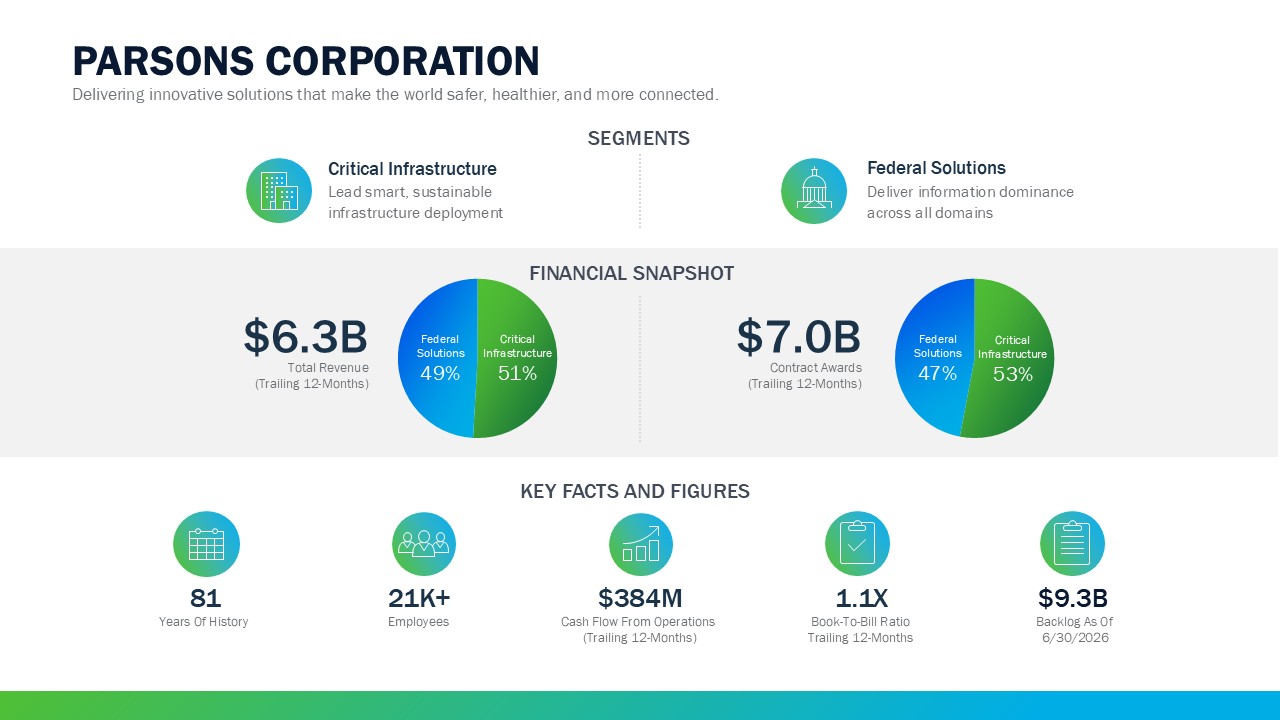
PARSONS CORPORATION Enabling a safer, smarter, and more interconnected world. Engineered solutions for complex physical and digital infrastructure challenges SEGMENTS KEY FACTS AND FIGURES Technology-driven solutions for defense and intelligence customers FINANCIAL SNAPSHOT $4B Total Revenue Trailing 12-Months (Q2 2020) $4B Contract Awards Trailing 12-Months (Q2 2020) 75+ Years Of History Federal Solutions 49% Critical Infrastructure 51% Federal Solutions 58% Critical Infrastructure 42% Federal Solutions Critical Infrastructure ~16K Employees 6% Revenue Growth Trailing 12-Months (Q2 2020) 1.0X Book-To-Bill Ratio Trailing 12-Months (Q2 2020) $7.7B Backlog As Of 6/30/2020 PARSONS CORPORATION.
Overview
We are a leading provider of the integrated solutions and services required in today’s complex security environment and a world of digital transformation. We deliver innovative technology-driven solutions to customers worldwide. We have developed significant expertise and differentiated capabilities in key areas of cyber and electronic warfare, space and missile defense, critical infrastructure protection, transportation, water and environment, and urban development. By combining our talented team of professionals and advanced technology, we solve complex technical challenges to enable a safer, smarter, more secure and more connected world.
We operate in two reporting segments, Federal Solutions and Critical Infrastructure. Our Federal Solutions business is an advanced technology provider to the U.S. government. Our Critical Infrastructure business provides integrated design and engineering services for complex physical and digital infrastructure around the globe.
Our employees provide services pursuant to contracts that we are awarded by the customer and specific task orders relating to such contracts. These contracts are often multi-year, which provides us backlog and visibility on our revenues for future periods. Many of our contracts and task orders are subject to renewal and rebidding at the end of their term, and some are subject to the exercise of contract options and issuance of task orders by the applicable government
entity. In addition to focusing on increasing our revenues through increased contract awards and backlog, we focus our financial performance on margin expansion and cash flow.
Key Metrics
We manage and assess the performance of our business by evaluating a variety of metrics. The following table sets forth selected key metrics (in thousands, except Book-to-Bill):
|
|
|
|
|
|
|
|
|
|
|
June 30, 2026 |
|
|
June 30, 2025 |
|
Awards (year to date) |
|
$ |
3,927,375 |
|
|
$ |
3,272,551 |
|
Backlog (1) |
|
$ |
9,256,893 |
|
|
$ |
8,943,038 |
|
Book-to-Bill (year to date) |
|
|
1.3 |
|
|
|
1.0 |
|
(1)Difference between our backlog of $9.3 billion and our remaining unsatisfied performance obligations, or RUPO, of $6.9 billion, each as of June 30, 2026, is due to (i) unissued task orders and unexercised option years, to the extent their issuance or exercise is probable, as well as (ii) contract awards, to the extent we believe contract execution and funding is probable.
Awards
Awards generally represent the amount of revenue expected to be earned in the future from funded and unfunded contract awards received during the period. Contract awards include both new and re-compete contracts and task orders. Given that new contract awards generate growth, we closely track our new awards.
The following table summarizes the year to-date value of new awards for the periods presented below (in thousands):
|
|
|
|
|
|
|
|
|
|
|
|
|
|
|
|
|
|
|
Three Months Ended |
|
|
Six Months Ended |
|
|
|
June 30, 2026 |
|
|
June 30, 2025 |
|
|
June 30, 2026 |
|
|
June 30, 2025 |
|
Federal Solutions |
|
$ |
985,300 |
|
|
$ |
650,770 |
|
|
$ |
2,016,634 |
|
|
$ |
1,395,479 |
|
Critical Infrastructure |
|
$ |
883,666 |
|
|
|
855,275 |
|
|
|
1,910,741 |
|
|
|
1,877,072 |
|
Total Awards |
|
$ |
1,868,966 |
|
|
$ |
1,506,045 |
|
|
$ |
3,927,375 |
|
|
$ |
3,272,551 |
|
The change in new awards from year to year is primarily due to ordinary course fluctuations in our business. The volume of contract awards can fluctuate in any given period due to win rate and the timing and size of the awards issued by our customers.
The increase in awards for the three and six months ended June 30, 2026 in our Critical Infrastructure segment when compared to the corresponding period last year was primarily driven by an overall increase in awards in the current year period. The increase in awards for the three and six months ended June 30, 2026 in our Federal Solutions segment when compared to the corresponding period last year was primarily driven by significant awards. The comparable period included a delay in the timing of awards of a number of contracts being pursued.
Backlog
We define backlog to include the following two components:
•Funded—Funded backlog represents the revenue value of orders for services under existing contracts for which funding is appropriated or otherwise authorized less revenue previously recognized on these contracts.
•Unfunded—Unfunded backlog represents the revenue value of orders for services under existing contracts for which funding has not been appropriated or otherwise authorized less revenue previously recognized on these contracts. Unfunded backlog does not include potential task orders expected to be awarded under multiple awards IDIQ (indefinite delivery, indefinite quantity) contract vehicles, where task orders are competitively awarded and separately priced.
Backlog includes (i) unissued task orders and unexercised option years, to the extent their issuance or exercise is probable, as well as (ii) contract awards, to the extent we believe contract execution and funding is probable.
The following table summarizes the value of our backlog at the respective dates presented below (in thousands):
|
|
|
|
|
|
|
|
|
|
|
June 30, 2026 |
|
|
June 30, 2025 |
|
Federal Solutions: |
|
|
|
|
|
|
Funded |
|
$ |
1,868,875 |
|
|
$ |
1,816,590 |
|
Unfunded |
|
|
2,636,203 |
|
|
|
2,656,547 |
|
Total Federal Solutions |
|
|
4,505,078 |
|
|
|
4,473,137 |
|
Critical Infrastructure: |
|
|
|
|
|
|
Funded |
|
|
4,712,089 |
|
|
|
4,421,015 |
|
Unfunded |
|
|
39,726 |
|
|
|
48,886 |
|
Total Critical Infrastructure |
|
|
4,751,815 |
|
|
|
4,469,901 |
|
Total Backlog (1) |
|
$ |
9,256,893 |
|
|
$ |
8,943,038 |
|
(1)Difference between our backlog of $9.3 billion and our RUPO of $6.9 billion, each as of June 30, 2026, is due to (i) unissued task orders and unexercised option years, to the extent their issuance or exercise is probable, as well as (ii) contract awards, to the extent we believe contract execution and funding is probable.
Our backlog includes orders under contracts that in some cases extend for several years. For example, the U.S. Congress generally appropriates funds for our U.S. federal government customers on a yearly basis, even though their contracts with us may call for performance that is expected to take a number of years to complete. As a result, our federal contracts typically are only partially funded at any point during their term. All or some of the work to be performed under the contracts may remain unfunded unless and until the U.S. Congress makes subsequent appropriations and the procuring agency allocates funding to the contract.
We expect to recognize $3.8 billion of our funded backlog at June 30, 2026 as revenues in the following twelve months. However, our U.S. federal government customers may cancel their contracts with us at any time through a termination for convenience or may elect to not exercise option periods under such contracts. In the case of a termination for convenience, we would not receive anticipated future revenues, but would generally be permitted to recover all or a portion of our incurred costs and fees for work performed. See “Risk Factors—Risk Relating to Our Business—We may not realize the full value of our backlog, which may result in lower-than-expected revenue” in the Company’s Form 10-K for the year ended December 31, 2025.
The increase in backlog in the Critical Infrastructure segment was primarily from ordinary course fluctuations in our business and an overall increase in awards. The decrease in Federal Solutions backlog was primarily related to a reduction in work on our confidential contract as a result of the Department of State reorganization issued May 29, 2025, partially offset by an overall increase in awards.
Book-to-Bill
Book-to-bill is the ratio of total awards to total revenue recorded in the same period. Our management believes our book-to-bill ratio is a useful indicator of our potential future revenue growth in that it measures the rate at which we are generating new awards compared to the Company’s current revenue. To drive future revenue growth, our goal is for the level of awards in a given period to exceed the revenue booked. A book-to-bill ratio greater than 1.0 indicates that awards generated in a given period exceeded the revenue recognized in the same period, while a book-to-bill ratio of less than 1.0 indicates that awards generated in such period were less than the revenue recognized in such period. The following table sets forth the book-to-bill ratio for the periods presented below:
|
|
|
|
|
|
|
|
|
|
|
|
|
|
|
|
|
|
|
Three Months Ended |
|
|
Six Months Ended |
|
|
|
June 30, 2026 |
|
|
June 30, 2025 |
|
|
June 30, 2026 |
|
|
June 30, 2025 |
|
Federal Solutions |
|
|
1.3 |
|
|
|
0.8 |
|
|
|
1.3 |
|
|
|
0.8 |
|
Critical Infrastructure |
|
|
1.1 |
|
|
|
1.1 |
|
|
|
1.2 |
|
|
|
1.3 |
|
Overall |
|
|
1.2 |
|
|
|
1.0 |
|
|
|
1.3 |
|
|
|
1.0 |
|
Factors and Trends Affecting Our Results of Operations
We believe that the financial performance of our business and our future success are dependent upon many factors, including those highlighted in this section. Our operating performance will depend upon many variables, including the success of our growth strategies and the timing and size of investments and expenditures that we choose to undertake, as well as market growth and other factors that are not within our control.
Government Spending
Changes in the relative mix of government spending and areas of spending growth, with shifts in priorities on homeland security, intelligence, defense-related programs, infrastructure and urbanization, and continued increased spending on technology and innovation, including cyber, artificial intelligence, connected communities and physical infrastructure, could impact our business and results of operations. Cost-cutting and efficiency initiatives, current and future budget restrictions, spending cuts and other efforts to reduce government spending could cause our government customers to reduce or delay funding or invest appropriated funds on a less consistent basis or not at all, and demand for our solutions or services could diminish. Furthermore, any disruption in the functioning of government agencies, including as a result of government closures and shutdowns, could have a negative impact on our operations and cause us to lose revenue or incur additional costs due to, among other things, our inability to deploy our staff to customer locations or facilities as a result of such disruptions.
Federal Budget Uncertainty
There is uncertainty around the timing, extent, nature and effect of Congressional and other U.S. government actions to address budgetary constraints, caps on the discretionary budget for defense and non-defense departments and agencies, and the ability of Congress to determine how to allocate the available budget authority and pass appropriations bills to fund both U.S. government departments and agencies that are, and those that are not, subject to the caps. Additionally, budget deficits and the growing U.S. national debt increase pressure on the U.S. government to reduce federal spending across all federal agencies, with uncertainty about the size and timing of those reductions. Furthermore, delays in the completion of future U.S. government budgets could in the future delay procurement of the federal government services we provide. A reduction in the amount of, or delays, or cancellations of funding for, services that we are contracted to provide to the U.S. government as a result of any of these impacts or related initiatives, legislation or otherwise could have a material adverse effect on our business and results of operations.
Regulations
Increased audit, review, investigation and general scrutiny by government agencies of performance under government contracts and compliance with the terms of those contracts and applicable laws could affect our operating results. Negative publicity and increased scrutiny of government contractors in general, including us, relating to government expenditures for contractor services and incidents involving the mishandling of sensitive or classified information, as well as the increasingly complex requirements of the U.S. Department of War and the U.S. intelligence community, including those related to cybersecurity, could impact our ability to perform in the markets we serve.
Competitive Markets
The industries we operate in consist of a large number of enterprises ranging from small, niche-oriented companies to multi-billion-dollar corporations that serve many government and commercial customers. We compete on the basis of our technical expertise, technological innovation, our ability to deliver cost-effective multi-faceted services in a timely manner, our reputation and relationships with our customers, qualified and/or security-clearance personnel, and pricing. We believe that we are well positioned to take advantage of the markets in which we operate because of our proven track record, long-term customer relationships, technology innovation, scalable and agile business offerings and world class talent. Our ability to effectively deliver on project engagements and successfully assist our customers affects our ability to win new contracts and drives our financial performance.
Acquired Operations
Altamira Technologies Corporation.
On January 14, 2026, the Company acquired a 100% ownership interest in Altamira Technologies Corporation ("ATC"), a privately owned company, for approximately $339 million in cash and up to an additional $45 million in the event an earn out EBITDA target is exceeded. The Company borrowed $330.0 million under the Credit Agreement to fund the acquisition. Headquartered in McLean, Virginia, ATC enhances Parsons’ defense and intelligence portfolio by delivering advanced analytics, signals intelligence (SIGINT), cyber, missile warning, and space capabilities, complementing the company’s strengths in all‑domain technology integration and Indo‑Pacific operations, and expanding with intelligence community (IC) customers. The financial results of ATC have been included in our consolidated results of operations from March 31, 2026 onward.
Applied Sciences Consulting, Inc.
On October 1, 2025, the Company acquired a 100% ownership interest in Applied Sciences Consulting, Inc. ("ASC"), a privately owned company, for $28.2 million from cash on hand. ASC specializes in water and stormwater solutions for cities, counties, and water management districts across the state of Florida. ASC enhances our ability to partner with Florida communities on delivering innovative solutions for their resiliency challenges, while expanding those capabilities to new and existing clients around the world. The financial results of ASC have been included in our consolidated results of operations from December 31, 2025 onward.
Chesapeake Technology International, Corp
On June 30, 2025, the Company acquired a 100% ownership interest in Chesapeake Technology International, Corp ("CTI"), a privately owned company, for $91.5 million from cash on hand. CTI brings extensive capabilities as an all-domain technology solutions provider, powered by cutting-edge products that enhance the warfighters’ ability to sense, evaluate and deliver effects within the invisible battlespaces. CTI enhances our mission-ready solutions for the Department of War. The financial results of CTI have been included in our consolidated results of operations from June 30, 2025 onward.
TRS Group, Inc.
On January 31, 2025, the Company acquired a 100% ownership interest in TRS Group, Inc. ("TRS") a privately owned company, for $36.6 million. TRS is an environmental solutions firm that specializes in remediation technology. The acquisition of TRS significantly enhances Parsons’ environmental remediation capabilities. The financial results of TRS have been included in our consolidated results of operations from January 31, 2025 onward.
Seasonality
Our results may be affected by variances as a result of weather conditions and contract award seasonality impacts that we experience across our businesses. The latter issue is typically driven by the U.S. federal government fiscal year-end, September 30. While not certain, it is not uncommon for U.S. government agencies to award task orders or complete other contract actions in the weeks before the end of the U.S. federal government fiscal year in order to avoid the loss of unexpended U.S. federal government fiscal year funds. In addition, we have also historically experienced higher bid and proposal costs in the months leading up to the U.S. federal government fiscal year-end as we pursue new contract opportunities expected to be awarded early in the following U.S. federal government fiscal year as a result of funding appropriated for that U.S. federal government fiscal year. Furthermore, many U.S. state governments with fiscal years ending on June 30 tend to accelerate spending during their first quarter, when new funding becomes available. We may continue to experience this seasonality in future periods, and our results of operations may be affected by it.
Results of Operations
Revenue
Our revenue consists of both services provided by our employees and pass-through fees from subcontractors and other direct costs. Our Federal Solutions segment derives revenue primarily from the U.S. federal government and our Critical Infrastructure segment derives revenue primarily from government and commercial customers.
We enter into the following types of contracts with our customers:
•Under cost-plus contracts, we are reimbursed for allowable or otherwise defined costs incurred, plus a fee. The contracts may also include incentives for various performance criteria, including quality, timeliness,
safety and cost-effectiveness. In addition, costs are generally subject to review by clients and regulatory audit agencies, and such reviews could result in costs being disputed as non-reimbursable under the terms of the contract.
•Under time-and-materials contracts, hourly billing rates are negotiated and charged to clients based on the actual time spent on a project. In addition, clients reimburse actual out-of-pocket costs for other direct costs and expenses that are incurred in connection with the performance under the contract.
•Under fixed-price contracts, clients pay an agreed fixed-amount negotiated in advance for a specified scope of work.
Refer to “Management’s Discussion and Analysis of Financial Condition and Results of Operations—Critical Accounting Policies and Estimates” and “Note 2—Summary of Significant Accounting Policies” in the notes to our consolidated financial statements included in the Company’s Form 10-K for the year ended December 31, 2025 for a description of our policies on revenue recognition.
The table below presents the percentage of total revenue for each type of contract.
|
|
|
|
|
|
|
|
|
|
|
Three Months Ended |
|
Six Months Ended |
|
|
June 30, 2026 |
|
June 30, 2025 |
|
June 30, 2026 |
|
June 30, 2025 |
Fixed-price |
|
29.7% |
|
33.6% |
|
30.6% |
|
35.3% |
Time-and-materials |
|
25.4% |
|
23.5% |
|
25.2% |
|
22.9% |
Cost-plus |
|
44.9% |
|
42.9% |
|
44.2% |
|
41.8% |
The amount of risk and potential reward varies under each type of contract. Under cost-plus contracts, there is limited financial risk, because we are reimbursed for all allowable costs up to a ceiling. However, profit margins on this type of contract tend to be lower than on time-and-materials and fixed-price contracts. Under time-and-materials contracts, we are reimbursed for the hours worked using the predetermined hourly rates for each labor category. In addition, we are typically reimbursed for other direct contract costs and expenses at cost. We assume financial risk on time-and-materials contracts because our labor costs may exceed the negotiated billing rates. Profit margins on well-managed time-and-materials contracts tend to be higher than profit margins on cost-plus contracts as long as we are able to staff those contracts with people who have an appropriate skill set. Under fixed-price contracts, we are required to deliver the objectives under the contract for a pre-determined price. Compared to time-and-materials and cost-plus contracts, fixed-price contracts generally offer higher profit margin opportunities because we receive the full benefit of any cost savings, but they also generally involve greater financial risk because we bear the risk of any cost overruns. In the aggregate, the contract type mix in our revenue for any given period will affect that period’s profitability. Over time, we have generally experienced a relatively stable contract mix.
The change in the contract mix for the three and six months ended June 30, 2026 compared to the corresponding periods last year primarily relates to decreased business volume from a fixed price contract from a confidential contract in our Federal Solutions segment.
Our recognition of profit on long-term contracts requires the use of assumptions related to transaction price and total cost of completion. Estimates are continually evaluated as work progresses and are revised when necessary. When a change in estimated cost or transaction price is determined to have an impact on contract profit, we record a positive or negative adjustment to revenue.
Joint Ventures
We conduct a portion of our business through joint ventures or similar partnership arrangements. For the joint ventures we control, we consolidate all the revenues and expenses in our consolidated statements of income (including revenues and expenses attributable to noncontrolling interests). For the joint ventures we do not control, we recognize equity in (losses) earnings of unconsolidated joint ventures. Our revenues included amounts related to services we provided to our unconsolidated joint ventures for the three months ended June 30, 2026 and June 30, 2025 of $46.7 million and $42.0 million, respectively and $96.3 million and $87.5 million for the six months ended June 30, 2026 and June 30, 2025, respectively.
Operating costs and expenses
Operating costs and expenses primarily include direct costs of contracts and selling, general and administrative expenses. Costs associated with compensation-related expenses for our people and facilities, which includes ESOP contribution expenses, are the most significant component of our operating expenses. Total ESOP contribution expense for the three months ended June 30, 2026 and June 30, 2025 was $19.8 million and $17.6 million, respectively and $39.1
million and $35.4 million for the six months ended June 30, 2026 and June 30, 2025, respectively and is recorded in “Direct cost of contracts” and “Selling, general and administrative expenses.”
Direct costs of contracts consist of direct labor and associated fringe benefits, indirect overhead, subcontractor and materials (“pass-through costs”), travel expenses and other expenses incurred to perform on contracts.
Selling, general and administrative expenses (“SG&A”) include salaries and wages and fringe benefits of our employees not performing work directly for customers, facility costs and other costs related to these indirect functions.
Other income and expenses
Other income and expenses primarily consist of interest income, interest expense and other income, net.
Interest income primarily consists of interest earned on U.S. government money market funds.
Interest expense consists of interest expense incurred under our Convertible Senior Notes, Term Loan, and Revolving Credit Agreement.
Other income, net primarily consists of gain or loss on sale of businesses and sale of assets, sublease income and transaction gain or loss related to movements in foreign currency exchange rates.
Adjusted EBITDA
The following table sets forth Adjusted EBITDA, Net Income Margin, and Adjusted EBITDA Margin for the three and six months ended June 30, 2026 and June 30, 2025.
|
|
|
|
|
|
|
|
|
|
|
|
|
|
|
|
|
|
|
Three Months Ended |
|
|
Six Months Ended |
|
(U.S. dollars in thousands) |
|
June 30, 2026 |
|
|
June 30, 2025 |
|
|
June 30, 2026 |
|
|
June 30, 2025 |
|
Adjusted EBITDA (1) |
|
$ |
42,220 |
|
|
$ |
149,131 |
|
|
$ |
193,149 |
|
|
$ |
297,907 |
|
Net Income Margin (2) |
|
|
0.0 |
% |
|
|
4.4 |
% |
|
|
2.1 |
% |
|
|
4.9 |
% |
Adjusted EBITDA Margin (3) |
|
|
2.7 |
% |
|
|
9.4 |
% |
|
|
6.3 |
% |
|
|
9.5 |
% |
(1)A reconciliation of net income attributable to Parsons Corporation to Adjusted EBITDA is set forth below (in thousands).
(2)Net Income Margin is calculated as net income including noncontrolling interest divided by revenue in the applicable period.
(3)Adjusted EBITDA Margin is calculated as Adjusted EBITDA divided by revenue in the applicable period.
|
|
|
|
|
|
|
|
|
|
|
|
|
|
|
|
|
|
|
Three Months Ended |
|
|
Six Months Ended |
|
|
|
June 30, 2026 |
|
|
June 30, 2025 |
|
|
June 30, 2026 |
|
|
June 30, 2025 |
|
Net income attributable to Parsons Corporation |
|
$ |
(15,219 |
) |
|
$ |
55,230 |
|
|
$ |
37,707 |
|
|
$ |
121,433 |
|
Interest expense, net |
|
|
15,821 |
|
|
|
11,501 |
|
|
|
30,008 |
|
|
|
21,605 |
|
Income tax expense |
|
|
4,222 |
|
|
|
18,690 |
|
|
|
20,309 |
|
|
|
37,667 |
|
Depreciation and amortization |
|
|
36,637 |
|
|
|
28,592 |
|
|
|
72,563 |
|
|
|
55,995 |
|
Net income attributable to noncontrolling interests |
|
|
14,754 |
|
|
|
15,259 |
|
|
|
27,039 |
|
|
|
30,843 |
|
Equity-based compensation |
|
|
10,077 |
|
|
|
11,519 |
|
|
|
19,531 |
|
|
|
18,622 |
|
Transaction-related costs (a) |
|
|
(7,126 |
) |
|
|
5,135 |
|
|
|
1,313 |
|
|
|
8,836 |
|
Restructuring (b) |
|
|
- |
|
|
|
2,361 |
|
|
|
- |
|
|
|
2,361 |
|
Other (c) |
|
|
(16,946 |
) |
|
|
844 |
|
|
|
(15,321 |
) |
|
|
545 |
|
Adjusted EBITDA |
|
$ |
42,220 |
|
|
$ |
149,131 |
|
|
$ |
193,149 |
|
|
$ |
297,907 |
|
(a)Reflects costs incurred in connection with acquisitions and other non-recurring transaction costs, primarily fees paid for professional services and employee retention.
(b)Reflects costs associated with and related to our corporate restructuring initiatives.
(c)Includes a combination of gain/loss related to sale of businesses and sale of fixed assets, software implementation costs, and other individually insignificant items that are non-recurring in nature.
Adjusted EBITDA is a supplemental measure of our operating performance used by management and our board of directors to assess our financial performance both on a segment and on a consolidated basis. We discuss Adjusted EBITDA because our management uses this measure for business planning purposes, including to manage the business against internal projected results of operations and measure the performance of the business generally. Adjusted EBITDA is frequently used by analysts, investors and other interested parties to evaluate companies in our industry.
Adjusted EBITDA is not a GAAP measure of our financial performance or liquidity and should not be considered as an alternative to net income as a measure of financial performance or cash flows from operations as measures of liquidity, or any other performance measure derived in accordance with GAAP. We define Adjusted EBITDA as net income attributable to Parsons Corporation, adjusted to include net income attributable to noncontrolling interests and to exclude interest expense (net of interest income), provision for income taxes, depreciation and amortization and certain other items that we do not consider in our evaluation of ongoing operating performance. These other items include, among other things, impairment of goodwill, intangible and other assets, interest and other expenses recognized on litigation matters, expenses incurred in connection with acquisitions and other non-recurring transaction costs, equity-based compensation and expenses related to our corporate restructuring initiatives. Adjusted EBITDA should not be construed as an inference that our future results will be unaffected by unusual or non-recurring items. Additionally, Adjusted EBITDA is not intended to be a measure of free cash flow for management’s discretionary use, as it does not reflect tax payments, debt service requirements, capital expenditures and certain other cash costs that may recur in the future, including, among other things, cash requirements for working capital needs and cash costs to replace assets being depreciated and amortized. Management compensates for these limitations by relying on our GAAP results in addition to using Adjusted EBITDA supplementally. Our measure of Adjusted EBITDA is not necessarily comparable to similarly titled captions of other companies due to different methods of calculation.
The following tables show Adjusted EBITDA attributable to Parsons Corporation for each of our reportable segments and Adjusted EBITDA attributable to noncontrolling interests (in thousands):
|
|
|
|
|
|
|
|
|
|
|
|
|
|
|
|
|
|
|
Three Months Ended |
|
|
Variance |
|
|
|
June 30, 2026 |
|
|
June 30, 2025 |
|
|
Dollar |
|
|
Percent |
|
Federal Solutions Adjusted EBITDA attributable to Parsons Corporation |
|
$ |
(13,786 |
) |
|
$ |
67,072 |
|
|
$ |
(80,858 |
) |
|
|
(120.6 |
)% |
Critical Infrastructure Adjusted EBITDA attributable to Parsons Corporation |
|
|
41,007 |
|
|
|
66,193 |
|
|
|
(25,186 |
) |
|
|
(38.0 |
)% |
Adjusted EBITDA attributable to noncontrolling interests |
|
|
14,999 |
|
|
|
15,866 |
|
|
|
(867 |
) |
|
|
(5.5 |
)% |
Total Adjusted EBITDA |
|
$ |
42,220 |
|
|
$ |
149,131 |
|
|
$ |
(106,911 |
) |
|
|
(71.7 |
)% |
|
|
|
|
|
|
|
|
|
|
|
|
|
|
|
|
|
|
|
Six Months Ended |
|
|
Variance |
|
|
|
June 30, 2026 |
|
|
June 30, 2025 |
|
|
Dollar |
|
|
Percent |
|
Federal Solutions Adjusted EBITDA attributable to Parsons Corporation |
|
$ |
57,767 |
|
|
$ |
142,604 |
|
|
$ |
(84,837 |
) |
|
|
(59.5 |
)% |
Critical Infrastructure Adjusted EBITDA attributable to Parsons Corporation |
|
|
107,908 |
|
|
$ |
124,380 |
|
|
|
(16,472 |
) |
|
|
(13.2 |
)% |
Adjusted EBITDA attributable to noncontrolling interests |
|
|
27,474 |
|
|
$ |
30,923 |
|
|
|
(3,449 |
) |
|
|
(11.2 |
)% |
Total Adjusted EBITDA |
|
$ |
193,149 |
|
|
$ |
297,907 |
|
|
$ |
(104,758 |
) |
|
|
(35.2 |
)% |
The following table sets forth our results of operations for the three and six months ended June 30, 2026 and June 30, 2025 as a percentage of revenue.
|
|
|
|
|
|
|
|
|
|
|
|
|
|
|
|
|
|
|
Three Months Ended |
|
|
Six Months Ended |
|
|
|
June 30, 2026 |
|
|
June 30, 2025 |
|
|
June 30, 2026 |
|
|
June 30, 2025 |
|
Revenues |
|
|
100.0 |
% |
|
|
100.0 |
% |
|
|
100.0 |
% |
|
|
100.0 |
% |
Direct costs of contracts |
|
|
81.3 |
% |
|
|
78.0 |
% |
|
|
78.7 |
% |
|
|
77.6 |
% |
Equity in (losses) earnings of unconsolidated joint ventures |
|
|
(2.1 |
)% |
|
|
(0.0 |
)% |
|
|
(0.9 |
)% |
|
|
(0.0 |
)% |
Selling, general and administrative expenses |
|
|
16.5 |
% |
|
|
15.9 |
% |
|
|
17.2 |
% |
|
|
15.8 |
% |
Operating income |
|
|
0.1 |
% |
|
|
6.0 |
% |
|
|
3.2 |
% |
|
|
6.5 |
% |
Interest income |
|
|
0.0 |
% |
|
|
0.1 |
% |
|
|
0.1 |
% |
|
|
0.1 |
% |
Interest expense |
|
|
(1.0 |
)% |
|
|
(0.8 |
)% |
|
|
(1.1 |
)% |
|
|
(0.8 |
)% |
Other income, net |
|
|
1.2 |
% |
|
|
0.3 |
% |
|
|
0.6 |
% |
|
|
0.2 |
% |
Total other income (expense) |
|
|
0.2 |
% |
|
|
(0.4 |
)% |
|
|
(0.4 |
)% |
|
|
(0.5 |
)% |
Income before income tax expense |
|
|
0.2 |
% |
|
|
5.6 |
% |
|
|
2.8 |
% |
|
|
6.1 |
% |
Income tax expense |
|
|
(0.3 |
)% |
|
|
(1.2 |
)% |
|
|
(0.7 |
)% |
|
|
(1.2 |
)% |
Net income including noncontrolling interests |
|
|
(0.0 |
)% |
|
|
4.4 |
% |
|
|
2.1 |
% |
|
|
4.9 |
% |
Net income attributable to noncontrolling interests |
|
|
(0.9 |
)% |
|
|
(1.0 |
)% |
|
|
(0.9 |
)% |
|
|
(1.0 |
)% |
Net income attributable to Parsons Corporation |
|
|
(1.0 |
)% |
|
|
3.5 |
% |
|
|
1.2 |
% |
|
|
3.9 |
% |
Revenue
|
|
|
|
|
|
|
|
|
|
|
|
|
|
|
|
|
|
|
Three Months Ended |
|
|
Variance |
|
(U.S. dollars in thousands) |
|
June 30, 2026 |
|
|
June 30, 2025 |
|
|
Dollar |
|
|
Percent |
|
Revenue |
|
$ |
1,575,867 |
|
|
$ |
1,584,323 |
|
|
$ |
(8,456 |
) |
|
|
(0.5 |
)% |
Revenue decreased $8.5 million for the three months ended June 30, 2026 when compared to the corresponding period last year, due to a decrease in revenue in our Federal Solutions segment of $44.6 million, offset by an increase in revenue in our Critical Infrastructure Segment of $36.1 million. See “Segment Results” below for a further discussion of the changes in the Company's revenue.
|
|
|
|
|
|
|
|
|
|
|
|
|
|
|
|
|
|
|
Six Months Ended |
|
|
Variance |
|
(U.S. dollars in thousands) |
|
June 30, 2026 |
|
|
June 30, 2025 |
|
|
Dollar |
|
|
Percent |
|
Revenue |
|
$ |
3,067,043 |
|
|
$ |
3,138,683 |
|
|
$ |
(71,640 |
) |
|
|
(2.3 |
)% |
Revenue decreased $71.6 million for the six months ended June 30, 2026 when compared to the corresponding period last year, due to a decrease in revenue in our Federal Solutions segment of $128.8 million, offset by an increase in revenue in our Critical Infrastructure Segment of $57.2 million. See “Segment Results” below for a further discussion of the changes in the Company's revenue.
Direct costs of contracts
|
|
|
|
|
|
|
|
|
|
|
|
|
|
|
|
|
|
|
Three Months Ended |
|
|
Variance |
|
(U.S. dollars in thousands) |
|
June 30, 2026 |
|
|
June 30, 2025 |
|
|
Dollar |
|
|
Percent |
|
Direct costs of contracts |
|
$ |
1,280,629 |
|
|
$ |
1,235,970 |
|
|
$ |
44,659 |
|
|
|
3.6 |
% |
Direct cost of contracts increased $44.7 million for the three months ended June 30, 2026 when compared to the corresponding period last year, primarily due to an increase of $24.9 million in our Federal Solutions segment and an increase of $19.8 million in our Critical Infrastructure segment. The increase in direct costs of contracts in the Federal Solutions segment is primarily related to a write down, partially offset by reduced volume from our confidential contract. See “Segment Results” below for further discussion. The increase in direct costs of contracts in the Critical Infrastructure segment is primarily related to increased volume from new and existing contracts.
|
|
|
|
|
|
|
|
|
|
|
|
|
|
|
|
|
|
|
Six Months Ended |
|
|
Variance |
|
(U.S. dollars in thousands) |
|
June 30, 2026 |
|
|
June 30, 2025 |
|
|
Dollar |
|
|
Percent |
|
Direct costs of contracts |
|
$ |
2,414,385 |
|
|
$ |
2,436,347 |
|
|
$ |
(21,962 |
) |
|
|
(0.9 |
)% |
Direct cost of contracts decreased $22.0 million for the six months ended June 30, 2026 when compared to the corresponding period last year, primarily due to an decrease of $51.6 million in our Federal Solutions segment and an increase of $29.7 million in our Critical Infrastructure segment. The decrease in direct costs of contracts in the Federal Solutions segment is primarily related to reduced volume from our confidential contract. See “Segment Results” below for further discussion. The increase in direct costs of contracts in the Critical Infrastructure segment is primarily related to increased volume from new and existing contracts.
Equity in losses of unconsolidated joint ventures
|
|
|
|
|
|
|
|
|
|
|
|
|
|
|
|
|
|
|
Three Months Ended |
|
|
Variance |
|
(U.S. dollars in thousands) |
|
June 30, 2026 |
|
|
June 30, 2025 |
|
|
Dollar |
|
|
Percent |
|
Equity in losses of unconsolidated joint ventures |
|
$ |
(33,748 |
) |
|
$ |
(642 |
) |
|
$ |
(33,106 |
) |
|
|
(5,156.7 |
)% |
Equity in losses of unconsolidated joint ventures decreased by $33.1 million for the three months ended June 30, 2026 compared to the corresponding period last year primarily due to a write down in the Critical Infrastructure segment. The Company is winding down its participation in construction joint ventures.
|
|
|
|
|
|
|
|
|
|
|
|
|
|
|
|
|
|
|
Six Months Ended |
|
|
Variance |
|
(U.S. dollars in thousands) |
|
June 30, 2026 |
|
|
June 30, 2025 |
|
|
Dollar |
|
|
Percent |
|
Equity in losses of unconsolidated joint ventures |
|
$ |
(27,592 |
) |
|
$ |
(1,329 |
) |
|
$ |
(26,263 |
) |
|
|
(1,976.1 |
)% |
Equity in losses of unconsolidated joint ventures decreased by $26.3 million for the six months ended June 30, 2026 compared to the corresponding period last year primarily due to a write down in the Critical Infrastructure segment. The Company is winding down its participation in construction joint ventures.
Selling, general and administrative expenses
|
|
|
|
|
|
|
|
|
|
|
|
|
|
|
|
|
|
|
Three Months Ended |
|
|
Variance |
|
(U.S. dollars in thousands) |
|
June 30, 2026 |
|
|
June 30, 2025 |
|
|
Dollar |
|
|
Percent |
|
Selling, general and administrative expenses |
|
$ |
260,195 |
|
|
$ |
252,050 |
|
|
$ |
8,145 |
|
|
|
3.2 |
% |
As a percentage of revenue, our SG&A increased by 0.6% to 16.5% for the three months ended June 30, 2026 compared to 15.9% for the corresponding period last year. The increase in SG&A was primarily due to acquisitions and intangible asset amortization associated with the Company's acquisitions compared to the corresponding period last year. Partially offsetting these increase in SG&A was a decrease in the estimated fair value of the ATC contingent consideration.
|
|
|
|
|
|
|
|
|
|
|
|
|
|
|
|
|
|
|
Six Months Ended |
|
|
Variance |
|
(U.S. dollars in thousands) |
|
June 30, 2026 |
|
|
June 30, 2025 |
|
|
Dollar |
|
|
Percent |
|
Selling, general and administrative expenses |
|
$ |
528,097 |
|
|
$ |
496,113 |
|
|
$ |
31,984 |
|
|
|
6.4 |
% |
As a percentage of revenue, our SG&A increased by 1.4% to 17.2% for the six months ended June 30, 2026 compared to 15.8% for the corresponding period last year. The increase in SG&A was primarily due to higher transaction costs, acquisitions and intangible asset amortization associated with the Company's acquisitions compared to the corresponding period last year. Partially offsetting these increase in SG&A was a decrease in the estimated fair value of the ATC contingent consideration.
Total other income (expense)
|
|
|
|
|
|
|
|
|
|
|
|
|
|
|
|
|
|
|
Three Months Ended |
|
|
Variance |
|
(U.S. dollars in thousands) |
|
June 30, 2026 |
|
|
June 30, 2025 |
|
|
Dollar |
|
|
Percent |
|
Interest income |
|
$ |
565 |
|
|
$ |
1,068 |
|
|
$ |
(503 |
) |
|
|
(47.1 |
)% |
Interest expense |
|
|
(16,386 |
) |
|
|
(12,569 |
) |
|
|
(3,817 |
) |
|
|
30.4 |
% |
Other income (expense), net |
|
|
18,283 |
|
|
|
5,019 |
|
|
|
13,264 |
|
|
|
264.3 |
% |
Total other income (expense) |
|
$ |
2,462 |
|
|
$ |
(6,482 |
) |
|
$ |
8,944 |
|
|
|
(138.0 |
)% |
|
|
|
|
|
|
|
|
|
|
|
|
|
|
|
|
|
|
|
Six Months Ended |
|
|
Variance |
|
(U.S. dollars in thousands) |
|
June 30, 2026 |
|
|
June 30, 2025 |
|
|
Dollar |
|
|
Percent |
|
Interest income |
|
$ |
2,376 |
|
|
$ |
3,210 |
|
|
$ |
(834 |
) |
|
|
(26.0 |
)% |
Interest expense |
|
|
(32,384 |
) |
|
|
(24,815 |
) |
|
|
(7,569 |
) |
|
|
30.5 |
% |
Other income (expense), net |
|
|
18,094 |
|
|
|
6,654 |
|
|
|
11,440 |
|
|
|
171.9 |
% |
Total other income (expense) |
|
$ |
(11,914 |
) |
|
$ |
(14,951 |
) |
|
$ |
3,037 |
|
|
|
-20.3 |
% |
Interest income is related to interest earned on investments in government money funds.
Interest expense for the three and six months ended June 30, 2026 and June 30, 2025 is primarily due to debt related to our Convertible Senior Notes, Term Loan, and Revolving Credit Facility.
The amounts in other income (expense), net are primarily related to a gain on sale of business, transaction gains and losses on foreign currency transactions and sublease income.
Income tax expense
|
|
|
|
|
|
|
|
|
|
|
|
|
|
|
|
|
|
|
Three Months Ended |
|
|
Variance |
|
(U.S. dollars in thousands) |
|
June 30, 2026 |
|
|
June 30, 2025 |
|
|
Dollar |
|
|
Percent |
|
Income tax expense |
|
$ |
4,222 |
|
|
$ |
18,690 |
|
|
$ |
(14,468 |
) |
|
|
(77.4 |
)% |
The Company’s effective tax rate was 112.4% and 21.0% and income tax expense was $4.2 million and $18.7 million for the three months ended June 30, 2026 and June 30, 2025, respectively. The decrease in tax expense for the three months ended June 30, 2026 compared to the three months ended June 30, 2025 was due primarily to the tax impact of a decrease in pre-tax income and a change in the jurisdictional mix of earnings, partially offset by increases in valuation allowances on foreign net operating loss carryovers (NOLs) and foreign tax credit carryovers (FTCs).
|
|
|
|
|
|
|
|
|
|
|
|
|
|
|
|
|
|
|
Six Months Ended |
|
|
Variance |
|
(U.S. dollars in thousands) |
|
June 30, 2026 |
|
|
June 30, 2025 |
|
|
Dollar |
|
|
Percent |
|
Income tax expense |
|
$ |
20,309 |
|
|
$ |
37,667 |
|
|
$ |
(17,358 |
) |
|
|
(46.1 |
)% |
The Company’s effective income tax rate was 23.9% and 19.8% for the six months ended June 30, 2026 and June 30, 2025, respectively. Income tax expense was $20.3 million and $37.7 million for the six months ended June 30, 2026 and June 30, 2025, respectively. The decrease in tax expense for the six months ended June 30, 2026 compared to the six months ended June 30, 2025 was due primarily to the tax impact of a decrease in pre-tax income and a change in the jurisdictional mix of earnings, partially offset by increases in valuation allowances on NOLs and FTCs and decreases in tax benefits from the foreign-derived deduction eligible income (FDDEI) and windfall equity-based compensation.
Segment Results
We evaluate segment operating performance using segment revenue and segment Adjusted EBITDA attributable to Parsons Corporation. Adjusted EBITDA attributable to Parsons Corporation is Adjusted EBITDA excluding Adjusted EBITDA attributable to noncontrolling interests. Presented above, in this Management’s Discussion and Analysis of Financial Condition and Results of Operations, is a discussion of our definition of Adjusted EBITDA, how we use this metric, why we present this metric and the material limitations on the usefulness of this metric. See “Note 18—Segments Information” in the notes to the consolidated financial statements in this Form 10-Q for further discussion regarding our segment Adjusted EBITDA attributable to Parsons Corporation.
The following table shows Adjusted EBITDA attributable to Parsons Corporation for each of our reportable segments and Adjusted EBITDA attributable to noncontrolling interests:
|
|
|
|
|
|
|
|
|
|
|
|
|
|
|
|
|
|
|
Three Months Ended |
|
|
Six Months Ended |
|
(U.S. dollars in thousands) |
|
June 30, 2026 |
|
|
June 30, 2025 |
|
|
June 30, 2026 |
|
|
June 30, 2025 |
|
Federal Solutions Adjusted EBITDA attributable to Parsons Corporation |
|
$ |
(13,786 |
) |
|
$ |
67,072 |
|
|
$ |
57,767 |
|
|
$ |
142,604 |
|
Critical Infrastructure Adjusted EBITDA attributable to Parsons Corporation |
|
|
41,007 |
|
|
|
66,193 |
|
|
|
107,908 |
|
|
|
124,380 |
|
Adjusted EBITDA attributable to noncontrolling interests |
|
|
14,999 |
|
|
|
15,866 |
|
|
|
27,474 |
|
|
|
30,923 |
|
Total Adjusted EBITDA |
|
$ |
42,220 |
|
|
$ |
149,131 |
|
|
$ |
193,149 |
|
|
$ |
297,907 |
|
Federal Solutions
|
|
|
|
|
|
|
|
|
|
|
|
|
|
|
|
|
|
|
Three Months Ended |
|
|
Variance |
|
(U.S. dollars in thousands) |
|
June 30, 2026 |
|
|
June 30, 2025 |
|
|
Dollar |
|
|
Percent |
|
Revenue |
|
$ |
760,868 |
|
|
$ |
805,464 |
|
|
$ |
(44,596 |
) |
|
|
(5.5 |
)% |
Adjusted EBITDA attributable to Parsons Corporation |
|
$ |
(13,786 |
) |
|
$ |
67,072 |
|
|
$ |
(80,858 |
) |
|
|
(120.6 |
)% |
The decrease in Federal Solutions revenue for the three months ended June 30, 2026 compared to the corresponding period last year was primarily driven by our confidential contract operating at a reduced volume as a result of the Department of State reorganization issued May 29, 2025 and write downs on projects. These decreases were offset by growth on existing contracts and acquisitions.
The decrease in Federal Solutions Adjusted EBITDA attributable to Parsons Corporation for the three months ended June 30, 2026 compared to the corresponding period last year was primarily due to write downs on projects and the factors impacting revenue discussed above.
|
|
|
|
|
|
|
|
|
|
|
|
|
|
|
|
|
|
|
Six Months Ended |
|
|
Variance |
|
(U.S. dollars in thousands) |
|
June 30, 2026 |
|
|
June 30, 2025 |
|
|
Dollar |
|
|
Percent |
|
Revenue |
|
$ |
1,519,216 |
|
|
$ |
1,648,021 |
|
|
$ |
(128,805 |
) |
|
|
(7.8 |
)% |
Adjusted EBITDA attributable to Parsons Corporation |
|
$ |
57,767 |
|
|
$ |
142,604 |
|
|
$ |
(84,837 |
) |
|
|
(59.5 |
)% |
The decrease in Federal Solutions revenue for the six months ended June 30, 2026 compared to the corresponding period last year was primarily driven by our confidential contract operating at a reduced volume as a result of the Department of State reorganization issued May 29, 2025. This decrease was offset by growth on existing contracts and acquisitions.
The decrease in Federal Solutions Adjusted EBITDA attributable to Parsons Corporation for the six months ended June 30, 2026 compared to the corresponding period last year was primarily due to the factors discussed above for Adjusted EBITDA for the three months ended June 30, 2026.
Critical Infrastructure
|
|
|
|
|
|
|
|
|
|
|
|
|
|
|
|
|
|
|
Three Months Ended |
|
|
Variance |
|
(U.S. dollars in thousands) |
|
June 30, 2026 |
|
|
June 30, 2025 |
|
|
Dollar |
|
|
Percent |
|
Revenue |
|
$ |
814,999 |
|
|
$ |
778,859 |
|
|
$ |
36,140 |
|
|
|
4.6 |
% |
Adjusted EBITDA attributable to Parsons Corporation |
|
$ |
41,007 |
|
|
$ |
66,193 |
|
|
$ |
(25,186 |
) |
|
|
(38.0 |
)% |
The increase in Critical Infrastructure revenue for the three months ended June 30, 2026 compared to the corresponding period last year was primarily related to organic growth and business acquisitions. Organic growth was primarily due to an increase in business volume from existing contracts and ramping up of recent awards.
The decrease in Critical Infrastructure Adjusted EBITDA attributable to Parsons Corporation for the three months ended June 30, 2026 compared to the corresponding period last year was primarily related to the equity in earnings impacts discussed above. This decrease in Adjusted EBITDA was partially offset by the revenue impacts above.
|
|
|
|
|
|
|
|
|
|
|
|
|
|
|
|
|
|
|
Six Months Ended |
|
|
Variance |
|
(U.S. dollars in thousands) |
|
June 30, 2026 |
|
|
June 30, 2025 |
|
|
Dollar |
|
|
Percent |
|
Revenue |
|
$ |
1,547,827 |
|
|
$ |
1,490,662 |
|
|
$ |
57,165 |
|
|
|
3.8 |
% |
Adjusted EBITDA attributable to Parsons Corporation |
|
$ |
107,908 |
|
|
$ |
124,380 |
|
|
$ |
(16,472 |
) |
|
|
(13.2 |
)% |
The increase in Critical Infrastructure revenue for the six months ended June 30, 2026 compared to the corresponding period last year was primarily related to organic growth and business acquisitions. Organic growth was primarily due to an increase in business volume from existing contracts and ramping up of recent awards.
The decrease in Critical Infrastructure Adjusted EBITDA attributable to Parsons Corporation for the six months ended June 30, 2026 compared to the corresponding period last year was primarily related to the equity in earnings impacts discussed above. This decrease in Adjusted EBITDA was partially offset by the revenue impacts above.
Liquidity and Capital Resources
We currently finance our operations and capital expenditures through a combination of internally generated cash from operations, our Convertible Senior Notes, Term Loan and periodic borrowings under our Revolving Credit Facility.
Generally, cash provided by operating activities has been adequate to fund our operations. Due to fluctuations in our cash flows and growth in our operations, it may be necessary from time to time in the future to borrow under our Credit Agreement to meet cash demands. Our management regularly monitors certain liquidity measures to monitor performance. We calculate our available liquidity as a sum of cash and cash equivalents from our consolidated balance sheet plus the amount available and unutilized on our Credit Agreement.
As of June 30, 2026, we believe we have adequate liquidity and capital resources to fund our operations, support our debt service and support our ongoing acquisition strategy for at least the next twelve months based on the liquidity from cash provided by our operating activities, cash and cash equivalents on-hand and our borrowing capacity under our Revolving Credit Facility. Management continually monitors debt maturities to strategically execute optimal terms and ensure appropriate levels of working capital liquidity are maintained for the company.
Cash Flows
Cash received from customers, either from the payment of invoices for work performed or for advances in excess of revenue recognized, is our primary source of cash. We generally do not begin work on contracts until funding is appropriated by the customers. Billing timetables and payment terms on our contracts vary based on a number of factors, including whether the contract type is cost-plus, time-and-materials, or fixed-price. We generally bill and collect cash more frequently under cost-plus and time-and-materials contracts, as we are authorized to bill as the costs are incurred or work
is performed. In contrast, we may be limited to bill certain fixed-price contracts only when specified milestones, including deliveries, are achieved. A number of our contracts may provide for performance-based payments, which allow us to bill and collect cash prior to completing the work.
Billed accounts receivable represents amounts billed to clients that have not been collected. Unbilled accounts receivable represents amounts where the Company has a present contractual right to bill but an invoice has not been issued to the customer at the period-end date.
Accounts receivable is the principal component of our working capital and is generally driven by revenue growth. Accounts receivable includes billed and unbilled amounts. The total amount of our accounts receivable can vary significantly over time but is generally sensitive to revenue levels. We experience delays in collections from time to time from Middle East customers. Net days sales outstanding, which we refer to as net DSO, is calculated by dividing (i) accounts receivable (net of project accruals, billings in excess of revenue and accounts payable) by (ii) average revenue per day (calculated by dividing trailing twelve months revenue by the number of days in that period). We focus on collecting outstanding receivables to reduce net DSO and improve working capital. Net DSO was 76 days at June 30, 2026, a 16 day increase from June 30, 2025. Impacting the change in DSO was lower volume from our confidential contract and delayed collections in the Middle East. Our working capital (current assets less current liabilities) was $1.1 billion at June 30, 2026 and $1.2 billion at December 31, 2025.
Our cash and cash equivalents decreased by $200.3 million to $266.0 million at June 30, 2026 from $466.4 million at December 31, 2025.
The following table summarizes our sources and uses of cash over the periods presented (in thousands):
|
|
|
|
|
|
|
|
|
|
|
Six Months Ended |
|
|
|
June 30, 2026 |
|
|
June 30, 2025 |
|
Net cash provided by operating activities |
|
$ |
53,884 |
|
|
$ |
148,014 |
|
Net cash used in investing activities |
|
|
(386,491 |
) |
|
|
(164,308 |
) |
Net cash provided by (used in) financing activities |
|
|
133,434 |
|
|
|
(29,193 |
) |
Effect of exchange rate changes |
|
|
(1,171 |
) |
|
|
3,266 |
|
Net decrease in cash and cash equivalents |
|
$ |
(200,344 |
) |
|
$ |
(42,221 |
) |
Operating Activities
Net cash provided by operating activities consists primarily of net income adjusted for noncash items, such as: equity in losses (earnings) of unconsolidated joint ventures, contributions of treasury stock, depreciation and amortization of property and equipment and intangible assets, provisions for doubtful accounts, amortization of deferred gains, and impairment charges. The timing between the conversion of our billed and unbilled receivables into cash from our customers and disbursements to our employees and vendors is the primary driver of changes in our working capital. Our operating cash flows are primarily affected by our ability to invoice and collect from our clients in a timely manner, our ability to manage our vendor payments and the overall profitability of our contracts.
Net cash provided by operating activities decreased $94.1 million for the six months ended June 30, 2026 compared to the six months ended June 30, 2025. The primary drivers of the decrease in cash flows provided by operating activities was a $56.2 million change in cash flows from net income after adjusting for non-cash items, a change in other long-term liabilities of $21.1 million, and a change in income taxes of $16.0 million.
Investing Activities
Net cash used in investing activities consists primarily of cash flows associated with capital expenditures, joint ventures and business acquisitions.
Net cash used in investing activities increased $222.2 million for the six months ended June 30, 2026, when compared to the six months ended June 30, 2025. This change was primarily driven by a $212.3 million increase in payments for acquisitions, net of cash acquired, a $21.4 million increase in investments in unconsolidated joint ventures, and a $8.1 million increase in capital expenditures, offset by $24.0 million in proceeds from sale of business.
Financing Activities
Net cash provided by (used in) financing activities is primarily associated with proceeds from debt, the repayment thereof, and distributions to noncontrolling interests.
Net cash provided by (used in) financing activities changed by $162.6 million for the six months ended June 30, 2026 compared to the six months ended June 30, 2025. The change in cash flows provided by (used in) financing activities is primarily driven by net proceeds of $234.0 million from our Revolving Credit Facility. Also impacting net cash provided by (used in) financing activities were a $8.5 million change in distributions to noncontrolling interest offset by a $10.0 million of repurchase of common stock.
Letters of Credit
We also have in place several secondary bank credit lines for issuing letters of credit, principally for foreign contracts, to support performance and completion guarantees. Letters of credit commitments outstanding under these bank lines aggregated to $338.7 million as of June 30, 2026. Letters of credit outstanding under the Credit Agreement total $40.9 million as of June 30, 2026.
Off-Balance Sheet Arrangements
As of June 30, 2026, we have no off-balance sheet arrangements that have or are reasonably likely to have a material current or future effect on our financial condition, changes in financial condition, revenue or expenses, results of operations, liquidity, capital expenditures or capital resources.
Recent Accounting Pronouncements
See the information set forth in “Note 3—New Accounting Pronouncements” in the notes to our consolidated financial statements included elsewhere in this Quarterly Report on Form 10-Q.
Critical Accounting Policies and Estimates
The preparation of the consolidated financial statements in accordance with GAAP requires management to make estimates, judgments, and assumptions that affect the amounts reported. Actual results could differ from those estimates. Our Annual Report on Form 10-K, filed with the SEC on February 11, 2026, includes a summary of critical accounting policies we believe are the most important to aid in understanding our financial results. There have been no changes to those critical accounting policies that have had a material impact on our reported amounts of assets, liabilities, revenues, or expenses during the six months ended June 30, 2026.
Item 3. Quantitative and Qualitative Disclosures About Market Risk.
Interest Rate Risk
We are exposed to interest rate risks related to the Company’s Revolving Credit Facility and Term Loan.
As of June 30, 2026, there was $234.0 million outstanding under the Revolving Credit Facility. Borrowings under the Credit Facility effective June 2025 bear interest at either the Term SOFR rate plus a margin between 1.0% and 1.625% or a base rate (as defined in the Credit Agreement) plus a margin of between 0% and 0.625%. The interest rate was 5.0% for all periods presented.
As of June 30, 2026, there was $450.0 million outstanding under the Term Loan. Borrowings under the Term Loan Agreement effective June 2025 will bear interest at either an adjusted Term SOFR benchmark rate plus a margin between 0.875% and 1.500% or a base rate plus a margin of between 0% and 0.500% and will initially bear interest at the middle of this range. The rates on June 30, 2026 and December 31, 2025 were 4.9% and 4.8%, respectively.
Foreign Currency Exchange Risk
We are exposed to foreign currency exchange rate risk resulting from our operations outside of the U.S. We limit exposure to foreign currency fluctuations in most of our contracts through provisions that require client payments in currencies corresponding to the currency in which costs are incurred. As a result of this natural hedge, we generally do not need to hedge foreign currency cash flows for contract work performed.
Item 4. Controls and Procedures.
Evaluation of Disclosure Control and Procedures
Our management carried out, as of June 30, 2026, with the participation of our Chief Executive Officer and our Chief Financial Officer, an evaluation of the effectiveness of our disclosure controls and procedures (as defined in Rules 13a-15(e) and 15d-15(e) under the Securities Exchange Act of 1934, as amended (the “Exchange Act”)). Based on that evaluation, our Chief Executive Officer and Chief Financial Officer concluded that, as of June 30, 2026, our disclosure controls and procedures were effective to provide reasonable assurance that material information required to be disclosed by us in reports we file under the Exchange Act is recorded, processed, summarized and reported within the time periods specified in the SEC rules and forms and that information required to be disclosed by us in the reports we file or submit under the Exchange Act is accumulated and communicated to our management, including our Chief Executive Officer and Chief Financial Officer, as appropriate to allow timely decisions regarding required disclosure.
Changes in Internal Control Over Financial Reporting
During the second quarter of 2026, there were no changes to our internal control over financial reporting that have materially affected, or are reasonably likely to materially affect, our internal control over financial reporting.
PART II—OTHER INFORMATION
Item 1. Legal Proceedings.
The information required by this Item 1 is included in “Note 12 – Contingencies” included in the Notes to Consolidated Financial Statements appearing under Part I, Item 1 of this Form 10-Q which is incorporated herein by reference.
Item 1A. Risk Factors.
There have been no material changes to our Risk Factors disclosed in the Company’s Form 10-K for the year ended December 31, 2025.
Item 2. Unregistered Sales of Equity Securities and Use of Proceeds.
Purchases of Equity Securities by the Issuer and Affiliated Purchasers
On August 9, 2021, the Company’s Board of Directors authorized the Company to acquire a number of shares of common stock having an aggregate market value of not greater than $100 million from time to time, commencing on August 12, 2021. The Board further amended this authorization in August 2022 to remove the prior expiration date and grant executive leadership the discretion to determine the price for such share repurchases. The Board further amended this authorization in March 2025 to increase and reset the repurchase capacity to $250 million. Repurchases made by the Company during the first quarter of 2025 were deducted from the reset capacity.
Under prior authorizations, the Company had repurchased shares with an aggregate market value of $79.7 million. The aggregate market value of shares of common stock the Company is authorized to acquire from prior authorizations and the March 2025 authorization as of June 30, 2026 was not greater than $329.7 million. Effective, July 24, 2026, the Board authorized additional Common Stock repurchase capacity of up to $250 million, and following such authorization, the current maximum buyback authority is not greater than 579.7 million.
As of June 30, 2026, the Company has spent $254.7 million (which includes commissions paid of $0.1 million) repurchasing 4,414,509 shares of common stock at an average price of $57.69 per share.
Repurchased shares of common stock are retired and included in “Repurchases of common stock” in cash flows from financing activities in the Consolidated Statements of Cash Flows. The primary purpose of the Company’s share repurchase program is to reduce the dilutive effect of shares issued under the Company’s ESOP and other stock benefit plans. The timing, amount and manner of share repurchases may depend upon market conditions and economic circumstances, availability of investment opportunities, the availability and costs of financing, the market price of the Company's common stock, other uses of capital and other factors.
The following table presents information with respect to repurchases of the Company's common stock for the three months ended June 30, 2026.
|
|
|
|
|
|
|
|
|
|
|
|
|
|
|
|
|
Period |
|
(a)
Total number of shares purchased (2) |
|
|
(b)
Average price paid per share (1) |
|
|
(c)
Total number of shares purchased as part of publicly announced plans or programs |
|
|
(d)
Maximum dollar value) of shares that may yet be purchased under the plans or programs |
|
April 1 to 30, 2026 |
|
|
- |
|
|
$ |
- |
|
|
|
- |
|
|
$ |
90,007,983 |
|
May 1 to 31, 2026 |
|
|
337,785 |
|
|
$ |
50.71 |
|
|
|
337,785 |
|
|
|
72,879,377 |
|
June 1 to 30, 2026 |
|
|
- |
|
|
$ |
- |
|
|
|
- |
|
|
|
72,879,377 |
|
Total |
|
|
337,785 |
|
|
$ |
50.71 |
|
|
|
337,785 |
|
|
$ |
72,879,377 |
|
(1)Includes commissions in the calculation of average price per share.
(2)Includes 42,500 shares purchased by affiliated purchasers through open market transactions. These transactions were not part of the Company’s share repurchase program.
Item 3. Defaults Upon Senior Securities.
None
Item 4. Mine Safety Disclosures.
Not Applicable
Item 5. Other Information.
10b5-1 Plans
During the three months ended June 30, 2026, none of our directors or officers adopted, modified or terminated any Rule 10b5-1 trading arrangement (as defined in Item 408(a) of Regulation S-K) or a non-Rule 10b5-1 trading arrangement (as defined in Item 408(c) of Regulation S-K).
Bylaws
On July 24, 2026, the Board of Directors (the “Board”) of Parsons Corporation (the “Company”) adopted the Third Amended and Restated Bylaws of the Company (as amended and restated, the “Amended and Restated Bylaws”), effective immediately. Among other things, the Amended and Restated Bylaws clarify certain exiting provisions and provide, as amended:
•The Board may cancel, postpone or reschedule any previously scheduled annual or special meeting of stockholders.
•With respect to the advance notice procedures for business brought before a meeting:
oOnly a duly authorized officer, partner or manager of a stockholder who is authorized in writing by such stockholder may act by proxy for a stockholder;
oProper notification by a stockholder wishing to make a meeting proposal must be timely and include additional information, such as the dates shares were acquired, the investment intent of such acquisitions, information relating to an expanded definition of Synthetic Equity Positions, and whether the proposing person intends to deliver a proxy statement to approve or adopt a proposal or otherwise solicit proxies or votes from stockholders in support of a proposal;
oThe Board may request that stockholders furnish additional information as may be reasonably required by the Boad, and the Company does not waive any rights to contest the sufficiency of the notice or the supporting documentation by making such a request; and
oNo business may be conducted at an annual meeting unless it has been properly proposed and noticed under the Amended and Restated Bylaws, and the Board may determine before the meeting that proposed business is improper and therefore will not be transacted.
•With respect to the advance notice procedures for nominations of directors:
oIf the election of directors is a matter specified in the notice of meeting, then for a stockholder to make any nomination for election to the Board, the stockholder must provide: (a) timely notice in writing to the Secretary of the Company; (b) information with respect to the candidate for nomination; and (c) updates to such information, if applicable, and in no event may a nominating person provide a notice with a greater number of director candidates than are subject to election by stockholders at an applicable meeting;
oSpecified information must be provided by a nominating person which will include participants in any proxy solicitation and affiliates of the nominating person and beneficial owners on whose behalf the nomination is made, and additional information must be provided as reasonably requested by the Board, all within prescribed timelines, including those imposed under applicable laws and regulations;
oAn elected director shall agree not to enter into any agreement concerning how he or she will vote, or any agreement that would interfere with the director fulfilling his or her fiduciary duty to the Company; and
oA stockholder-nominated director candidate is only eligible if both the candidate and the nominating stockholder comply with the advance notice nomination procedures and no such candidate can be seated as a director unless properly nominated and then elected.
•A quorum, once established, shall not be broken by the withdrawal of votes to render the quorum insufficient. At any recessed or adjourned meeting in which a quorum is present, any business may be transacted that may have been transacted at the meeting as originally noticed.
•The chairperson of any stockholders’ meeting may determine, if the facts warrant, that an item of business was not properly brought before the meeting, and, as a result, such business shall not be transacted.
•Any stockholder directly or indirectly soliciting proxies from other stockholders must use a proxy card color other than white, which shall be reserved for the exclusive use of the Board.
•The requirements for proper delivery of notice to the Company, and that the Company shall not be required to accept any document improperly delivered.
•Notice to stockholders by the Company may be given in writing directed to the stockholder’s mailing address (or by electronic transmission to the stockholder’s electronic email address) as it appears on the records of the Company.
•The federal district courts of the United States shall be the exclusive forum for resolution of any complaint asserting causes of action arising under the Securities Act of 1933, as amended, including all causes of action asserted against any defendant of such complaint.
The foregoing summary of the Amended and Restated Bylaws does not purport to be complete and is qualified in its entirety by reference to the complete text of the Amended and Restated Bylaws, which are attached hereto as Exhibit 3.1 and are incorporated herein by reference.
Item 6. Exhibits.
|
|
|
Exhibit Number |
|
Description |
|
|
|
3.1* |
|
Third Amended and Restated Bylaws of Parsons Corporation, effective July 24, 2026. |
|
|
|
19.1* |
|
Parsons Corporation Insider Trading Compliance Policy. |
|
|
|
31.1* |
|
Certification of Principal Executive Officer Pursuant to Rules 13a-14(a) and 15d-14(a) under the Securities Exchange Act of 1934, as Adopted Pursuant to Section 302 of the Sarbanes-Oxley Act of 2002. |
|
|
|
31.2* |
|
Certification of Principal Financial Officer Pursuant to Rules 13a-14(a) and 15d-14(a) under the Securities Exchange Act of 1934, as Adopted Pursuant to Section 302 of the Sarbanes-Oxley Act of 2002. |
|
|
|
32.1** |
|
Certification of Principal Executive Officer Pursuant to 18 U.S.C. Section 1350, as Adopted Pursuant to Section 906 of the Sarbanes-Oxley Act of 2002. |
|
|
|
32.2** |
|
Certification of Principal Financial Officer Pursuant to 18 U.S.C. Section 1350, as Adopted Pursuant to Section 906 of the Sarbanes-Oxley Act of 2002. |
|
|
|
101 |
|
The following financial statements from the Company’s Quarterly Report on Form 10-Q for the quarter ended June 30, 2026, formatted in Inline XBRL: (i) Consolidated Balance Sheets, (ii) Consolidated Statements of Earnings, (iii) Consolidated Statements of Comprehensive Income (Loss), (iv) Consolidated Statements of Stockholders’ Equity, (v) Consolidated Statements of Cash Flows and (vi) Notes to Consolidated Financial Statements, tagged as blocks of text and including detailed tags. |
|
|
|
104 |
|
Cover Page Interactive Data File (formatted as inline XBRL with applicable taxonomy extension information contained in Exhibits 101). |
* Filed herewith.
** Furnished herewith.
SIGNATURES
Pursuant to the requirements of the Securities Exchange Act of 1934, the registrant has duly caused this report to be signed on its behalf by the undersigned thereunto duly authorized.
|
|
|
|
Parsons Corporation |
|
|
|
Date: July 29, 2026 |
By: |
/s/ Matthew M. Ofilos |
|
|
Matthew M. Ofilos |
|
|
Chief Financial Officer |
|
|
(Principal Financial Officer and Duly Authorized Officer) |
EX-3.1
Exhibit 3.1
PARSONS CORPORATION
THIRD AMENDED AND RESTATED BYLAWS
Article I
OFFICES
Section 1.01 Registered Office. The registered office of Parsons Corporation (the “Corporation”) in the State of Delaware, and the name of the registered agent at such address, shall be as set forth in the Corporation’s certificate of incorporation, as the same may be amended and/or restated from time to time (the “Certificate of Incorporation”).
Section 1.02 Other Offices. The Corporation may have additional offices at any place or places, within or outside the State of Delaware, as the Corporation’s board of directors (the “Board”) may from time to time establish or as the business of the Corporation may require.
Article II
MEETINGS OF STOCKHOLDERS
Section 2.01 Annual Meetings. The Board shall designate the date and time of the annual meeting of stockholders. At the annual meeting of stockholders, directors shall be elected and other proper business properly brought before the meeting in accordance with Section 2.04 may be transacted. The Board may postpone, reschedule or cancel any previously scheduled annual meeting of stockholders.
Section 2.02 Special Meetings. Special meetings of the stockholders may be called only by such Persons and only in such manner as set forth in the Certificate of Incorporation.
No business may be transacted at any special meeting of stockholders other than the business specified in the notice of such meeting. The Board may postpone, reschedule or cancel any previously scheduled special meeting of stockholders.
Section 2.03 Place of Meetings. All meetings of the stockholders shall be held at such place, if any, within or outside the State of Delaware, as may from time to time be designated by the Board. The Board may, in its sole discretion, determine that a meeting of stockholders shall not be held at any place, but may instead be held solely by means of remote communication as authorized by Section 211(a)(2) of the General Corporation Law of the State of Delaware (the “DGCL”). In the absence of any such designation or determination, stockholders’ meetings shall be held at the Corporation’s principal executive office.
Section 2.04 Advance Notice Procedures for Business Brought before a Meeting.
(i) At an annual meeting of the stockholders, only such business shall be conducted as shall have been properly brought before the meeting. To be properly brought before an annual meeting, business must be (a) specified in a notice of meeting given by or at the direction of the Board, (b) if not specified in a notice of meeting, otherwise brought before the meeting by the Board or the chairperson of the meeting, or (c) otherwise properly brought before the meeting by a stockholder present in Person who (A)(1) was a record owner of shares of capital stock of the Corporation both at the time of giving the notice provided for in this Section 2.04 and at the time of the meeting, (2) is entitled to vote at the meeting and (3) has complied with this Section 2.04 or (B) properly made such proposal in accordance with Rule 14a-8 under the Securities Exchange Act of 1934, as amended, and the rules and regulations thereunder (as so amended and inclusive of such rules and regulations, the “Exchange Act”), which proposal has been included in the proxy statement for the annual meeting. The foregoing clause (c)
shall be the exclusive means for a stockholder to propose business to be brought before an annual meeting of the stockholders. The only matters that may be brought before a special meeting are the matters specified in the Corporation’s notice of meeting given by or at the direction of the Person calling the meeting pursuant to the Certificate of Incorporation and Section 2.02 of these bylaws, and stockholders shall not be permitted to propose business to be brought before a special meeting of the stockholders. For purposes of Article II of these bylaws, “present in person” shall mean that the stockholder proposing that the business be brought before the annual or special meeting of the Corporation, or, if the proposing stockholder is not an individual, a qualified representative of such proposing stockholder, appear at such annual meeting, either in person or, if the Board has determined that the meeting will be held by means of remote communication pursuant to Section 2.03, by means of remote communication and a “qualified representative” of such proposing stockholder shall be a duly authorized officer, manager or partner of such stockholder or any other person authorized by a writing executed by such stockholder or an electronic transmission delivered by such stockholder to act for such stockholder as proxy at the meeting of stockholders and such person must produce such writing or electronic transmission, or a reliable reproduction of the writing or electronic transmission, at or before the meeting of stockholders in writing or by electronic transmission. This Section 2.04 shall apply to any business proposed by such stockholder that may be brought before an annual or special meeting of stockholders other than nominations for election to the Board, which shall be governed by Section 2.05 of these bylaws. Stockholders seeking to nominate Persons for election to the Board must comply with Section 2.05 of these bylaws, and this Section 2.04 shall not be applicable to nominations for election to the Board except as expressly provided in Section 2.05 of these bylaws.
(ii) Without qualification, for business to be properly brought before an annual meeting by a stockholder, the stockholder must (a) provide Timely Notice (as defined below) thereof in writing and in proper form to the Secretary of the Corporation and (b) provide any updates or supplements to such notice at the times and in the forms required by this Section 2.04. To be timely, a stockholder’s notice must be delivered to, or mailed and received at, the principal executive offices of the Corporation not less than ninety (90) days nor more than one hundred twenty (120) days prior to the one-year anniversary of the preceding year’s annual meeting; provided, however, that if the date of the annual meeting is more than thirty (30) days before or more than sixty (60) days after such anniversary date or if no annual meeting was held in the preceding year, notice by the stockholder to be timely must be so delivered, or mailed and received, not more than the one hundred twentieth (120th) day prior to such annual meeting and not later than (i) the ninetieth (90th) day prior to such annual meeting or (ii) if later, the tenth (10th) day following the day on which public disclosure of the date of such annual meeting was first made by the Corporation (such notice within such time periods, “Timely Notice”). In no event shall any adjournment or postponement of an annual meeting or the announcement thereof commence a new time period (or extend any time period) for the giving of Timely Notice as described above.
(iii) To be in proper form for purposes of this Section 2.04, a stockholder’s notice to the Secretary shall set forth:
(a) As to each Proposing Person (as defined below), (A) the name and address of such Proposing Person (including, if applicable, the name and address that appear on the Corporation’s books and records), (B) the number of shares of each class or series of capital stock of the Corporation that are, directly or indirectly, owned of record or beneficially owned (within the meaning of Rule 13d-3 under the Exchange Act) by such Proposing Person, except that such Proposing Person shall in all events be deemed to beneficially own any shares of any class or series of capital stock of the Corporation as to which such Proposing Person has a right to acquire beneficial ownership at any time in the future, (C) the date or dates such shares were acquired, (D) the investment intent of such acquisition and (E) any pledge by such Proposing Person with respect to any of such shares (the disclosures to be made pursuant to the foregoing clauses (A) through (E) are referred to as “Stockholder Information”);
(b) As to each Proposing Person,
(A) the material terms and conditions of any “derivative security” (as such term is defined in Rule 16a-1(c) under the Exchange Act) that constitutes a “call equivalent position” (as such term is defined in Rule 16a-1(b) under the Exchange Act) or a “put equivalent position” (as such term is defined in Rule 16a-1(h) under the Exchange Act) or other derivative or synthetic arrangement in respect of any class or series of shares of capital stock of the Corporation (“Synthetic Equity Position”) that is, directly or indirectly, held or maintained by, held for the benefit of, or involving such Proposing Person, including, without limitation,
(1) any option, warrant, convertible security, stock appreciation right, future or similar right with an exercise or conversion privilege or a settlement payment or mechanism at a price related to any class or series of shares of capital stock of the Corporation or with a value derived in whole or in part from the value of any shares of any class or series of shares of capital stock of the Corporation,
(2) any derivative or synthetic arrangement having the characteristics of a long position or a short position in any class or series of shares of capital stock of the Corporation, including, without limitation, a stock loan transaction, a stock borrow transaction, or a share repurchase transaction or
(3) any contract, derivative, swap or other transaction or series of transactions designed to
(x) produce economic benefits and risks that correspond substantially to the ownership of any class or series of shares of capital stock of the Corporation,
(y) mitigate any loss relating to, reduce the economic risk (of ownership or otherwise) of, or manage the risk of share price decrease in, any class or series of shares of capital stock of the Corporation, or
(z) increase or decrease the voting power in respect of any class or series of shares of capital stock of the Corporation held or maintained by, held for the benefit of, or involving such Proposing Person,
including, without limitation, due to the fact that the value of such contract, derivative, swap or other transaction or series of transactions is determined by reference to the price, value or volatility of any class or series of shares of capital stock of the Corporation, whether or not such instrument, contract or right shall be subject to settlement in the underlying class or series of shares of capital stock of the Corporation, through the delivery of cash or other property, or otherwise, and without regard to whether the holder thereof may have entered into transactions that hedge or mitigate the economic effect of such instrument, contract or right, or any other direct or indirect opportunity to profit or share in any profit derived from any increase or decrease in the price or value of any shares of any class or series of shares of capital stock of the Corporation; provided that, for the purposes of the definition of “Synthetic Equity Position,” the term “derivative security” shall also include any security or instrument that would not otherwise constitute a “derivative security” as a result of any feature that would make any conversion, exercise or similar right or privilege of such security or instrument becoming determinable only at some future date or upon the happening of a future occurrence, in which case the determination of the amount of securities into which such security or instrument would be convertible or exercisable shall be made assuming that such security or instrument is immediately convertible or exercisable at the time of such determination; and, provided, further, that any Proposing Person satisfying the requirements of Rule 13d-1(b)(1) under the Exchange Act (other than a Proposing Person that so satisfies Rule 13d-1(b)(1) under the Exchange Act solely by reason of Rule 13d-1(b)(1)(ii)(E)) shall not be deemed to hold or maintain the notional amount of any securities that underlie any Synthetic Equity Position that is, directly or indirectly, held or maintained by, held for the benefit of, or involving such Proposing Person as a hedge with respect
to a bona fide derivatives trade or position of such Proposing Person arising in the ordinary course of such Proposing Person’s business as a derivatives dealer,
(B) a description of any agreement, arrangement or understanding with respect to any rights to dividends on the shares of any class or series of shares of capital stock of the Corporation owned beneficially by such Proposing Person that are separated or separable pursuant to such agreement, arrangement or understanding from the underlying shares of capital stock of the Corporation,
(C) any material pending or threatened legal proceeding in which such Proposing Person is a party or material participant involving the Corporation or any of its officers or directors, or any affiliate of the Corporation,
(D) any other material relationship between such Proposing Person, on the one hand, and the Corporation or any affiliate of the Corporation, on the other hand,
(E) any direct or indirect material interest in any material contract or agreement of such Proposing Person with the Corporation or any affiliate of the Corporation (including, in any such case, any employment agreement, collective bargaining agreement or consulting agreement),
(F) any proportionate interest in shares of capital stock of the Corporation or a Synthetic Equity Position held, directly or indirectly, by a general or limited partnership, limited liability company or similar entity in which any such Proposing Person (1) is a general partner or, directly or indirectly, beneficially owns an interest in a general partner of such general or limited partnership or (2) is the manager, managing member or, directly or indirectly, beneficially owns an interest in the manager or managing member of such limited liability company or similar entity,
(G) a representation that such Proposing Person intends or is part of a group that intends to deliver a proxy statement and/or form of proxy to holders of at least the percentage of the Corporation’s outstanding capital stock required to approve or adopt the proposal or otherwise solicit proxies or votes from stockholders in support of such proposal, and
(H) any other information relating to such Proposing Person that would be required to be disclosed in a proxy statement or other filing required to be made in connection with solicitations of proxies or consents by such Proposing Person in support of the business proposed to be brought before the meeting pursuant to Section 14(a) of the Exchange Act,
(the disclosures to be made pursuant to the foregoing clauses (A) through (H) are referred to as “Disclosable Interests”); provided, however, that Disclosable Interests shall not include any such disclosures with respect to the ordinary course business activities of any broker, dealer, commercial bank, trust company or other nominee who is a Proposing Person solely as a result of being the stockholder directed to prepare and submit the notice required by these bylaws on behalf of a beneficial owner; and
(c) As to each item of business that the stockholder proposes to bring before the annual meeting, (A) a brief description of the business desired to be brought before the annual meeting, the reasons for conducting such business at the annual meeting and any material interest in such business of each Proposing Person, (B) the text of the proposal or business (including the text of any resolutions proposed for consideration and in the event that such business includes a proposal to amend the bylaws, the language of the proposed amendment), (C) a reasonably detailed description of all agreements, arrangements and understandings (x) between or among any of the Proposing Persons or (y) between or among
any Proposing Person and any other Person or entity (including their names) in connection with the proposal of such business by such stockholder and (D) any other information relating to such item of business that would be required to be disclosed in a proxy statement or other filing required to be made in connection with solicitations of proxies in support of the business proposed to be brought before the meeting pursuant to Section 14(a) of the Exchange Act; provided, however, that the disclosures required by this Section 2.04(iii) shall not include any disclosures with respect to any broker, dealer, commercial bank, trust company or other nominee who is a Proposing Person solely as a result of being the stockholder directed to prepare and submit the notice required by these bylaws on behalf of a beneficial owner.
(iv) For purposes of this Section 2.04, the term “Proposing Person” shall mean (a) the stockholder providing the notice of business proposed to be brought before an annual meeting, (b) the beneficial owner or beneficial owners, if different, on whose behalf the notice of the business proposed to be brought before the annual meeting is made, (c) any participant (as defined in paragraphs (a) (ii)-(vi) of Instruction 3 to Item 4 of Schedule 14A) with such stockholder in such solicitation and (d) any affiliate (within the meaning of Rule 12b-2 under the Exchange Act for purposes of these Bylaws) of such stockholder or beneficial owner.
(v) The Board may request that any Proposing Person furnish such additional information as may be reasonably required by the Board. Such Proposing Person shall provide such additional information within five (5) days after it has been requested by the Board.
(vi) A Proposing Person shall update and supplement its notice to the Corporation of its intent to propose business at an annual meeting, if necessary, so that the information provided or required to be provided in such notice pursuant to this Section 2.04 shall be true and correct as of the record date for stockholders entitled to vote at the meeting and as of the date that is ten (10) business days prior to the meeting or any adjournment or postponement thereof, and such update and supplement shall be delivered to, or mailed and received by, the Secretary at the principal executive offices of the Corporation not later than five (5) business days after the record date for stockholders entitled to vote at the meeting (in the case of the update and supplement required to be made as of such record date), and not later than eight (8) business days prior to the date for the meeting or, if practicable, any adjournment or postponement thereof (and, if not practicable, on the first practicable date prior to the date to which the meeting has been adjourned or postponed) (in the case of the update and supplement required to be made as of ten (10) business days prior to the meeting or any adjournment or postponement thereof). For the avoidance of doubt, the obligation to update and supplement as set forth in this paragraph or any other Section of these bylaws shall not limit the Corporation’s rights with respect to any deficiencies in any notice provided by a stockholder, extend any applicable deadlines hereunder or enable or be deemed to permit a stockholder who has previously submitted notice hereunder to amend or update any proposal or to submit any new proposal, including by changing or adding matters, business or resolutions proposed to be brought before a meeting of the stockholders.
(vii) Notwithstanding anything in these bylaws to the contrary, no business shall be conducted at an annual meeting that is not properly brought before the meeting in accordance with this Section 2.04. The presiding officer of the meeting (or, in advance of any meeting of stockholders, the Board or an authorized committee thereof) shall, if the facts warrant, determine that the business was not properly brought before the meeting in accordance with this Section 2.04, and if he or she should so determine, he or she shall so declare to the meeting and any such business not properly brought before the meeting shall not be transacted.
(viii) This Section 2.04 is expressly intended to apply to any business proposed by a stockholder to be brought before an annual meeting of stockholders other than any proposal made in accordance with Rule 14a-8 under the Exchange Act and included in the Corporation’s proxy statement. In addition to the requirements of this Section 2.04 with respect to any business proposed to be brought before an annual meeting, each Proposing Person shall comply with all applicable requirements of the Exchange Act with respect to any such business. Nothing in this Section 2.04 shall be deemed to affect
the rights of stockholders to request inclusion of proposals in the Corporation’s proxy statement pursuant to Rule 14a-8 under the Exchange Act.
(ix) For purposes of these bylaws, “public disclosure” shall mean disclosure in a press release reported by a national news service or in a document publicly filed by the Corporation with the Securities and Exchange Commission pursuant to Sections 13, 14 or 15(d) of the Exchange Act.
Section 2.05 Advance Notice Procedures for Nominations of Directors.
(i) Nominations of any Person for election to the Board at an annual meeting or at a special meeting (but only if the election of directors is a matter specified in the notice of meeting given by or at the direction of the person calling such special meeting) may be made at such meeting only (a) by or at the direction of the Board, including by any committee or Persons duly authorized to do so by the Board or these bylaws, or (b) by a stockholder present in Person (as defined in Section 2.04) (1) who was a record owner of shares of capital stock of the Corporation both at the time of giving the notice provided for in this Section 2.05 and at the time of the meeting, (2) is entitled to vote at the meeting and (3) has complied with this Section 2.05 as to such notice and nomination. The foregoing clause (b) shall be the exclusive means for a stockholder to make any nomination of a Person or Persons for election to the Board at an annual meeting or special meeting.
(ii) (1) Without qualification, for a stockholder to make any nomination of a Person or Persons for election to the Board at an annual meeting, the stockholder must (a) provide Timely Notice (as defined in Section 2.04(ii) of these bylaws) thereof in writing and in proper form to the Secretary of the Corporation, (b) provide the information, agreements and questionnaires with respect to each Nominating Person (as defined below) and its candidate for nomination as required to be set forth by this Section 2.05, and (c) provide any updates or supplements to such notice at the times and in the forms required by this Section 2.05.
(2) Without qualification, if the election of directors is a matter specified in the notice of meeting given by or at the direction of the Person calling a special meeting, then for a stockholder to make any nomination of a Person or Persons for election to the Board at a special meeting, the stockholder must (A) provide timely notice thereof in writing and in proper form to the Secretary of the Corporation at the principal executive offices of the Corporation, (B) provide the information with respect to each Nominating Person and its candidate for nomination as required by this Section 2.05 and (C) provide any updates or supplements to such notice at the times and in the forms required by this Section. To be timely, a stockholder’s notice for nominations to be made at a special meeting must be delivered to, or mailed and received at, the principal executive offices of the Corporation not earlier than the one hundred twentieth (120th) day prior to such special meeting and not later than the ninetieth (90th) day prior to such special meeting, or, if later, the tenth (10th) day following the day on which public disclosure of the date of such special meeting was first made (such notice within such time periods, “Special Meeting Timely Notice”).
(3) In no event shall any adjournment or postponement of an annual meeting or special meeting or the announcement thereof commence a new time period (or extend any time period) for the giving of a stockholder’s notice as described above.
(4) In no event may a Nominating Person provide Timely Notice or Special Meeting Timely Notice, as applicable, with respect to a greater number of director candidates than are subject to election by stockholders at the applicable meeting. If the Corporation shall, subsequent to such notice, increase the number of directors subject to election at the meeting, such notice as to any additional nominees shall be due on the later of (i) the conclusion of the time period for Timely Notice or Special Meeting Timely Notice, as applicable, or (ii) the tenth day following the date of public disclosure (as defined in Section 2.04) of such increase.
(iii) To be in proper form for purposes of this Section 2.05, a stockholder’s notice to the Secretary shall set forth:
(a) As to each Nominating Person, the Stockholder Information (as defined in Section 2.04(iii)(a) of these bylaws) except that for purposes of this Section 2.05, the term “Nominating Person” shall be substituted for the term “Proposing Person” in all places it appears in Section 2.04(iii)(a);
(b) As to each Nominating Person, any Disclosable Interests (as defined in Section 2.04(iii)(b), except that for purposes of this Section 2.05 the term “Nominating Person” shall be substituted for the term “Proposing Person” in all places it appears in Section 2.04(iii)(b) and the disclosure with respect to the business to be brought before the meeting in Section 2.04(iii)(c) shall be made with respect to the nomination proposed to be made at the meeting); and provided that, in lieu of including the representation set forth in Section 2.04(iii)(b)(G), the Nominating Person’s notice for purposes of this Section 2.05 shall include a representation as to whether the Nominating Person intends or is part of a group which intends to deliver a proxy statement and solicit the holders of shares representing at least 67% of the voting power of shares entitled to vote on the election of directors in support of director nominees other than the Corporation’s nominees in accordance with Rule 14a-19 promulgated under the Exchange Act; and
(c) As to each candidate whom a Nominating Person proposes to nominate for election as a director, (A) all information relating to such candidate for nomination that is required to be disclosed in a proxy statement or other filings required to be made in connection with solicitations of proxies for election of directors in a contested election pursuant to Section 14(a) under the Exchange Act (including such candidate’s written consent to being named in a proxy statement and accompanying proxy card relating to the Corporation’s next meeting of stockholders at which directors are to be elected and to serving as a director for a full term if elected), (B) a description of any direct or indirect material interest in any material contract or agreement between or among any Nominating Person, on the one hand, and each candidate for nomination or his or her respective associates (as defined in Rule 14a-1(a) promulgated under the Exchange Act) or any other participants (as defined in paragraphs (a)(ii)-(vi) of Instruction 3 to Item 4 of Schedule 14A) in such solicitation, on the other hand, including, without limitation, all information that would be required to be disclosed pursuant to Item 404 under Regulation S-K if such Nominating Person were the “registrant” for purposes of such rule and the candidate for nomination were a director or executive officer of such registrant, and (C) a completed and signed questionnaire, representation and agreement as provided in Section 2.05(vii).
(iv) For purposes of this Section 2.05, the term “Nominating Person” shall mean (a) the stockholder providing the notice of the nomination proposed to be made at the meeting, (b) the beneficial owner or beneficial owners, if different, on whose behalf the notice of the nomination proposed to be made at the meeting is made, (c) any participant (as defined in paragraphs (a)(ii)-(vi) of Instruction 3 to Item 4 of Schedule 14A) with such stockholder in such solicitation and (d) any affiliate of such stockholder or beneficial owners.
(v) The Board may request that any Nominating Person furnish such additional information as may be reasonably required by the Board. Such Nominating Person shall provide such additional information within five (5) days after it has been requested by the Board.
(vi) A stockholder providing notice of any nomination proposed to be made at a meeting or any candidate for nomination as a director shall further update and supplement such notice or the materials delivered pursuant to this Section, as applicable, if necessary, so that the information provided or required to be provided in such notice pursuant to this Section 2.05 shall be true and correct as of the record date for stockholders entitled to vote at the meeting and as of the date that is ten (10) business days prior to the meeting or any adjournment or postponement thereof, and such update and supplement shall be delivered to, or mailed and received by, the Secretary at the principal executive
offices of the Corporation not later than five (5) business days after the record date for stockholders entitled to vote at the meeting (in the case of the update and supplement required to be made as of such record date), and not later than eight (8) business days prior to the date for the meeting or, if practicable, any adjournment or postponement thereof (and, if not practicable, on the first practicable date prior to the date to which the meeting has been adjourned or postponed) (in the case of the update and supplement required to be made as of ten (10) business days prior to the meeting or any adjournment or postponement thereof). For the avoidance of doubt, the obligation to update and supplement as set forth in this paragraph or any other Section of these bylaws shall not limit the Corporation’s rights with respect to any deficiencies in any notice provided by a stockholder, extend any applicable deadlines hereunder or enable or be deemed to permit a stockholder who has previously submitted notice hereunder to amend or update any nomination, including by changing or adding nominees, or to submit any new nomination, or submit any new proposal, matters, business or resolutions proposed to be brought before a meeting of the stockholders.
(vii) To be eligible to be a candidate for election as a director of the Corporation at an annual meeting or special meeting, a candidate must be nominated in the manner prescribed in this Section 2.05 and the candidate for nomination, whether nominated by the Board or by a stockholder of record, must have previously delivered to the Secretary at the principal executive offices of the Corporation, (a) a completed written questionnaire (in the form provided by the Corporation within ten (10) days upon written request of any stockholder of record thereof) with respect to the background, qualifications, stock ownership and independence of such candidate for nomination and (b) a written representation and agreement (in the form provided by the Corporation within ten (10) days upon written request of any stockholder of record thereof) that such candidate for nomination (A) is not and, if elected as a director during his or her term of office, will not become a party to (1) any agreement, arrangement or understanding with, and has not given and will not give any commitment or assurance to, any person or entity as to how such proposed nominee, if elected as a director of the Corporation, will act or vote on any issue or question (a “Voting Commitment”) or (2) any Voting Commitment that could limit or interfere with such proposed nominee’s ability to comply, if elected as a director of the Corporation, with such proposed nominee’s fiduciary duties under applicable law, (B) is not, and will not become a party to, any agreement, arrangement or understanding with any Person or entity other than the Corporation with respect to any direct or indirect compensation or reimbursement for service as a director of the Corporation that has not been disclosed therein, (C) if elected as a director of the Corporation, will comply with all applicable corporate governance, conflict of interest, confidentiality, stock ownership and trading and other policies and guidelines of the Corporation applicable to directors and in effect during such Person’s term in office as a director (and, if requested by any candidate for nomination, the Secretary of the Corporation shall provide to such candidate for nomination all such policies and guidelines then in effect), and (D) if elected as a director of the Corporation, intends to serve the entire term until the next meeting at which such candidate would face re-election.
(viii) The Board may also require any proposed candidate for nomination as a Director to furnish such other information as may reasonably be requested by the Board in writing prior to the meeting of stockholders at which such candidate’s nomination is to be acted upon. Without limiting the generality of the foregoing, the Board may request such other information in order for the Board to determine the eligibility of such candidate for nomination to be an independent director of the Corporation or to comply with the director qualification standards and additional selection criteria in accordance with the Corporation’s Corporate Governance Guidelines. Such other information shall be delivered to, or mailed and received by, the Secretary at the principal executive offices of the Corporation not later than five (5) business days after the request by the Board has been delivered to, or mailed and received by, the Nominating Person.
(ix) In addition to the requirements of this Section 2.05 with respect to any nomination proposed to be made at a meeting, each Nominating Person shall comply with all applicable requirements of the Exchange Act with respect to any such nominations. Notwithstanding the foregoing provisions of this Section 2.05, unless otherwise required by law, (i) no Nominating Person shall solicit proxies in support of director nominees other than the Corporation’s nominees unless such Nominating Person has, or is part of a group that has, complied with Rule 14a-19 promulgated under the Exchange
Act in connection with the solicitation of such proxies, including the provision to the Corporation of notices required thereunder in accordance with the time frames required in this Section or by Rule 14a-19 promulgated under the Exchange Act, as applicable, and (ii) if (1) any Nominating Person provides notice in accordance with Rule 14a-19(b) promulgated under the Exchange Act and (2) (x) such notice in accordance with Rule 14a-19(b) is not provided within the time period for Timely Notice or Special Meeting Timely Notice, as applicable, (y) such Nominating Person subsequently fails to comply with the requirements of Rule 14a-19(a)(2) or Rule 14a-19(a)(3) promulgated under the Exchange Act or (z) such Nominating Person fails to timely provide reasonable evidence sufficient to satisfy the Corporation that such Nominating Person has met the requirements of Rule 14a-19(a)(3) promulgated under the Exchange Act in accordance with the following sentence, then the nomination of such Nominating Person’s proposed nominees shall be disregarded, notwithstanding that each such nominee is included as a nominee in the Corporation’s proxy statement, notice of meeting or other proxy materials for any meeting of stockholders (or any supplement thereto) and notwithstanding that proxies or votes in respect of the election of such proposed nominees may have been received by the Corporation (which proxies and votes shall be disregarded). If any Nominating Person provides notice in accordance with Rule 14a-19(b) promulgated under the Exchange Act, such Nominating Person shall deliver to the Corporation, no later than seven (7) business days prior to the applicable meeting, reasonable evidence that it has met the requirements of Rule 14a-19(a)(3) promulgated under the Exchange Act.
(x) No candidate nominated pursuant to Section 2.05(i)(b) shall be eligible for nomination as a director of the Corporation unless such candidate for nomination and the Nominating Person seeking to place such candidate’s name in nomination has complied with this Section 2.05, as applicable. The presiding officer at the meeting shall, if the facts warrant, determine that a nomination was not properly made in accordance with this Section 2.05, and if he or she should so determine, he or she shall so declare such determination to the meeting, the defective nomination shall be disregarded and any ballots cast for the candidate in question (but in the case of any form of ballot listing other qualified nominees, only the ballots cast for the nominee in question) shall be void and of no force or effect.
(xi) Notwithstanding anything in these bylaws to the contrary, no candidate for nomination pursuant to this Section 2.05 shall be eligible to be seated as a director of the Corporation unless nominated in accordance with this Section 2.05 and elected as a director.
Section 2.06 Notice of Stockholders’ Meetings. Unless otherwise provided by law, the Certificate of Incorporation or these bylaws, the notice of any meeting of stockholders shall be sent or otherwise given in accordance with Section 11.01 of these bylaws not less than ten (10) nor more than sixty (60) days before the date of the meeting to each stockholder entitled to vote at such meeting. The notice shall specify the place, if any, date and time of the meeting, the means of remote communication, if any, by which stockholders and proxy holders may be deemed to be present in Person and vote at such meeting, and, in the case of a special meeting of stockholders, the purpose or purposes for which the meeting is called.
Section 2.07 Quorum. Unless otherwise provided by law, the Certificate of Incorporation or these bylaws, the holders of a majority in voting power of the stock issued and outstanding and entitled to vote, present in Person, or by remote communication, if applicable, or represented by proxy, shall constitute a quorum for the transaction of business at all meetings of the stockholders. A quorum, once established at a meeting, shall not be broken by the withdrawal of enough votes to leave less than a quorum. If, however, a quorum is not present or represented at any meeting of the stockholders, then either (i) the chairperson of the meeting or (ii) a majority in voting power of the stockholders entitled to vote at the meeting, present in Person, or by remote communication, if applicable, or represented by proxy, shall have power to recess the meeting or adjourn the meeting from time to time in the manner provided in Section 2.08 of these bylaws until a quorum is present or represented. At any recessed or adjourned meeting at which a quorum is present or represented, any business may be transacted that might have been transacted at the meeting as originally noticed.
Section 2.08 Adjourned Meeting; Notice. When a meeting is adjourned to another time or place, unless these bylaws otherwise require, notice need not be given of the adjourned meeting if the time, place, if any, thereof, and the means of remote communications, if any, by which stockholders and proxy holders may be deemed to be present in Person and vote at such adjourned meeting are announced at the meeting at which the adjournment is taken or are provided in any other manner permitted by the DGCL. At any adjourned meeting, the Corporation may transact any business which might have been transacted at the original meeting. If the adjournment is for more than thirty (30) days, a notice of the adjourned meeting shall be given to each stockholder of record entitled to vote at the meeting. If after the adjournment a new record date for determination of stockholders entitled to vote is fixed for the adjourned meeting, the Board shall fix as the record date for determining stockholders entitled to notice of such adjourned meeting the same or an earlier date as that fixed for determination of stockholders entitled to vote at the adjourned meeting, and shall give notice of the adjourned meeting to each stockholder of record entitled to vote at such meeting as of the record date so fixed for notice of such adjourned meeting.
Section 2.09 Conduct of Business. The date and time of the opening and the closing of the polls for each matter upon which the stockholders will vote at a meeting shall be announced at the meeting by the Person presiding over the meeting. The Board may adopt by resolution such rules and regulations for the conduct of the meeting of stockholders as it shall deem appropriate. Except to the extent inconsistent with such rules and regulations as adopted by the Board, the chairperson of any meeting of stockholders shall have the right and authority to convene and (for any or no reason) to recess and/or adjourn the meeting, to prescribe such rules, regulations and procedures (which need not be in writing) and to do all such acts as, in the judgment of such chairperson, are appropriate for the proper conduct of the meeting. Such rules, regulations or procedures, whether adopted by the Board or prescribed by the chairperson of the meeting, may include, without limitation, the following: (i) the establishment of an agenda or order of business for the meeting; (ii) rules and procedures for maintaining order at the meeting and the safety of those present (including, without limitation, rules and procedures for removal of disruptive persons from the meeting); (iii) limitations on attendance at or participation in the meeting to stockholders entitled to vote at the meeting, their duly authorized and constituted proxies or such other Persons as the chairperson of the meeting shall determine; (iv) restrictions on entry to the meeting after the time fixed for the commencement thereof; and (v) limitations on the time allotted to questions or comments by participants. The chairperson of any meeting of stockholders, in addition to making any other determinations that may be appropriate to the conduct of the meeting (including, without limitation, determinations with respect to the administration and/or interpretation of any of the rules, regulations or procedures of the meeting, whether adopted by the Board or prescribed by the chairperson of the meeting), shall, if the facts warrant, determine and declare to the meeting that a matter of business was not properly brought before the meeting and if such chairperson of the meeting should so determine, such chairperson of the meeting shall so declare to the meeting and any such matter or business not properly brought before the meeting shall not be transacted or considered. Unless and to the extent determined by the Board or the chairperson of the meeting, meetings of stockholders shall not be required to be held in accordance with the rules of parliamentary procedure.
Section 2.10 Voting. Except as may be otherwise provided in the Certificate of Incorporation, these bylaws or the DGCL, each stockholder shall be entitled to one (1) vote for each share of capital stock held by such stockholder.
Except as otherwise provided by the Certificate of Incorporation, at all duly called or convened meetings of stockholders at which a quorum is present, for the election of directors, a plurality of the votes cast shall be sufficient to elect a director. Except as otherwise provided by the Certificate of Incorporation, these bylaws, the rules or regulations of any stock exchange applicable to the Corporation, or applicable law or pursuant to any regulation applicable to the Corporation or its securities, each other matter presented to the stockholders at a duly called or convened meeting at which a quorum is present shall be decided by the affirmative vote of the holders of a majority in voting power of the votes cast (excluding abstentions and broker non-votes) on such matter.
Section 2.11 Record Date for Stockholder Meetings and Other Purposes. In order that the Corporation may determine the stockholders entitled to notice of or to vote at any meeting of stockholders or any adjournment thereof, the Board may fix a record date, which record date shall not precede the date upon which the resolution fixing the record date is adopted by the Board, and which record date shall, unless otherwise required by law, not be more than sixty (60) days nor less than ten (10) days before the date of such meeting. If the Board so fixes a date, such date shall also be the record date for determining the stockholders entitled to vote at such meeting unless the Board determines, at the time it fixes such record date, that a later date on or before the date of the meeting shall be the date for making such determination. If no record date is fixed by the Board, the record date for determining stockholders entitled to notice of or to vote at a meeting of stockholders shall be the close of business on the next day preceding the day on which notice is first given, or, if notice is waived, at the close of business on the day next preceding the day on which the meeting is held. A determination of stockholders of record entitled to notice of or to vote at a meeting of stockholders shall apply to any adjournment of the meeting; provided, however, that the Board may fix a new record date for the determination of stockholders entitled to vote at the adjourned meeting; and in such case shall also fix as the record date for stockholders entitled to notice of such adjourned meeting the same or an earlier date as that fixed for determination of stockholders entitled to vote in accordance herewith at the adjourned meeting.
In order that the Corporation may determine the stockholders entitled to receive payment of any dividend or other distribution or allotment or any rights or the stockholders entitled to exercise any rights in respect of any change, conversion or exchange of capital stock, or for the purposes of any other lawful action, the Board may fix a record date, which record date shall not precede the date upon which the resolution fixing the record date is adopted, and which record date shall be not more than sixty (60) days prior to such action. If no record date is fixed, the record date for determining stockholders for any such purpose shall be at the close of business on the day on which the Board adopts the resolution relating thereto.
Section 2.12 Proxies. Each stockholder entitled to vote at a meeting of stockholders may authorize another Person or Persons to act for such stockholder by proxy authorized by an instrument in writing or by a transmission permitted by law, including Rule 14a-19 promulgated under the Exchange Act, filed in accordance with the procedure established for the meeting, but, no such proxy shall be voted or acted upon after three (3) years from its date, unless the proxy provides for a longer period. The revocability of a proxy that states on its face that it is irrevocable shall be governed by the provisions of Section 212 of the DGCL. A proxy may be in the form of an electronic transmission which sets forth or is submitted with information from which it can be determined that the electronic transmission was authorized by the stockholder.
Any stockholder directly or indirectly soliciting proxies from other stockholders must use a proxy card color other than white, which shall be reserved for the exclusive use by the Board.
Section 2.13 List of Stockholders Entitled to Vote. The Corporation shall prepare, no later than the tenth (10th) day before each meeting of stockholders, a complete list of the stockholders entitled to vote at the meeting (provided, however, that if the record date for determining the stockholders entitled to vote is less than ten (10) days before the date of the meeting, the list shall reflect the stockholders entitled to vote as of the tenth day before the meeting date), arranged in alphabetical order, and showing the address of each stockholder and the number of shares registered in the name of each stockholder. The Corporation shall not be required to include electronic mail addresses or other electronic contact information on such list. Such list shall be open to the examination of any stockholder, for any purpose germane to the meeting for a period of ten (10) days ending on the day before the meeting date: (i) on a reasonably accessible electronic network, provided that the information required to gain access to such list is provided with the notice of the meeting, or (ii) during ordinary business hours, at the Corporation’s principal executive office. In the event that the Corporation determines to make the list available on an electronic network, the Corporation may take reasonable steps to ensure that such information is available only to stockholders of the Corporation. Such list shall presumptively determine the identity of the stockholders entitled to vote at the meeting and the number of shares held by each of them. Except as otherwise provided by law, the stock ledger shall be the only evidence as to who are the stockholders
entitled to examine the list of stockholders required by this Section 2.13 or to vote in Person or by proxy at any meeting of stockholders.
Section 2.14 Inspectors of Election. Before any meeting of stockholders, the Corporation shall appoint an inspector or inspectors of election to act at the meeting or its adjournment and make a written report thereof. The Corporation may designate one or more Persons as alternate inspectors to replace any inspector who fails to act. If any Person appointed as inspector or any alternate fails to appear or fails or refuses to act, then the chairperson of the meeting shall appoint a Person to fill that vacancy.
Such inspectors shall:
(i) determine the number of shares outstanding and the voting power of each, the number of shares represented at the meeting and the validity of any proxies and ballots;
(ii) count all votes or ballots;
(iii) count and tabulate all votes;
(iv) determine and retain for a reasonable period a record of the disposition of any challenges made to any determination by the inspector(s); and
(v) certify its or their determination of the number of shares represented at the meeting and its or their count of all votes and ballots.
Each inspector, before entering upon the discharge of the duties of inspector, shall take and sign an oath faithfully to execute the duties of inspection with strict impartiality and according to the best of such inspector’s ability. Any report or certificate made by the inspectors of election is prima facie evidence of the facts stated therein. The inspectors of election may appoint such Persons to assist them in performing their duties as they determine.
Section 2.15 Delivery to the Corporation. Whenever this Article II requires one or more persons (including a record or beneficial owner of stock) to deliver a document or information to the Corporation or any officer, employee or agent thereof (including any notice, request, questionnaire, revocation, representation or other document or agreement), such document or information shall be in writing exclusively (and not in an electronic transmission) and shall be delivered exclusively by hand (including, without limitation, overnight courier service) or by certified or registered mail, return receipt requested, and the Corporation shall not be required to accept delivery of any document not in such written form or so delivered. For the avoidance of doubt, the Corporation expressly opts out of Section 116 of the DGCL with respect to the delivery of information and documents to the Corporation required by this Article II.
Article III
BOARD OF DIRECTORS
Section 3.01 General Powers. The business and affairs of the Corporation shall be managed by or under the direction of the Board, except as may be otherwise provided by the DGCL or in the Certificate of Incorporation.
Section 3.02 Number of Directors. Subject to the Certificate of Incorporation, the total number of directors constituting the Board shall be determined from time to time by resolution of the Board. No reduction of the authorized number of directors shall have the effect of removing any director before that director’s term of office expires.
Section 3.03 Election, Qualification and Term of Office of Directors. Except as provided in Section 3.04 of these bylaws, each director, including a director elected to fill a vacancy or newly created
directorship, shall hold office until the expiration of the term of the class, if any, for which elected and until such director’s successor is elected and qualified or until such director’s earlier death, resignation, disqualification or removal. Directors need not be stockholders. The Certificate of Incorporation or these bylaws may prescribe qualifications for directors. The election of directors is subject to any provisions contained in the Certificate of Incorporation relating thereto, including any provision for a classified board and for cumulative voting.
Section 3.04 Resignations and Vacancies. Any director of the Corporation may resign at any time upon notice given in writing or by electronic transmission to the Corporation. The resignation shall take effect at the time specified therein or upon the happening of an event specified therein, and if no time or event is specified, at the time of its receipt. When one or more directors so resigns and the resignation is effective at a future date or upon the happening of an event to occur on a future date, a majority of the directors then in office, including those who have so resigned, shall have power to fill such vacancy or vacancies, the vote thereon to take effect when such resignation or resignations shall become effective, and each director so chosen shall hold office as provided in Section 3.03.
Unless otherwise provided in the Certificate of Incorporation or these bylaws, vacancies resulting from the death, resignation, disqualification or removal of any director and newly created directorships resulting from any increase in the authorized number of directors shall be filled only by a majority of the directors then in office, although less than a quorum, or by a sole remaining director.
Section 3.05 Place of Meetings; Meetings by Telephone. The Board may hold its meetings, both regular and special, either within or outside the State of Delaware. Unless otherwise restricted by the Certificate of Incorporation or these bylaws, members of the Board, or any committee designated by the Board, may participate in a meeting of the Board, or any committee, by means of conference telephone or other communications equipment by means of which all Persons participating in the meeting can hear each other, and such participation in a meeting pursuant to this bylaw shall constitute presence in Person at the meeting.
Section 3.06 Regular Meetings. Regular meetings of the Board may be held within or outside the State of Delaware and at such time and at such place which has been designated by the Board and publicized among all directors, either orally or in writing, by telephone, including a voice-messaging system or other system designed to record and communicate messages, facsimile, telegraph or telex, or by electronic mail or other means of electronic transmission. No further notice shall be required for regular meetings of the Board.
Section 3.07 Special Meetings; Notice. Special meetings of the Board for any purpose or purposes may be called at any time by the chairperson of the Board, the chief executive officer, the president, the secretary or a majority of the total number of directors constituting the Board.
Notice of the time and place of special meetings shall be:
(i) delivered personally by hand, by courier or by telephone;
(ii) sent by United States first-class mail, postage prepaid;
(iii) sent by facsimile or electronic mail; or
(iv) sent by other means of electronic transmission,
directed to each director at that director’s address, telephone number, facsimile number or electronic mail address, or other address for electronic transmission, as the case may be, as shown on the Corporation’s records.
If the notice is (i) delivered personally by hand, by courier or by telephone, (ii) sent by facsimile or electronic mail, or (iii) sent by other means of electronic transmission, it shall be delivered or sent at least twenty-four (24) hours before the time of the holding of the meeting. If the notice is sent by U.S. mail, it shall be deposited in the U.S. mail at least four (4) days before the time of the holding of the meeting. The notice need not specify the place of the meeting (if the meeting is to be held at the Corporation’s principal executive office) nor the purpose of the meeting.
Section 3.08 Quorum and Manner of Acting. At all meetings of the Board, unless otherwise provided by the Certificate of Incorporation a majority of the total number of directors shall constitute a quorum for the transaction of business. The vote of a majority of the directors present at any meeting at which a quorum is present shall be the act of the Board, except as may be otherwise specifically provided by statute, the Certificate of Incorporation or these bylaws. If a quorum is not present at any meeting of the Board, then the directors present thereat may adjourn the meeting from time to time, without notice other than announcement at the meeting, until a quorum is present.
Section 3.09 Action by Consent. Unless otherwise restricted by the Certificate of Incorporation or these bylaws, any action required or permitted to be taken at any meeting of the Board, or of any committee thereof, may be taken without a meeting if all members of the Board or committee, as the case may be, consent thereto in writing or by electronic transmission. After an action is taken, the consent or consents relating thereto shall be filed with the minutes of the proceedings of the Board or the committee thereof, in the same paper or electronic form as the minutes are maintained. Such action by written consent or consent by electronic transmission shall have the same force and effect as a unanimous vote of the Board.
Section 3.10 Compensation. Unless otherwise restricted by the Certificate of Incorporation or these bylaws, the Board shall have the authority to fix the compensation, including fees and reimbursement of expenses, of directors for services to the Corporation in any capacity.
Article IV
COMMITTEES
Section 4.01 Committees of Directors. The Board may designate one (1) or more committees, each committee to consist, of one (1) or more of the directors of the Corporation. The Board may designate one (1) or more directors as alternate members of any committee, who may replace any absent or disqualified member at any meeting of the committee. In the absence or disqualification of a member of a committee, the member or members thereof present at any meeting and not disqualified from voting, whether or not such member or members constitute a quorum, may unanimously appoint another member of the Board to act at the meeting in the place of any such absent or disqualified member. Any such committee, to the extent provided in the resolution of the Board or in these bylaws, shall have and may exercise all the powers and authority of the Board in the management of the business and affairs of the Corporation, and may authorize the seal of the Corporation to be affixed to all papers that may require it; but no such committee shall have the power or authority to (i) approve or adopt, or recommend to the stockholders, any action or matter expressly required by the DGCL to be submitted to stockholders for approval, or (ii) adopt, amend or repeal any bylaw of the Corporation.
Section 4.02 Committee Minutes. Each committee shall keep regular minutes of its meetings and report the same to the Board when required.
Section 4.03 Meetings and Actions of Committees. Meetings and actions of committees shall be governed by, and held and taken in accordance with, the provisions of:
(i) Section 3.05 (place of meetings and meetings by telephone);
(ii) Section 3.06 (regular meetings);
(iii) Section 3.07 (special meetings and notice);
(iv) Section 3.09 (action without a meeting); and
(v) Section 10.03 (waiver of notice),
with such changes in the context of those bylaws as are necessary to substitute the committee and its members for the Board and its members. However:
(i) the time of regular meetings of committees may be determined either by resolution of the Board or by resolution of the committee;
(ii) special meetings of committees may also be called by resolution of the Board or the chairperson of the applicable committee; and
(iii) the Board may adopt rules for the governance of any committee to override the provisions that would otherwise apply to the committee pursuant to this Section 4.03, provided that such rules do not violate the provisions of the Certificate of Incorporation or applicable law.
Section 4.04 Subcommittees. Unless otherwise provided in the Certificate of Incorporation, these bylaws or the resolutions of the Board designating the committee, a committee may create one (1) or more subcommittees, each subcommittee to consist of one (1) or more members of the committee, and delegate to a subcommittee any or all of the powers and authority of the committee.
Article V
OFFICERS
Section 5.01 Officers. The officers of the Corporation shall include a president and a secretary. The Corporation may also have, at the discretion of the Board, a chairperson of the Board, a vice chairperson of the Board, a chief executive officer, a chief financial officer, a treasurer, one (1) or more vice presidents, one (1) or more assistant vice presidents, one (1) or more assistant treasurers, one (1) or more assistant secretaries, and any such other officers as may be appointed in accordance with the provisions of these bylaws. Any number of offices may be held by the same Person. No officer need be a stockholder or director of the Corporation.
Section 5.02 Appointment of Officers. The Board shall appoint the officers of the Corporation, except such officers as may be appointed in accordance with the provisions of Section 5.03 of these bylaws.
Section 5.03 Subordinate Officers. The Board may appoint, or empower the chief executive officer or, in the absence of a chief executive officer, the president, to appoint, such other officers and agents as the business of the Corporation may require. Each of such officers and agents shall hold office for such period, have such authority, and perform such duties as are provided in these bylaws or as the Board may from time to time determine.
Section 5.04 Removal and Resignation of Officers. Subject to the rights, if any, of an officer under any contract of employment, any officer may be removed, either with or without cause, by the Board or, except in the case of an officer chosen by the Board, by any officer upon whom such power of removal may be conferred by the Board.
Any officer may resign at any time by giving written notice to the Corporation. Any resignation shall take effect at the date of the receipt of that notice or at any later time specified in that notice. Unless otherwise specified in the notice of resignation, the acceptance of the resignation shall not be necessary to make it effective. Any resignation is without prejudice to the rights, if any, of the Corporation under any contract to which the officer is a party.
Section 5.05 Vacancies in Offices. Any vacancy occurring in any office of the Corporation shall be filled by the Board or as provided in Section 5.02.
Section 5.06 Representation of Shares of Other Corporations. The chairperson of the Board, the chief executive officer, the president, any vice president, the treasurer, the secretary or assistant secretary of this Corporation, or any other Person authorized by the Board, the chief executive officer, the president or a vice president, is authorized to vote, represent and exercise on behalf of this Corporation all rights incident to any and all shares or voting securities of any other corporation or other persons standing in the name of this Corporation. The authority granted herein may be exercised either by such Person directly or by any other Person authorized to do so by proxy or power of attorney duly executed by such Person having the authority.
Section 5.07 Authority and Duties of Officers. All officers of the Corporation shall respectively have such authority and perform such duties in the management of the business of the Corporation as may be provided herein or designated from time to time by the Board and, to the extent not so provided, as generally pertain to their respective offices, subject to the control of the Board.
Section 5.08 Compensation. The compensation of the officers of the Corporation for their services as such shall be fixed from time to time by or at the direction of the Board. An officer of the Corporation shall not be prevented from receiving compensation by reason of the fact that he or she is also a director of the Corporation.
Article VI
RECORDS
A stock ledger consisting of one or more records in which the names of all of the Corporation’s stockholders of record, the address and number of shares registered in the name of each such stockholder, and all issuances and transfers of stock of the corporation are recorded in accordance with Section 224 of the DGCL shall be administered by or on behalf of the Corporation. Any records administered by or on behalf of the Corporation in the regular course of its business, including its stock ledger, books of account, and minute books, may be kept on, or by means of, or be in the form of, any information storage device, or method, or one or more electronic networks or databases (including one or more distributed electronic networks or databases), provided that the records so kept can be converted into clearly legible paper form within a reasonable time and, with respect to the stock ledger, that the records so kept (i) can be used to prepare the list of stockholders specified in Sections 219 and 220 of the DGCL, (ii) record the information specified in Sections 156, 159, 217(a) and 218 of the DGCL, and (iii) record transfers of stock as governed by Article 8 of the Uniform Commercial Code as adopted in the State of Delaware.
Article VII
CONTRACTS, CHECKS, DRAFTS, BANK ACCOUNTS, ETC.
Section 7.01 Execution of Corporate Contracts and Instruments. The Board, except as otherwise provided in these bylaws, may authorize any officer or officers, or agent or agents, to enter into any contract or execute any instrument in the name of and on behalf of the Corporation, and such authority may be general or confined to specific instances; and unless so authorized or ratified by the Board or by these bylaws or within the agency power of an officer, no officer, agent or employee shall have any power or authority to bind the Corporation by any contract or engagement or to pledge its credit or to render it liable for any purpose or for any amount.
Article VIII
SHARES AND THEIR TRANSFER
Section 8.01 Certificate for Stock. The shares of the Corporation shall be represented by certificates, provided that the Board by resolution may provide that some or all of the shares of any class
or series of stock of the Corporation shall be uncertificated. Certificates for the shares of stock, if any, shall be in such form as is consistent with the Certificate of Incorporation and applicable law. Every holder of stock represented by a certificate shall be entitled to have a certificate signed by, or in the name of the Corporation by, any two officers authorized to sign stock certificates representing the number of shares registered in certificate form. The chairperson or vice chairperson of the Board, the president, vice president, the treasurer, any assistant treasurer, the secretary or any assistant secretary of the Corporation shall be specifically authorized to sign stock certificates. Any or all of the signatures on the certificate may be a facsimile. In case any officer, transfer agent or registrar who has signed or whose facsimile signature has been placed upon a certificate has ceased to be such officer, transfer agent or registrar before such certificate is issued, it may be issued by the Corporation with the same effect as if he or she were such officer, transfer agent or registrar at the date of issue.
Section 8.02 Special Designation of Certificates.
If the Corporation is authorized to issue more than one class of stock or more than one series of any class, then the powers, the designations, the preferences and the relative, participating, optional or other special rights of each class of stock or series thereof and the qualifications, limitations or restrictions of such preferences and/or rights shall be set forth in full or summarized on the face or on the back of the certificate that the Corporation shall issue to represent such class or series of stock (or, in the case of uncertificated shares, set forth in a notice provided pursuant to Section 151 of the DGCL); provided, however, that except as otherwise provided in Section 202 of the DGCL, in lieu of the foregoing requirements, there may be set forth on the face or back of the certificate that the Corporation shall issue to represent such class or series of stock (or, in the case of any uncertificated shares, included in the aforementioned notice) a statement that the Corporation will furnish without charge to each stockholder who so requests the powers, the designations, the preferences and the relative, participating, optional or other special rights of each class of stock or series thereof and the qualifications, limitations or restrictions of such preferences and/or rights.
Section 8.03 Lost Certificates. Except as provided in this Section 8.03, no new certificates for shares shall be issued to replace a previously issued certificate unless the latter is surrendered to the Corporation and cancelled at the same time. The Corporation may issue a new certificate of stock or uncertificated shares in the place of any certificate theretofore issued by it, alleged to have been lost, stolen or destroyed, and the Corporation may require the owner of the lost, stolen or destroyed certificate, or such owner’s legal representative, to give the Corporation a bond sufficient to indemnify it against any claim that may be made against it on account of the alleged loss, theft or destruction of any such certificate or the issuance of such new certificate or uncertificated shares.
Section 8.04 Fiscal Year. The fiscal year of the Corporation shall be fixed by resolution of the Board and may be changed by the Board.
Section 8.05 Seal. The Corporation may adopt a corporate seal, which shall be adopted and which may be altered by the Board.
The Corporation may use the corporate seal by causing it or a facsimile thereof to be impressed or affixed or in any other manner reproduced
Section 8.06 Transfers of Stock. Shares of the Corporation shall be transferable in the manner prescribed by law and in these bylaws. Shares of stock of the Corporation shall be transferred on the books of the Corporation only by the holder of record thereof or by such holder’s attorney duly authorized in writing, upon surrender to the Corporation of the certificate or certificates representing such shares endorsed by the appropriate Person or Persons (or by delivery of duly executed instructions with respect to uncertificated shares), with such evidence of the authenticity of such endorsement or execution, transfer, authorization and other matters as the Corporation may reasonably require, and accompanied by all necessary stock transfer stamps. No transfer of stock shall be valid as against the Corporation for any purpose until it shall have been entered in the stock records of the Corporation by an entry showing the names of the Persons from and to whom it was transferred.
Section 8.07 Stock Transfer Agreements. The Corporation shall have power to enter into and perform any agreement with any number of stockholders of any one or more classes or series of stock of the Corporation to restrict the transfer of shares of stock of the Corporation of any one or more classes owned by such stockholders in any manner not prohibited by the DGCL.
Section 8.08 Shares Without Certificates The Corporation may adopt a system of issuance, recordation and transfer of its shares of stock by electronic or other means not involving the issuance of certificates, provided the use of such system by the Corporation is permitted in accordance with applicable law.
Section 8.09 Registered Stockholders.
The Corporation:
(i) shall be entitled to recognize the exclusive right of a Person registered on its books as the owner of shares to receive dividends and to vote as such owner; and
(ii) shall not be bound to recognize any equitable or other claim to or interest in such share or shares on the part of another Person, whether or not it shall have express or other notice thereof, except as otherwise provided by the laws of the State of Delaware.
Article IX
INDEMNIFICATION
Section 9.01 Indemnification of Directors and Officers. The Corporation shall indemnify and hold harmless, to the fullest extent permitted by the DGCL as it presently exists or may hereafter be amended, any director or officer of the Corporation who was or is made or is threatened to be made a party or is otherwise involved in any action, suit or proceeding, whether civil, criminal, administrative or investigative (a “Proceeding”) by reason of the fact that he or she, or a Person for whom he or she is the legal representative, is or was a director or officer of the Corporation or, while serving as a director or officer of the Corporation, is or was serving at the request of the Corporation as a director, officer, employee or agent of another corporation or of a partnership, joint venture, trust, enterprise or non-profit entity (a “covered person”), including service with respect to employee benefit plans, against all liability and loss suffered and expenses (including attorneys’ fees, judgments, fines ERISA excise taxes or penalties and amounts paid in settlement) reasonably incurred by such Person in connection with any such Proceeding. Notwithstanding the preceding sentence, except as otherwise provided in Section 9.04, the Corporation shall be required to indemnify a Person in connection with a Proceeding initiated by such Person only if the Proceeding was authorized in the specific case by the Board.
Section 9.02 Indemnification of Others. The Corporation shall have the power to indemnify and hold harmless, to the fullest extent permitted by applicable law as it presently exists or may hereafter be amended, any employee or agent of the Corporation who was or is made or is threatened to be made a party or is otherwise involved in any Proceeding by reason of the fact that he or she, or a Person for whom he or she is the legal representative, is or was an employee or agent of the Corporation or is or was serving at the request of the Corporation as a director, officer, employee or agent of another corporation or of a partnership, joint venture, trust, enterprise or non-profit entity, including service with respect to employee benefit plans, against all liability and loss suffered and expenses reasonably incurred by such Person in connection with any such Proceeding.
Section 9.03 Prepayment of Expenses. The Corporation shall to the fullest extent not prohibited by applicable law pay the expenses (including attorneys’ fees) incurred by any covered person, and may pay the expenses incurred by any employee or agent of the Corporation, in defending any Proceeding in advance of its final disposition; provided, however, that, such payment of expenses in advance of the final disposition of the Proceeding shall be made only upon receipt of an undertaking by
the Person to repay all amounts advanced if it should be ultimately determined that the Person is not entitled to be indemnified under this Article IX or otherwise.
Section 9.04 Determination; Claim. If a claim for indemnification (following the final disposition of such Proceeding) under this Article IX is not paid in full within sixty (60) days, or a claim for advancement of expenses under this Article IX is not paid in full within thirty (30) days, after a written claim therefor has been received by the Corporation the claimant may thereafter (but not before) file suit to recover the unpaid amount of such claim and, if successful in whole or in part, shall be entitled to be paid the expense of prosecuting such claim to the fullest extent permitted by law. In any such action the Corporation shall have the burden of proving that the claimant was not entitled to the requested indemnification or payment of expenses under applicable law.
Section 9.05 Non-Exclusivity of Rights. The rights conferred on any Person by this Article IX shall not be exclusive of any other rights which such Person may have or hereafter acquire under any statute, provision of the Certificate of Incorporation, these bylaws, agreement, vote of stockholders or disinterested directors or otherwise.
Section 9.06 Insurance. The Corporation may purchase and maintain insurance on behalf of any Person who is or was a director, officer, employee or agent of the Corporation, or is or was serving at the request of the Corporation as a director, officer, employee or agent of another corporation, partnership, joint venture, trust enterprise or non-profit entity against any liability asserted against him or her and incurred by him or her in any such capacity, or arising out of his or her status as such, whether or not the Corporation would have the power to indemnify him or her against such liability under the provisions of the DGCL.
Section 9.07 Other Indemnification. The Corporation’s obligation, if any, to indemnify or advance expenses to any Person who was or is serving at its request as a director, officer, employee or agent of another corporation, partnership, joint venture, trust, enterprise or non-profit entity shall be reduced by any amount such Person may collect as indemnification or advancement of expenses from such other corporation, partnership, joint venture, trust, enterprise or non-profit enterprise.
Section 9.08 Continuation of Indemnification. The rights to indemnification and to prepayment of expenses provided by, or granted pursuant to, this Article IX shall continue notwithstanding that the Person has ceased to be a director or officer of the Corporation and shall inure to the benefit of the estate, heirs, executors, administrators, legatees and distributees of such Person.
Section 9.09 Amendment or Repeal; Interpretation. The provisions of this Article IX shall constitute a contract between the Corporation, on the one hand, and, on the other hand, each individual who serves or has served as a director or officer of the Corporation (whether before or after the adoption of these bylaws), in consideration of such Person’s performance of such services, and pursuant to this Article IX the Corporation intends to be legally bound to each such current or former director or officer of the Corporation. With respect to current and former directors and officers of the Corporation, the rights conferred under this Article IX are present contractual rights and such rights are fully vested, and shall be deemed to have vested fully, immediately upon adoption of theses bylaws. With respect to any directors or officers of the Corporation who commence service following adoption of these bylaws, the rights conferred under this provision shall be present contractual rights and such rights shall fully vest, and be deemed to have vested fully, immediately upon such director or officer commencing service as a director or officer of the Corporation. Any repeal or modification of the foregoing provisions of this Article IX shall not adversely affect any right or protection (i) hereunder of any Person in respect of any act or omission occurring prior to the time of such repeal or modification or (ii) under any agreement providing for indemnification or advancement of expenses to an officer or director of the Corporation in effect prior to the time of such repeal or modification.
Any reference to an officer of the Corporation in this Article IX shall be deemed to refer exclusively to the chairperson of the Board, a vice chairperson of the Board, a chief executive officer, a chief financial officer, a treasurer appointed pursuant to Article V of these bylaws, and to any vice
president, assistant secretary, assistant treasurer, or other officer of the Corporation appointed by (x) the Board pursuant to Article V of these bylaws or (y) an officer to whom the Board has delegated the power to appoint officers pursuant to Article V of these bylaws, and any reference to an officer of any other corporation, partnership, joint venture, trust, employee benefit plan or other enterprise shall be deemed to refer exclusively to an officer appointed by the board of directors (or equivalent governing body) of such other entity pursuant to the Certificate of Incorporation and bylaws (or equivalent organizational documents) of such other corporation, partnership, joint venture, trust, employee benefit plan or other enterprise. The fact that any Person who is or was an employee of the Corporation or an employee of any other corporation, partnership, joint venture, trust, employee benefit plan or other enterprise has been given or has used the title of “vice president” or any other title that could be construed to suggest or imply that such Person is or may be an officer of the Corporation or of such other corporation, partnership, joint venture, trust, employee benefit plan or other enterprise shall not result in such Person being constituted as, or being deemed to be, an officer of the Corporation or of such other corporation, partnership, joint venture, trust, employee benefit plan or other enterprise for purposes of this Article IX.
Article X
MISCELLANEOUS
Section 10.01 Construction; Definitions. Unless the context requires otherwise, the general provisions, rules of construction and definitions in the DGCL shall govern the construction of these bylaws. Without limiting the generality of this provision, the singular number includes the plural and the plural number includes the singular.
Section 10.02 Dividends. The Board, subject to any restrictions contained in either (i) the DGCL or (ii) the Certificate of Incorporation, may declare and pay dividends upon the shares of its capital stock. Dividends may be paid in cash, in property or in shares of the Corporation’s capital stock.
The Board may set apart out of any of the funds of the Corporation available for dividends a reserve or reserves for any proper purpose and may abolish any such reserve. Such purposes shall include but not be limited to equalizing dividends, repairing or maintaining any property of the Corporation, and meeting contingencies.
Section 10.03 Waiver of Notices. Whenever notice is required to be given under any provision of the DGCL, the Certificate of Incorporation or these bylaws, a written waiver, signed by the Person entitled to notice, or a waiver by electronic transmission by the Person entitled to notice, whether before or after the time of the event for which notice is to be given, shall be deemed equivalent to notice. Attendance of a Person at a meeting shall constitute a waiver of notice of such meeting, except when the Person attends a meeting for the express purpose of objecting at the beginning of the meeting, to the transaction of any business because the meeting is not lawfully called or convened. Neither the business to be transacted at, nor the purpose of, any regular or special meeting of the stockholders need be specified in any written waiver of notice or any waiver by electronic transmission unless so required by the Certificate of Incorporation or these bylaws.
Article XI
NOTICE BY ELECTRONIC TRANSMISSION
Section 11.01 Notice by Electronic Transmission.
Without limiting the manner by which notice otherwise may be given effectively to stockholders, any notice to stockholders given by the Corporation under any provisions of the DGCL, the Certificate of Incorporation, or these bylaws may be given in writing directed to the stockholder’s mailing address (or by electronic transmission directed to the stockholder’s electronic mail address, as applicable) as it appears on the records of the Corporation and shall be given (1) if mailed, when the notice is deposited in the U.S. mail, postage prepaid, (2) if delivered by courier service, the earlier of when the notice is received or left at such stockholder’s address or (3) if given by electronic mail, when directed to such stockholder’s electronic mail address unless the stockholder has notified the Corporation in writing or by electronic
transmission of an objection to receiving notice by electronic mail. A notice by electronic mail must include a prominent legend that the communication is an important notice regarding the Corporation.
Without limiting the manner by which notice otherwise may be given effectively to stockholders, any notice to stockholders given by the Corporation under any provision of the DGCL, the Certificate of Incorporation or these bylaws shall be effective if given by a form of electronic transmission consented to by the stockholder to whom the notice is given. Any such consent shall be revocable by the stockholder by written notice or electronic transmission to the Corporation. Notwithstanding the provisions of this paragraph, the Corporation may give a notice by electronic mail in accordance with the first paragraph of this section without obtaining the consent required by this paragraph.
Any notice given pursuant to the preceding paragraph shall be deemed given:
(i) if by facsimile telecommunication, when directed to a number at which the stockholder has consented to receive notice;
(ii) if by a posting on an electronic network together with separate notice to the stockholder of such specific posting, upon the later of (A) such posting and (B) the giving of such separate notice; and
(iii) if by any other form of electronic transmission, when directed to the stockholder.
Notwithstanding the foregoing, a notice may not be given by an electronic transmission from and after the time that (1) the Corporation is unable to deliver by such electronic transmission two (2) consecutive notices given by the Corporation and (2) such inability becomes known to the Secretary or an Assistant Secretary of the Corporation or to the transfer agent, or other person responsible for the giving of notice, provided, however, the inadvertent failure to discover such inability shall not invalidate any meeting or other action.
An affidavit of the secretary or an assistant secretary or of the transfer agent or other agent of the Corporation that the notice has been given shall, in the absence of fraud, be prima facie evidence of the facts stated therein.
Article XII
AMENDMENTS
The Board is expressly empowered to adopt, amend or repeal the bylaws of the Corporation. Any adoption, amendment or repeal of the bylaws of the Corporation by the Board shall require the approval of a majority of the number of directors then in office. The stockholders also shall have power to adopt, amend or repeal the bylaws of the Corporation, whether adopted by them or otherwise.
Article XIII
FORUM SELECTION
Unless the Corporation consents in writing to the selection of an alternative forum, (a) the Court of Chancery (the “Chancery Court”) of the State of Delaware (or, in the event that the Chancery Court does not have jurisdiction, other state courts of the State of Delaware) shall, to the fullest extent permitted by law, be the sole and exclusive forum for (i) any derivative action, suit or proceeding brought on behalf of the Corporation, (ii) any action, suit or proceeding asserting a claim of breach of a fiduciary duty owed by any director, officer, employee or agent of the Corporation to the Corporation or to the Corporation’s stockholders, (iii) any action, suit or proceeding arising pursuant to any provision of the DGCL or the Certificate of Incorporation or these bylaws (as either may be amended from time to time) or (iv) any action, suit or proceeding asserting a claim against the Corporation governed by the internal affairs doctrine and (b) subject to the preceding provisions of this Article XIII, the federal district courts of the United States of America shall be the exclusive forum for the resolution of any complaint asserting a
cause or causes of action arising under the Securities Act of 1933, as amended, including all causes of action asserted against any defendant to such complaint. If any action the subject matter of which is within the scope of clause (a) of the immediately preceding sentence is filed in a court other than the courts in the State of Delaware (a “Foreign Action”) in the name of any stockholder, such stockholder shall be deemed to have consented to (x) the personal jurisdiction of the state and federal courts in the State of Delaware in connection with any action brought in any such court to enforce the provisions of clause (a) of the immediately preceding sentence and (y) having service of process made upon such stockholder in any such action by service upon such stockholder’s counsel in the Foreign Action as agent for such stockholder.
Any person or entity purchasing or otherwise acquiring any interest in any security of the Corporation shall be deemed to have notice of and consented to this Article XIII. This provision is intended to benefit and may be enforced by the Corporation, its officers and directors, the underwriters to any offering giving rise to such complaint, and any other professional or entity whose profession gives authority to a statement made by that person or entity and who has prepared or certified any part of the documents underlying the offering.
Article XIV
DEFINITIONS
As used in these bylaws, unless the context otherwise requires, the following terms shall have the following meanings:
An “affiliate” means, with respect to any Person, any other Person that controls, is controlled by, or is under common control with such Person. For the purposes of this definition, “control,” when used with respect to any Person, means the power to direct or cause the direction of the affairs or management of that Person, whether through the ownership of voting securities, as trustee (or the power to appoint a trustee), Personal representative or executor, by contract, credit arrangement or otherwise and “controlled” and “controlling” have meanings correlative to the foregoing.
An “electronic transmission” means any form of communication, not directly involving the physical transmission of paper, including the use of, or participation in, one or more electronic networks or databases (including one or more distributed electronic networks or databases), that creates a record that may be retained,
An “electronic mail” means an electronic transmission directed to a unique electronic mail address (which electronic mail shall be deemed to include any files attached thereto and any information hyperlinked to a website if such electronic mail includes the contact information of an officer or agent of the Corporation who is available to assist with accessing such files and information).
An “electronic mail address” means a destination, commonly expressed as a string of characters, consisting of a unique user name or mailbox (commonly referred to as the “local part” of the address) and a reference to an internet domain (commonly referred to as the “domain part” of the address), whether or not displayed, to which electronic mail can be sent or delivered.
The term “Person” or “person” means any individual, general partnership, limited partnership, limited liability company, corporation, trust, business trust, joint stock company, joint venture, unincorporated association, cooperative or association or any other legal entity or organization of whatever nature, and shall include any successor (by merger or otherwise) of such entity.
EX-19.1
Exhibit 19.1
Parsons Corporation
Insider Trading Compliance Policy
Introduction
Preventing insider trading is necessary to comply with securities laws and to preserve the reputation and integrity of Parsons Corporation (the “Company”), as well as that of all persons affiliated with the Company. This Insider Trading Compliance Policy (this “Policy”) strictly prohibits “insider trading.” Generally, an “insider” is someone who, by virtue of their relationship with the Company, has, or is reasonably likely to have, access to material nonpublic information about the Company. Insider trading occurs when an insider transacts in a security (including purchases, sales, gifts, or other transfers) while in possession of material nonpublic information, or unlawfully discloses such information to others (known as “tipping”) who trade based on it.
Please refer to the definitions section of this Policy for additional information on the terms used in this Policy, such as “securities,” “material nonpublic information,” and “transaction.”
Policy
No officer, director, or employee of the Company shall, directly or indirectly transact (including purchases, sales, gifts, or other transfers) in any type of security while in possession of material nonpublic information relating to that security, whether the issuer of such security is the Company or any other company. Additionally, and without limitation:
•Directly or indirectly, sharing, communicating or tipping material nonpublic information about the Company to anyone outside of the Company (except in accordance with the Company’s policies regarding the protection or authorized external disclosure of Company information), or to anyone within the Company other than on a need-to-know basis, is strictly prohibited and constitutes a violation of this Policy;
•The use or tipping of material nonpublic information about the Company in connection with any transaction involving the Company’s securities, including gifts, is strictly prohibited and constitutes a violation of this Policy; and
•The use or tipping of material nonpublic information about the Company in connection with any transactions, trades, or investment decisions involving the securities of other companies (including competitors, customers, suppliers, contractors or other economically related entities), where the value of such securities is reasonably likely to be affected by that information, is strictly prohibited and will be treated as a violation of this Policy. This prohibition includes so‑called “shadow trading,” i.e., trading in the securities of another issuer whose value may be linked to the Company’s nonpublic information.
This Policy’s prohibitions against insider trading broadly cover your direct or indirect transactions in the Company’s securities. As such, transactions by any person, family member, or entity acting in concert with you, at your suggestion, or on your behalf may be attributed to you and be deemed a violation of this Policy.
The Company will conduct all trading in its own account in full compliance with all applicable laws, listing standards, rules, and regulations, including those governing insider trading and market abuse. The Company will maintain and follow appropriate procedures and controls to help ensure that any such transactions are carried out lawfully and consistent with this Policy.
As provided in the Parsons Code of Conduct, confidential and other nonpublic information obtained through your work at Parsons may not be used for the purpose of participating in, influencing, or profiting from prediction markets or similar event-based trading platforms (such as those available on Polymarket or Kalshi). As such, this Policy prohibits the use or tipping of the Company’s confidential information, or confidential information of the Company’s customers, contractors and suppliers, in connection with prediction market transactions or event-based contracts. Accordingly, even if such confidential information does not rise to the level of material nonpublic information, the use or tipping of confidential information in prediction market transactions or event-based contracts is strictly prohibited and will be treated as a violation of this Policy. Please refer to the definitions section of this Policy for additional information on the term “prediction market transaction or event-based contract.”
Blackout Periods
Regular Quarterly Blackout Period. No officer, director or employee shall transact in any security of the Company during the regular quarterly blackout period, which (i) begins on the 15th day of the final month of the Company’s fiscal quarter and (ii) ends upon completion of the first full trading day after the public release of earnings information for such fiscal quarter.
Special Blackout Period. No officer, director or employee shall transact in any security of the Company during a special blackout period, which may be declared from time to time by the Chief Legal Officer, the Chief Executive Officer or the Chair of the Board of Directors (the “Board”). Special blackout periods may be applicable only to a subset of persons subject to this Policy.
Pre-clearance Procedures
In addition to the general terms of this Policy, Pre-Clearance Persons are subject to additional requirements. All transactions in the Company’s securities, including gifts, by (i) a Pre-Clearance Person, (ii) a Pre-Clearance Person’s Family Members and/or (iii) a Pre-Clearance Person’s Controlled Entities must be cleared in advance by the Chief Legal Officer in accordance with the procedures described below. Please refer to the definitions section of this Policy for definitions of “Family Members” and “Controlled Entities.”
The term “Pre-Clearance Person” means: (i) each member of the Board, (ii) each member of the Executive Leadership Team (“ELT”), (iii) each ELT direct report at a level of Vice President or above, (iv) each ELT direct or indirect report who the applicable ELT member determines (after consultation with the Chief Legal Officer) regularly comes in contact with material nonpublic information about the Company in the discharge of his or her job duties, and (v) each other person who is designated in writing as a Pre-Clearance Person by the Chief Legal Officer.
•A request for pre-clearance should be submitted by the Pre-Clearance Person to the Chief Legal Officer at least two trading days in advance of the proposed transaction.
•When submitting a pre-clearance request, the Pre-Clearance Person must also execute the Insider Trading Certificate attached to this Policy as Attachment A. Covered persons acknowledge that they have received and understand this Policy, agree to comply with it, annually certify their compliance and that they are not aware of material nonpublic information, and understand the timing requirements for completing the transaction, as described below.
•The Chief Legal Officer is under no obligation to approve a transaction submitted for pre-clearance, and may determine not to permit the transaction for reasons that may not be known to the Pre-Clearance Person. If a Pre-Clearance Person seeks pre-clearance and permission to engage in the transaction is denied, then he or she should refrain from initiating any transaction in Company securities, and should not inform any other person of the restriction.
•All transactions that are pre-cleared for a Pre-Clearance Person, including pre-clearance to enter into a Rule 10b5-1 Plan or make ESOP diversification transactions, must be affected within five trading days of receipt of the pre-clearance unless the Chief Legal Officer determines otherwise and as communicated to the Pre-Clearance Person in writing.
•The Chief Legal Officer may delegate to other officers or employees of the Company the authority to grant pre-clearance to Pre-Clearance Persons under this Policy.
Rule 10b5-1 Plans
Rule 10b5-1 under the Securities Exchange Act of 1934 provides an affirmative defense from insider trading liability. In order to be eligible to rely on this defense, a person must enter into a plan for transactions in an issuer’s securities that meet certain conditions specified in Rule 10b5-1 (a “Rule 10b5-1 Plan”), including that the Rule 10b5-1 Plan is entered into at a time when the person is not aware of material nonpublic information related to the securities covered by the plan. Once a Rule 10b5-1 Plan is adopted, the person must not exercise any influence over the amount of securities to be traded, the price at which they are to be traded or the date of the trade. All persons entering into a Rule 10b5-1 plan must act in good faith with respect to that plan.
•Pre-Clearance Persons are encouraged, but not required, to transact in the Company’s securities via a Rule 10b5-1 Plan that complies with applicable law and this Policy.
•Anyone wishing to enter into a Rule 10b5-1 Plan, regardless of whether they are a Pre-Clearance Person, is required under this Policy to obtain pre-clearance prior to entering into such Rule 10b5-1 Plan.
Permitted Transactions
This Policy does not apply in the case of the following transactions, except as specifically noted:
•Employee Stock Ownership Plan. This Policy does not apply to contributions to the Company’s Employee Stock Ownership Plan (“ESOP”) on your behalf by the Company (whether a contribution of cash or the Company’s securities). ESOP diversification elections that are made with respect to the Company’s securities should only be made when you are not in possession of material nonpublic information regarding the Company. ESOP diversification elections by a Pre-Clearance Person are subject to pre-clearance, as described herein.
•Restricted Stock and Restricted Stock Unit Awards. This Policy does not apply to (a) the vesting of restricted stock, performance-based restricted stock, restricted stock units or performance-based restricted stock units, or (b) shares withheld by the Company to satisfy tax withholding requirements upon the vesting of any such equity awards. The Policy does apply, however, to any market sale of stock following the vesting of such equity awards.
•Stock Option Exercises. This Policy does not apply to (a) the exercise of an employee stock option acquired pursuant to the Company’s equity incentive plans where the exercise price is paid in cash by the option holder to the Company, or (b) shares withheld by the Company to satisfy tax withholding requirements. This Policy does apply, however, to (y) any sale of stock as part of a broker-assisted cashless exercise of an option, or (z) any other market sale of the underlying stock, including for the purpose of generating the cash needed to pay the exercise price of an option.
•401(k) Plan. This Policy does not apply to indirect purchases of the Company’s securities through funds purchased and sold in the Company’s 401(k) plan.
•Other Similar Transactions. Any purchase of Company securities directly from the Company or sales of Company securities directly to the Company are not subject to this Policy.
Prohibited Transactions
The Company has determined that there is a heightened legal risk and/or the appearance of improper or inappropriate conduct if the persons subject to this Policy engage in certain types of transactions. Therefore, officers, directors and employees shall comply with the following policies with respect to certain transactions in the Company securities:
•ShortSales. Short sales of the Company’s securities evidence an expectation on the part of the seller that the securities will decline in value, and therefore signal to the market that the seller has no confidence in the Company or its short-term prospects. In addition, short sales may reduce the seller’s incentive to improve the Company’s performance. For these reasons, short sales of the Company’s securities are prohibited by this Policy. In addition, as noted below, Section 16(c) of the Securities Exchange Act of 1934 strictly prohibits Section 16 reporting persons (e.g., directors and officers) from making short sales of the Company’s equity securities, i.e., sales of shares that the insider does not own at the time of sale, or sales of shares against which the insider does not deliver the shares within 20 days after thesale.
•Publicly Traded Options. A transaction in options is, in effect, a bet on the short-term movement of the Company’s stock and therefore creates the appearance that an officer, director or employee is trading based on inside information. Transactions in options also may focus an officer’s, director’s, or employee’s attention on short-term performance at the expense of the Company’s long-term objectives. Accordingly, transactions in puts, calls or other derivative securities involving the Company’s equity securities, on an exchange or in any other organized market, are prohibited by this Policy.
•Hedging Transactions. Certain forms of hedging or monetization transactions, such as zero-cost collars and forward sale contracts, allow an officer, director, or employee to lock in much of the value of his or her stock holdings, often in exchange for all or part of the potential for upside appreciation in the stock. These transactions allow the officer, director, or employee to continue to own the covered securities, but without the full risks and rewards of ownership. When that occurs, the officer, director or employee may no longer have the same objectives as the Company’s other stockholders. Therefore, such transactions involving the Company’s securities are prohibited by this Policy.
•Purchases of the Company’s Securities on Margin; Pledging the Company’s Securities to Secure Margin or Other Loans. Purchasing on margin means borrowing from a brokerage firm, bank or other entity to transact in the Company’s securities (other than in connection with a cashless exercise of stock options under the Company’s equity plans). Margin purchases of the Company’s securities are prohibited by this Policy. Pledging the Company’s securities as collateral to secure loans is also prohibited. This prohibition means, among other things, that you cannot hold the Company’s securities in a “margin account” (which would allow you to borrow against your holdings to buy securities).
Consequences
Insider trading is prohibited by law and by this Policy, and may result in severe consequences, including civil and criminal penalties (such as imprisonment, disgorgement, and substantial fines for individuals and entities) as well as Company‑imposed disciplinary measures, up to and including removal or dismissal for cause.
Scope
This Policy applies to all officers, directors and employees of the Company. Individuals subject to this Policy are responsible for ensuring that members of their families and households also comply with this Policy. This Policy also applies to any entities controlled by individuals subject to the Policy, including any corporations, partnerships or trusts, and transactions by these entities should be treated for the purposes of this Policy and applicable securities laws as if they were for the individual’s own account. This Policy extends to all activities within and outside an individual’s Company duties. Every officer, director and employee must review this Policy. If designated in writing by the Chief Legal Officer, the Company’s contractors, advisors and consultants will be subject to this Policy. Questions regarding the Policy should be directed to the Company’s Chief Legal Officer.
References
Related Documents in the Policy & Procedure Center (PPC):
External References:
•Securities Exchange Act of 1934
Definitions
Insider trading: Refers to transactions in a security while in possession of “material,” “nonpublic” information relating to the security.
It is generally understood that insider trading includes the following:
•Trading by insiders while in possession of material nonpublic information;
•Trading by persons other than insiders while in possession of material nonpublic information, if the information either was given in breach of an insider’s fiduciary duty to keep it confidential or was misappropriated; and
•Communicating or tipping material nonpublic information to others, including recommending the purchase or sale of a security while in possession of such information.
Insider: an insider is someone who, by virtue of their relationship with the Company, has, or is reasonably likely to have, access to material nonpublic information about the Company.
Material Nonpublic Information: The materiality of information depends upon the circumstances. Information is considered “material” if there is a substantial likelihood that a reasonable investor would consider it important in making a decision to buy, sell or hold a security, or if the information is likely to have a significant effect on the market price of the security. Material information can be positive or negative and can relate to virtually any aspect of a company’s business or to any type of security, debt, or equity.
Examples of material information include (but are not limited to) information about corporate earnings or earnings forecasts; possible mergers, acquisitions, tender offers or dispositions; major new products or product developments; important business developments such as major contract awards or cancellations, developments regarding strategic collaborators or the status of regulatory submissions; management or control changes; significant borrowing or financing developments including pending public sales or offerings of debt or equity securities; defaults on borrowings; bankruptcies; and significant litigation or regulatory actions. Moreover, material information does not have to be related to a company’s business. For example, the contents of a forthcoming media story that is expected to affect the market price of a security can be material.
Information is “nonpublic” if it is not available to the general public. In order for information to be considered public, it must be widely disseminated in a manner making it generally available to investors through such media as Dow Jones, Business Wire, Reuters, The Wall Street Journal, Associated Press, or United Press International, a broadcast on widely available radio or television programs, publication in a widely available newspaper, magazine or news web site, a conference call that complies with Regulation FD (the SEC’s Fair Disclosure rule), or public disclosure documents filed with the SEC that are available on the SEC’s web site.
The circulation of rumors, even if accurate and reported in the media, does not constitute effective public dissemination. In addition, even after a public announcement, a reasonable period of time must lapse for the market to react to the information. Generally, one should allow one full trading day following publication as a reasonable waiting period before such information is deemed to be public.
Securities: include stocks, bonds, notes, debentures, options, warrants and other convertible securities, as well as derivative securities that are not issued by the security’s issuer, such as exchange-traded put or call options or swaps. The term “security” of the Company is construed broadly and includes the Company’s common stock (which is traded on the NYSE under the ticker symbol “PSN”) and any other type of securities that the Company may issue from time to time. Similarly, the term “security” generally and broadly applies to any securities issued by an issuer other than the Company.
Transaction: a transaction in a security includes any purchase, sale, or transfer of the security, including personal or charitable gifts. A transaction is any action that changes your ownership or economic interest in a security, whether or not money changes hands or the transfer occurs on the open market. This includes conventional cash‑for‑security trades, gifts and other transfers, and transactions that affect your economic interest in, or future rights with respect to, a security, such as acquisitions and exercises of warrants, puts, calls, or other derivative securities. All transactions in the Company’s securities are subject to the same insider trading restrictions and pre‑clearance requirements as a standard stock sale.
Prediction Market Transaction or Event-Based Contract: means any agreement, instrument, or trade (including on an online platform or exchange) that allows a person to buy, sell, or otherwise take a position on the outcome or likelihood of a future event, where the payoff or value is determined by whether, or how, that event occurs.
Controlled Entity (as relates to a Pre-Clearance Person): means any entity that a Pre-Clearance Person influences or controls, including any corporations, partnerships or trusts. Transactions by Controlled Entities should be treated for the purposes of this Policy and applicable securities laws as if they were for the Pre-Clearance Person’s own account.
Family Member (as relates to a Pre-Clearance Person): means any family members who reside with the Pre-Clearance Person (including a spouse, domestic partner, a child, a child away at college, stepchildren, grandchildren, parents, stepparents, grandparents, siblings and in-laws), anyone else who lives in your household, and any family members who do not live in your household but whose transactions in Company securities are directed by you or are subject to your influence or control, such as parents or children who consult with you before they trade in Company securities. Transactions by Family Members should be treated for the purposes of this Policy and applicable securities laws as if they were for the Pre-Clearance Person’s own account.
Responsibilities
Chief Legal Officer is responsible for administering this Policy, including pre-clearance review, designation of Pre-Clearance Persons, declaration or administration of special blackout periods as applicable, and delegation of pre-clearance authority where appropriate.
Officers, directors, and employees are responsible for understanding and complying with this Policy and for ensuring that applicable Family Members, household members, and Controlled Entities comply with the Policy.
Pre-Clearance Persons are responsible for obtaining required pre-clearance before transactions in Company securities, Rule 10b5-1 Plans, gifts, and ESOP diversification transactions as described in this Policy.
Legal Department is responsible for maintaining this Policy and supporting compliance review, certification, and recordkeeping processes as applicable.
Exceptions
No exceptions to this Policy are permitted unless approved in writing by the Chief Legal Officer or other authorized Company authority, where permitted by applicable law and Company governance requirements.
Effective: July 28, 2026
ATTACHMENT A
CERTIFICATION OFCOMPLIANCE
|
|
TO: |
John Martinez, Esq., Chief Legal Officer |
FROM: |
____________________________ |
RE: |
INSIDER TRADING COMPLIANCE POLICY OF PARSONS CORPORATION |
I have received, reviewed and understand the above-referenced Insider Trading Compliance Policy, including all references and attachments, and undertake, as a condition to my present and continued employment (or, if I am not an employee, affiliation) with Parsons Corporation, to comply fully with the policies, standards and procedures contained and referenced therein.
I hereby certify, to the best of my knowledge, that during the calendar year ending December 31, 20[ ], I have complied fully with all policies, standards and procedures set forth in the above-referenced Insider Trading Compliance Policy.
I further certify that I am not aware of material nonpublic information about the Company.
I also acknowledge and understand that all pre-cleared transactions, including pre-clearance to enter into a Rule 10b5-1 Plan or make ESOP diversification transactions, must be affected within five trading days of receipt of the pre-clearance unless the Chief Legal Officer determines otherwise and as communicated to the Pre-Clearance Person in writing.
|
|
______________________ |
______________________ |
SIGNATURE |
DATE |
______________________ |
|
TITLE |
|
EX-31.1
CERTIFICATION PURSUANT TO
RULES 13a-14(a) AND 15d-14(a) UNDER THE SECURITIES EXCHANGE ACT OF 1934,
AS ADOPTED PURSUANT TO SECTION 302 OF THE SARBANES-OXLEY ACT OF 2002
I, Carey A. Smith, certify that:
1.I have reviewed this Quarterly Report on Form 10-Q of Parsons Corporation;
2.Based on my knowledge, this report does not contain any untrue statement of a material fact or omit to state a material fact necessary to make the statements made, in light of the circumstances under which such statements were made, not misleading with respect to the period covered by this report;
3.Based on my knowledge, the financial statements, and other financial information included in this report, fairly present in all material respects the financial condition, results of operations and cash flows of the registrant as of, and for, the periods presented in this report;
4.The registrant's other certifying officer(s) and I are responsible for establishing and maintaining disclosure controls and procedures (as defined in Exchange Act Rules 13a-15(e) and 15d-15(e)) and internal control over financial reporting (as defined in Exchange Act Rules 13a-15(f) and 15d-15(f)) for the registrant and have:
(a)Designed such disclosure controls and procedures, or caused such disclosure controls and procedures to be designed under our supervision, to ensure that material information relating to the registrant, including its consolidated subsidiaries, is made known to us by others within those entities, particularly during the period in which this report is being prepared;
(b)Designed such internal control over financial reporting, or caused such internal control over financial reporting to be designed under our supervision, to provide reasonable assurance regarding the reliability of financial reporting and the preparation of financial statements for external purposes in accordance with generally accepted accounting principles;
(c)Evaluated the effectiveness of the registrant's disclosure controls and procedures and presented in this report our conclusions about the effectiveness of the disclosure controls and procedures, as of the end of the period covered by this report based on such evaluation; and
(d)Disclosed in this report any change in the registrant's internal control over financial reporting that occurred during the registrant's most recent fiscal quarter (the registrant's fourth fiscal quarter in the case of an annual report) that has materially affected, or is reasonably likely to materially affect, the registrant's internal control over financial reporting; and
5.The registrant's other certifying officer(s) and I have disclosed, based on our most recent evaluation of internal control over financial reporting, to the registrant's auditors and the audit committee of the registrant's board of directors (or persons performing the equivalent functions):
(a)All significant deficiencies and material weaknesses in the design or operation of internal control over financial reporting which are reasonably likely to adversely affect the registrant's ability to record, process, summarize and report financial information; and
(b)Any fraud, whether or not material, that involves management or other employees who have a significant role in the registrant's internal control over financial reporting.
|
|
|
Date: July 29, 2026 |
By: |
/s/ Carey A. Smith |
|
|
Carey A. Smith |
|
|
Chief Executive Officer |
EX-31.2
CERTIFICATION PURSUANT TO
RULES 13a-14(a) AND 15d-14(a) UNDER THE SECURITIES EXCHANGE ACT OF 1934,
AS ADOPTED PURSUANT TO SECTION 302 OF THE SARBANES-OXLEY ACT OF 2002
I, Matthew M. Ofilos, certify that:
1.I have reviewed this Quarterly Report on Form 10-Q of Parsons Corporation;
2.Based on my knowledge, this report does not contain any untrue statement of a material fact or omit to state a material fact necessary to make the statements made, in light of the circumstances under which such statements were made, not misleading with respect to the period covered by this report;
3.Based on my knowledge, the financial statements, and other financial information included in this report, fairly present in all material respects the financial condition, results of operations and cash flows of the registrant as of, and for, the periods presented in this report;
4.The registrant's other certifying officer(s) and I are responsible for establishing and maintaining disclosure controls and procedures (as defined in Exchange Act Rules 13a-15(e) and 15d-15(e)) and internal control over financial reporting (as defined in Exchange Act Rules 13a-15(f) and 15d-15(f)) for the registrant and have:
(a)Designed such disclosure controls and procedures, or caused such disclosure controls and procedures to be designed under our supervision, to ensure that material information relating to the registrant, including its consolidated subsidiaries, is made known to us by others within those entities, particularly during the period in which this report is being prepared;
(b)Designed such internal control over financial reporting, or caused such internal control over financial reporting to be designed under our supervision, to provide reasonable assurance regarding the reliability of financial reporting and the preparation of financial statements for external purposes in accordance with generally accepted accounting principles;
(c)Evaluated the effectiveness of the registrant's disclosure controls and procedures and presented in this report our conclusions about the effectiveness of the disclosure controls and procedures, as of the end of the period covered by this report based on such evaluation; and
(d)Disclosed in this report any change in the registrant's internal control over financial reporting that occurred during the registrant's most recent fiscal quarter (the registrant's fourth fiscal quarter in the case of an annual report) that has materially affected, or is reasonably likely to materially affect, the registrant's internal control over financial reporting; and
5.The registrant's other certifying officer(s) and I have disclosed, based on our most recent evaluation of internal control over financial reporting, to the registrant's auditors and the audit committee of the registrant's board of directors (or persons performing the equivalent functions):
(a)All significant deficiencies and material weaknesses in the design or operation of internal control over financial reporting which are reasonably likely to adversely affect the registrant's ability to record, process, summarize and report financial information; and
(b)Any fraud, whether or not material, that involves management or other employees who have a significant role in the registrant's internal control over financial reporting.
|
|
|
Date: July 29, 2026 |
By: |
/s/ Matthew M. Ofilos |
|
|
Matthew M. Ofilos |
|
|
Chief Financial Officer |
EX-32.1
CERTIFICATION PURSUANT TO
18 U.S.C. SECTION 1350, AS ADOPTED PURSUANT TO
SECTION 906 OF THE SARBANES-OXLEY ACT OF 2002
In connection with the Quarterly Report of Parsons Corporation (the “Company”) on Form 10-Q for the period ending June 30, 2026 as filed with the Securities and Exchange Commission on the date hereof (the “Report”), I, Carey A. Smith, Chief Executive Officer of the Company, certify, pursuant to 18 U.S.C. § 1350, as adopted pursuant to § 906 of the Sarbanes-Oxley Act of 2002, that:
(1)The Report fully complies with the requirements of section 13(a) or 15(d) of the Securities Exchange Act of 1934; and
(2)The information contained in the Report fairly presents, in all material respects, the financial condition and result of operations of the Company.
|
|
|
|
Date: July 29, 2026 |
|
By: |
/s/ Carey A. Smith |
|
|
|
Carey A. Smith |
|
|
|
Chief Executive Officer |
A signed original of this written statement required by Section 906 has been provided to the Company and will be retained by the Company and furnished to the Securities and Exchange Commission or its staff upon request.
EX-32.2
CERTIFICATION PURSUANT TO
18 U.S.C. SECTION 1350, AS ADOPTED PURSUANT TO
SECTION 906 OF THE SARBANES-OXLEY ACT OF 2002
In connection with the Quarterly Report of Parsons Corporation (the “Company”) on Form 10-Q for the period ending June 30, 2026 as filed with the Securities and Exchange Commission on the date hereof (the “Report”), I, Matthew M. Ofilos, Chief Financial Officer of the Company, certify, pursuant to 18 U.S.C. § 1350, as adopted pursuant to § 906 of the Sarbanes-Oxley Act of 2002, that:
(1)The Report fully complies with the requirements of section 13(a) or 15(d) of the Securities Exchange Act of 1934; and
(2)The information contained in the Report fairly presents, in all material respects, the financial condition and result of operations of the Company.
|
|
|
|
Date: July 29, 2026 |
|
By: |
/s/ Matthew M. Ofilos |
|
|
|
Matthew M. Ofilos |
|
|
|
Chief Financial Officer |
A signed original of this written statement required by Section 906 has been provided to the Company and will be retained by the Company and furnished to the Securities and Exchange Commission or its staff upon request.